






Definition & Meaning
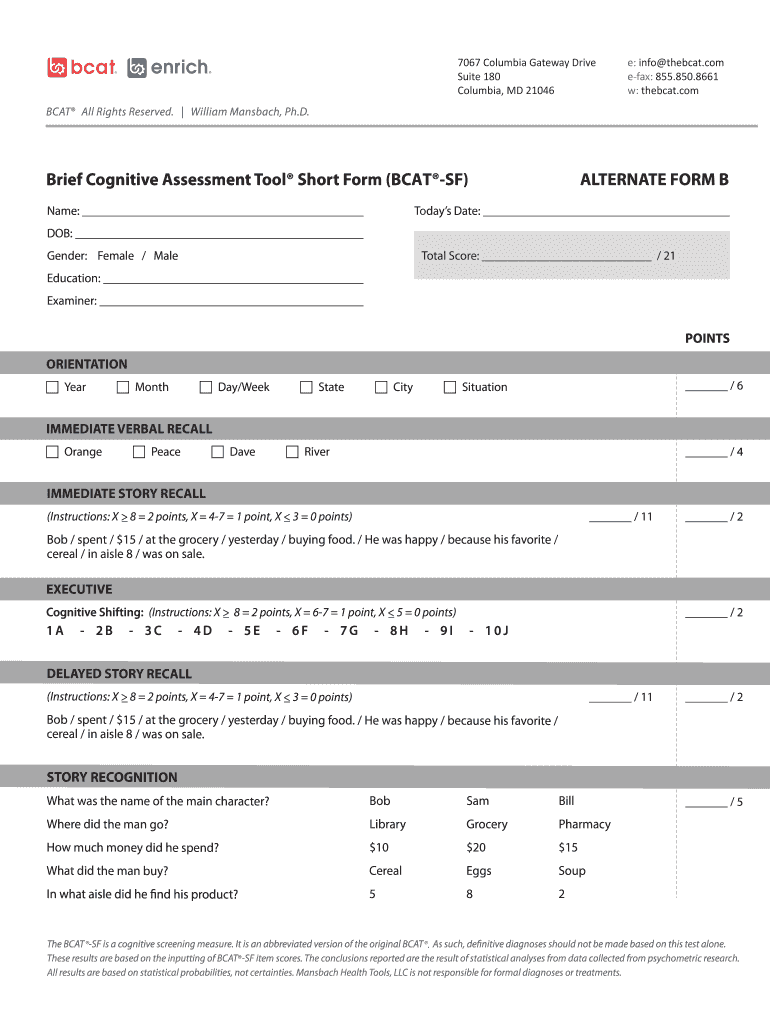
The Brief Cognitive Assessment Tool Short Form (bcat sf) is designed to quickly evaluate cognitive function, often used in clinical settings to assess mental status. It's a streamlined version of a broader cognitive assessment tool, focusing on essential cognitive abilities like memory, reasoning, and attention. This tool helps healthcare professionals determine cognitive impairments, offering a rapid yet comprehensive overview of a patient's cognitive health. Understanding its application can be critical for early detection of cognitive disorders.
Practical Applications of bcat sf
- Healthcare Evaluations: Used in diagnostic scenarios to assess a patient's cognitive baseline.
- Research Settings: Applied in studies that monitor cognitive changes over time.
- Geriatric Assessments: Utilized frequently for older adults to detect early signs of dementia.
Steps to Complete the bcat sf
Completing the bcat sf involves a series of steps that ensure accurate data collection and patient comfort.
- Preparation: Ensure the environment is quiet and free from distractions.
- Introduction: Explain the purpose of the assessment to the patient.
- Administer Questions: Follow the standard protocol to present questions or tasks.
- Scoring: Carefully score each response according to predefined guidelines.
- Review: Analyze the results to identify any cognitive impairments.
Detailed Breakdown
- Preparation: Set up a conducive environment and prepare any necessary materials.
- Scoring: Consistently follow scoring instructions to maintain accuracy for evaluation.
Who Typically Uses the bcat sf
The bcat sf is predominantly used by healthcare professionals who require a brief yet effective assessment of cognitive function.


Common Users
- Psychologists: Use it in psychiatric evaluations.
- Neurologists: Apply it for initial screening of cognitive disorders.
- Gerontologists: Focus on aging populations to identify early dementia symptoms.

Important Terms Related to bcat sf
To fully understand the bcat sf, one must be familiar with several key terms associated with cognitive assessments.
Key Terms
- Cognitive Impairment: A deficiency in mental functions such as memory and reasoning.
- Standard Protocol: The established set of procedures for administering the assessment.
- Scoring Guidelines: A framework for evaluating responses to ensure consistency.
Key Elements of the bcat sf
The bcat sf contains specific elements critical to its function as a cognitive assessment tool.
Core Components
- Memory Evaluation: Measures recall ability through various memory tasks.
- Attention Tasks: Assesses the patient's ability to focus and sustain attention.
- Reasoning Challenges: Evaluates higher-level cognitive processes like problem-solving.
Examples of Using the bcat sf
The bcat sf is applied in numerous situations where quick cognitive assessments are needed.
Case Studies
- Elderly Care: Regular assessments in nursing homes to track cognitive changes.
- Hospital Settings: Initial screenings for patients admitted with neurological symptoms.
- Research Studies: Longitudinal studies tracking cognitive decline over time.
Digital vs. Paper Version
The bcat sf can be administered in both digital and paper formats, each with advantages and limitations.
Comparative Analysis
- Digital Version: Offers quick scoring and data tracking; suitable for tech-savvy environments.
- Paper Version: Provides tactile interaction; preferred in settings lacking digital access.
Eligibility Criteria
Eligibility for undergoing bcat sf assessments often depends on specific conditions or indicators of cognitive decline.

Criteria Detailing
- Age Range: Primarily targeted at adults, especially the elderly.
- Symptoms: Recommended for individuals showing signs of cognitive deterioration.
- Situational Indicators: Used when mental impairment is suspected in clinical evaluations.