







Definition & Meaning
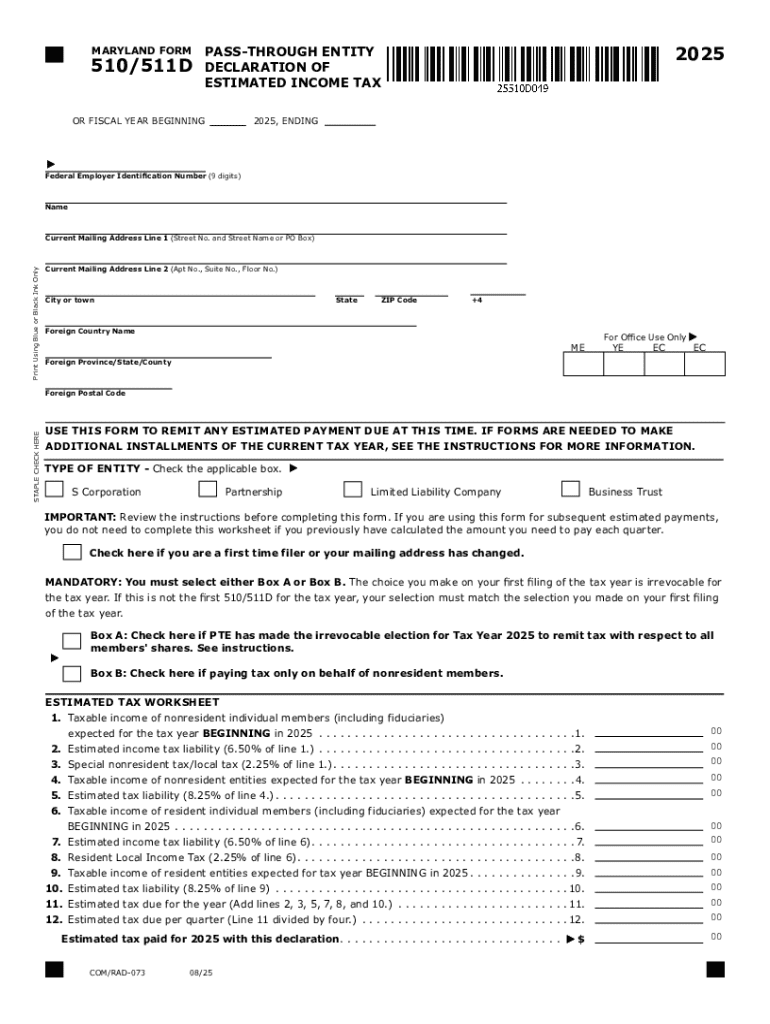
The 2025 Maryland Form 510-511D Pass-Through Entity Declaration of Estimated Income Tax is an official document used by pass-through entities, such as S-corporations and partnerships, in Maryland. This form is specifically designed to declare and remit estimated income taxes that these entities owe to the state. A pass-through entity passes the tax obligation to its members or shareholders rather than paying the income tax at the corporate level.
Important Aspects
- Pass-Through Entities: Includes S-corporations, partnerships, and certain LLCs.
- Estimated Taxes: Taxes expected to be owed during the fiscal year.
- Declaration Requirement: Mandatory to avoid penalties.
How to Use the Form
Utilizing the 2025 Maryland Form 510-511D requires meticulous entry of estimated income tax details for the fiscal year. Entities must assess anticipated net income and calculate the requisite tax based on Maryland's tax laws.
Instructions
- Gather Financial Data: Financial details from the previous year can help project income.
- Calculate Estimated Tax: Use Maryland’s tax rates for pass-through entities.
- Complete Sections: Fill in personal and business information accurately.
- Review for Accuracy: Double-check calculations and details.
Steps to Complete the Form
Detailed steps ensure that the completion and submission of Form 510-511D are smooth and error-free. Follow these procedures:
- Complete Entity Information:
- Business Name
- Federal Employer Identification Number (FEIN)
- Calculate Estimated Net Income: Forecast income for the fiscal year.
- Assess Tax Liability: Use current Maryland tax brackets.
- Input Estimated Payments: Include any already made tax payments.
- Sign and Date the Form: Certification of accuracy required.
- Submit to Maryland Comptroller: Via selected delivery method.
How to Obtain the Form
The Form 510-511D can be accessed through various methods depending on convenience and preference.
Availability
- Online Download: Available on the Maryland Comptroller’s website.
- Request by Mail: Contact the Comptroller’s office for a mailed form.
- Professional Tax Software: Often includes state forms as part of their package.
Who Typically Uses the Form
Pass-through entities operating within Maryland primarily utilize this form to comply with tax regulations.


Typical Users
- S-Corporations: Businesses operating under subchapter S.
- Partnerships: Joint business operations sharing tax responsibilities.
- LLCs: Depending on tax election as pass-through.
Key Elements of the Form
Comprehension of the essential components of Form 510-511D is crucial for accurate completion and submission.
Components
- Business Information: Identifying information of the entity.
- Income Projections: Estimated income for the fiscal year.
- Tax Calculations: Breakdown of anticipated tax obligations.
Filing Deadlines / Important Dates
Timely filing of the Form 510-511D is vital to prevent penalties and interest from accruing on unpaid taxes.
Critical Dates
- Quarterly Deadlines: Align with IRS estimated tax deadlines.
- Due by Fiscal Year-End: Typically April 15th for calendar year businesses.
- Specific Extensions: May be granted under certain circumstances.
Penalties for Non-Compliance
Failure to comply with Form 510-511D filing requirements can result in financial repercussions and other consequences.
Consequences
- Late Fees: Charges accrued for missed deadlines.
- Interest: On unpaid estimated taxes.
- Legal Action: Potential for increased scrutiny from tax authorities.
Form Submission Methods
Various submission options cater to the specific needs and preferences of entities filing Form 510-511D.
Available Options
- Online Submission: Via the state’s electronic filing system.
- Mail: Traditional, physical submission to the Maryland tax office.
- In-Person: Direct submission at Maryland Comptroller’s office.
State-Specific Rules
Maryland has specific rules that govern the filing and payment of taxes by pass-through entities, distinct from federal regulations.
Specific Regulations
- State Tax Rates: Differ from federal rates and are subject to change annually.
- Specific Exemptions: Criteria under which certain incomes or entities may be exempt.
- Local Surtaxes: Additionally required by certain jurisdictions in Maryland.
Required Documents
Ensuring the readiness of essential documents simplifies the Form 510-511D filing process.
Necessary Documentation
- Financial Statements: Income projections and past financial reports.
- Tax Payment Receipts: Proof of any prepayments or withholdings.
- Previous Year’s Return: Referencing prior year’s data for accuracy.
By adhering to these structured guidelines and topics, pass-through entities can ensure accurate and compliant submission of the 2025 Maryland Form 510-511D Pass-Through Entity Declaration of Estimated Income Tax.


