Understanding the NYC RPIE Statement: What Property 2026

Get Form
Understanding the NYC RPIE Statement: What Property Preview on Page 1

Here's how it works

01. Edit your form online
Type text, add images, blackout confidential details, add comments, highlights and more.

02. Sign it in a few clicks
Draw your signature, type it, upload its image, or use your mobile device as a signature pad.

03. Share your form with others
Send it via email, link, or fax. You can also download it, export it or print it out.

Definition & Meaning

The NYC Real Property Income & Expense (RPIE) Statement is a mandatory annual filing for owners of designated income-producing properties in New York City. It serves as a financial disclosure document, capturing detailed information about a property's income and expenses. This statement helps the city's Department of Finance assess the value of properties for real estate tax purposes. Understanding the RPIE is crucial for property owners to ensure compliance and avoid penalties.

Key Elements of the NYC RPIE Statement

The RPIE statement contains several key elements that need to be clearly understood:

  • Property Identification: Includes details such as the property address, block and lot numbers, and any associated identifiers.
  • Income Information: Covers all revenue streams from the property, including rental income, common area maintenance fees, and other related earnings.
  • Expense Documentation: Provides a breakdown of all operating costs, such as utilities, repairs, insurance, and management fees.
  • Vacancy Rates: Requires documentation of occupancy levels and any efforts to fill vacancies.
  • Certification and Signatures: The statement must be certified for accuracy and signed by the property owner or an authorized agent.

Each of these components is critical for presenting an accurate view of a property's financial health.

Steps to Complete the NYC RPIE Statement

Filing an RPIE statement involves several specific actions:

  1. Gather Documentation: Collect all relevant financial records, including income statements, lease agreements, and expense receipts.
  2. Access the Filing System: Log in to the New York City Department of Finance's online portal.
  3. Enter Property Details: Fill in the property identification section with accurate information.
  4. Input Financial Data: Enter all income sources and expenses as per the forms.
  5. Review and Certify: Ensure all information is correct and certify the form.
  6. Submit Form: Finalize the submission through the online platform, ensuring receipt of confirmation.

Ensuring each step is thoroughly completed can mitigate the risk of errors.

Why Should You Understand the NYC RPIE Statement

Understanding the RPIE statement is not only a legal obligation but also provides benefits:

  • Ensures Compliance: Avoids penalties by meeting annual filing requirements.
  • Accurate Tax Assessment: Aids in an accurate assessment of property value, directly impacting tax statements.
  • Informed Decision-Making: Offers insights into property performance, helping in strategic decision-making for improvements and management.
  • Enhances Credibility: Maintains a good standing with city regulators and can foster a favorable reputation with potential investors.

Important Terms Related to the NYC RPIE Statement

The following terms are integral to comprehending the RPIE statement:

  • Gross Income: Total earnings generated by the property before deductions.
  • Net Operating Income (NOI): Income remaining after operational expenses are deducted, excluding taxes and financing costs.
  • Assessed Value: The property value as determined by the NYC Department of Finance, influenced by the RPIE filings.
  • Cap Rate: Capitalization rate used in real estate to estimate the investor's potential return on investment.

Having a clear understanding of these terms is vital for accurately completing and analyzing the RPIE statement.

Filing Deadlines / Important Dates

For timely submission:

  • Annual Deadline: The RPIE statement is typically due on June 1st each year. This date may vary, so it is essential to confirm annually.
  • Extensions: Extensions may be available under particular circumstances but must be requested in advance.
  • Penalties for Late Filing: Failing to file on time can result in significant penalties, potentially impacting future real estate dealings.

Staying informed about these schedules can prevent unnecessary fines.

Penalties for Non-Compliance

Failing to comply with RPIE filing requirements can lead to:

  • Monetary Fines: Significant financial penalties can be imposed for late or non-filing.
  • Increased Scrutiny: Non-compliance may result in more frequent audits and inspections by tax authorities.
  • Loss of Legal Protections: May impact legal standings or protections typically afforded to compliant property owners.

Understanding these potential repercussions is crucial for proactive management.

Software Compatibility

For those utilizing modern technology solutions:

  • Online Integration: The RPIE can be completed and filed using online systems offered by the NYC Department of Finance.
  • Software Support: Compatible with popular accounting platforms such as QuickBooks, enabling streamlined financial data transfer.
  • Export Options: Files from software systems can often be directly exported for RPIE filing, reducing duplicate data entry.

Leveraging compatible software can greatly simplify the filing process.

be ready to get more

Complete this form in 5 minutes or less

Get form

Got questions?

We have answers to the most popular questions from our customers. If you can't find an answer to your question, please contact us.
Contact us
Property Classifications in NYC. Properties in New York City are split into four classes. Class 1 is small homes with one to three units. Class 2 is larger residential buildings with more than three units, including co-ops and condos.
Class A properties will usually have more appreciation potential, but if an investor is looking for more immediate returns, they may want to consider investing in Class B or Class C properties for their cash flow potential. Risk Tolerance: The most risk-adverse investors will want to buy Class A properties.
Class 1 property means Assessed Property that is or is intended to be developed as detached single family dwelling units, including ancillary uses thereto.
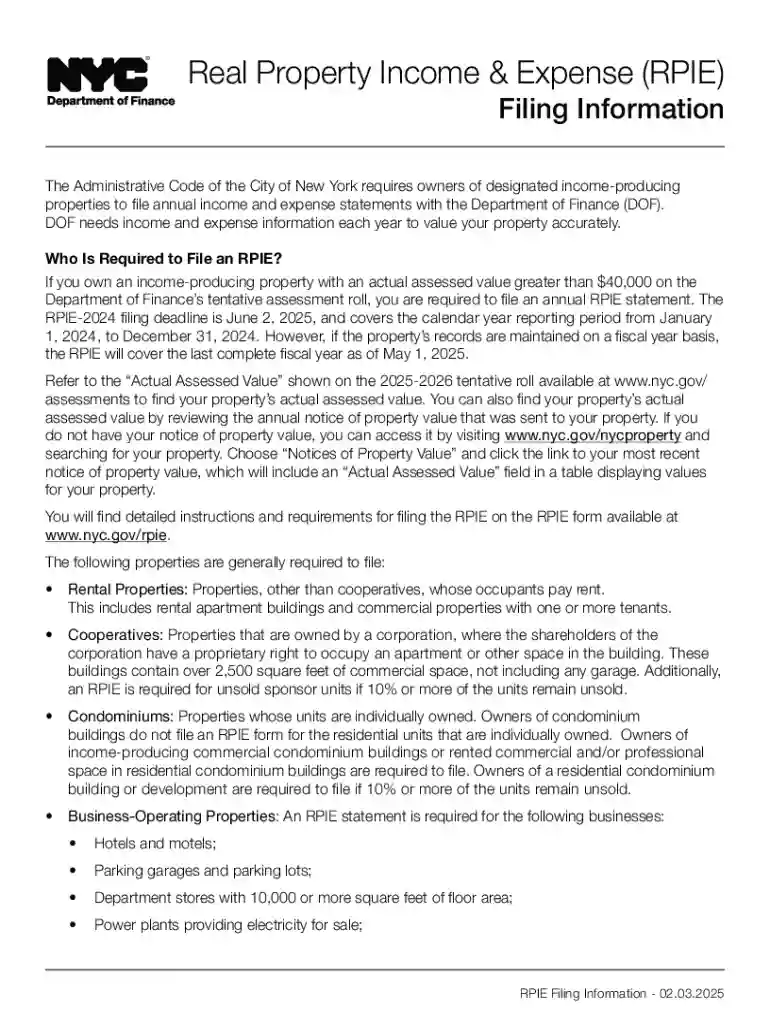
The Real Property Income and Expense (RPIE) statement is used by the Department of Finance to determine the value and property tax for certain income-producing properties. RPIE information is filed each year for the previous year.
Who Is Required to File an RPIE? If you own an income-producing property with an actual assessed value greater than $40,000 on the Department of Finances tentative assessment roll, you are required to file an annual RPIE statement.

Security and compliance

At DocHub, your data security is our priority. We follow HIPAA, SOC2, GDPR, and other standards, so you can work on your documents with confidence.

Learn more
ccpa2
pci-dss
gdpr-compliance
hipaa
soc-compliance
be ready to get more

Complete this form in 5 minutes or less

Get form

People also ask

Properties in New York City are divided into four classes, each valued and assessed differently under the law. Class 2 includes residential properties with more than three units, including cooperatives and condominiums. Market values are calculated differently for each tax class.
Class 4: All commercial and industrial properties, such as office, retail, factory buildings, and all other properties not included in tax classes 1, 2, or 3.

Related links