




01. Edit your form online
Type text, add images, blackout confidential details, add comments, highlights and more.

Type text, add images, blackout confidential details, add comments, highlights and more.

Draw your signature, type it, upload its image, or use your mobile device as a signature pad.

Send it via email, link, or fax. You can also download it, export it or print it out.
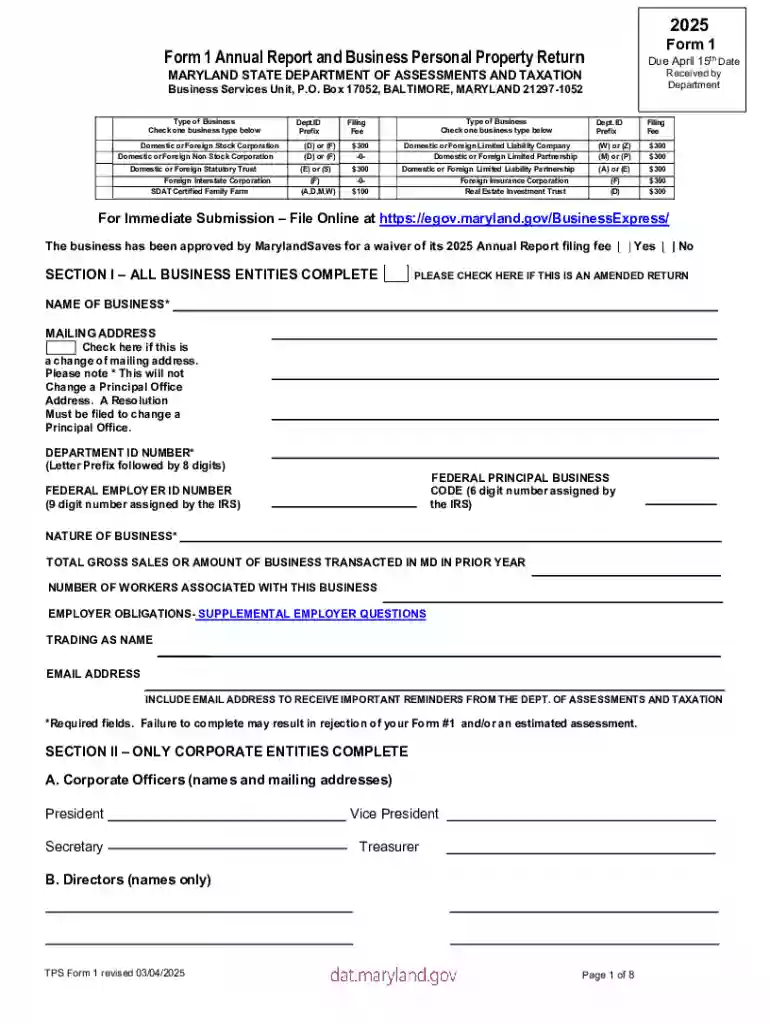
The "Form 1 Annual Report and Business Personal Property Return" is an official document used by businesses to report various details about their operations to the Maryland State Department of Assessments and Taxation. This form serves multiple purposes:
Understanding the elements and requirements of this form is crucial for adhering to Maryland's regulatory norms.
Obtaining the Form 1 Annual Report and Business Personal Property Return is straightforward. Businesses can access the form online via the Maryland State Department of Assessments and Taxation website. Here’s how you can get it:
Selecting the right method depends on whether you prefer paper or digital documentation, but using the online version can streamline the filing process.
Completing the Form 1 includes several critical steps that must be followed for successful submission:
Filling the form accurately is fundamental, as errors can delay processing or result in penalties.
For most businesses, the deadline to submit Form 1 is April 15th of each year. Adhering to this deadline is critical because:
Businesses should plan ahead to gather necessary documentation well before the deadline to avoid last-minute rushes.
Preparing the required documents in advance simplifies the filing process. Essential documents include:
Having these documents ready can help expedite filling out the form and ensure completeness.
Businesses have several options for submitting Form 1:
The choice of submission method can depend on business preference and the need for immediate proof of submission.
Non-compliance with Form 1 requirements can result in various penalties:
Hence, it is crucial to ensure accurate and timely filing of the form to avoid these potential issues.
Choosing between a digital or paper version of Form 1 depends on several factors:
Considering the pros and cons of each option can help businesses decide which version to use.
At DocHub, your data security is our priority. We follow HIPAA, SOC2, GDPR, and other standards, so you can work on your documents with confidence.




Dec 31, 2019 Tax Rates Reduced The tax rate for the first and second tax bracket is reduced from 4% to 3.86% and from 5.84% to 5.04%, respectively.Read more
Jan 1, 2025 ID# ON THE CHECK. If filing by mail, please return with applicable filing fee to: Department of Assessments and Taxation, Business Services Unit.Read more
Jan 31, 2012 property, personal property that has a. Line 18. Employee Form 5500, Annual Return/Report of. Certain business start-up and.Read more


