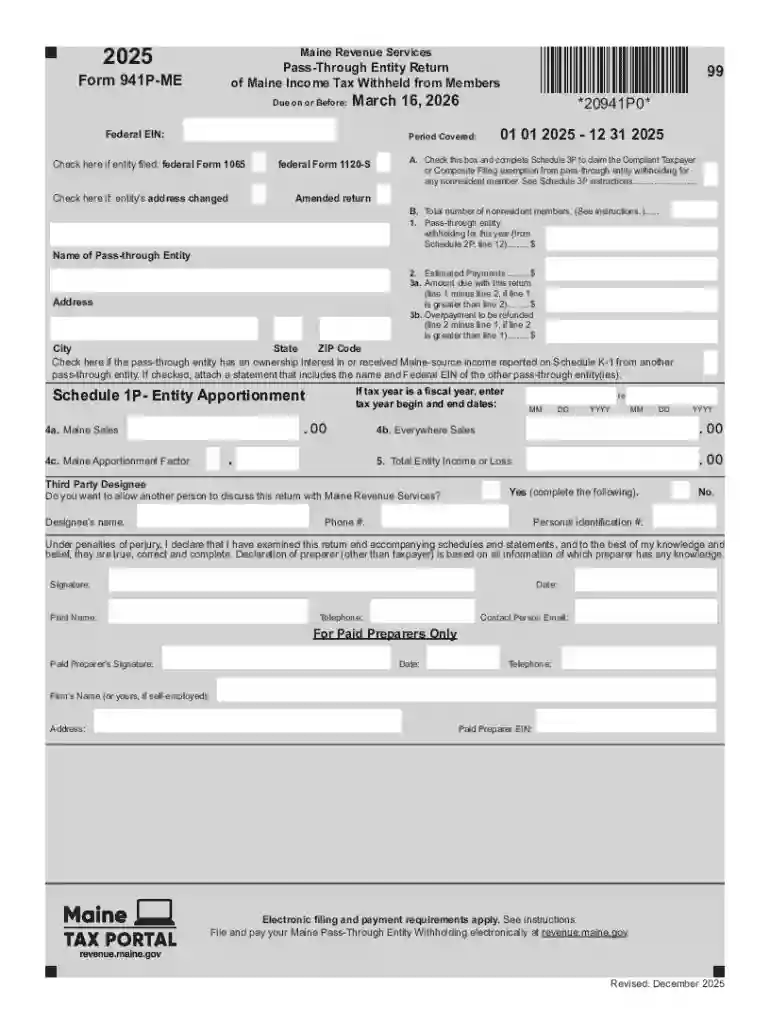
Pass-through Entity Taxes - 2025Maine Revenue Services 2026

Get Form
Pass-through Entity Taxes - 2025Maine Revenue Services Preview on Page 1

Here's how it works

01. Edit your form online
Type text, add images, blackout confidential details, add comments, highlights and more.

02. Sign it in a few clicks
Draw your signature, type it, upload its image, or use your mobile device as a signature pad.

03. Share your form with others
Send it via email, link, or fax. You can also download it, export it or print it out.

Definition and Meaning of Pass-through Entity Taxes

Pass-through entity taxes refer to state-level fiscal measures designed for businesses such as partnerships, S corporations, and LLCs, where taxes on income "pass through" to their owners' tax returns instead of being paid at the corporate level. In the context of the 2025 Maine Revenue Services, these taxes relate to specific filing and withholding requirements for entities operating within Maine. This approach simplifies tax obligations for businesses by allowing income, deductions, and credits to be reported on individual tax returns, aligning with federal guidelines to avoid double taxation.

The Implications for Businesses in Maine

  • Owner-Level Taxation: The income and losses of pass-through entities are attributed directly to the owners, who then report these figures on their personal tax returns. This method aligns with the federal framework, reducing complexity.
  • Maine-specific Deductions and Credits: Businesses operating in Maine can leverage state-specific tax deductions and credits unique to pass-through entities, enhancing financial efficiency.
  • Policies for Complying with State Regulations: Understanding Maine's unique regulations for pass-through entities is critical to ensure compliance and avoid penalties.

Steps to Complete the Pass-through Entity Taxes - 2025Maine Revenue Services

Completing the Pass-through Entity Taxes form for the 2025 Maine Revenue Services involves ensuring accurate documentation to reflect the business's financial activities. Here are the key steps:

  1. Gather Necessary Information: Collect all financial documents, including income statements, balance sheets, and records of transactions relevant to 2025.
  2. Identify Relevant Deductions and Credits: Determine what state deductions and credits your entity is eligible for, ensuring you lower your overall tax liability.
  3. Accurate Allocation of Income and Expenses: Ensure that income and expenses are correctly attributed to members or shareholders in proportion to ownership percentages.
  4. Complete Form Fields: Enter all required data in the designated fields on the form, ensuring accuracy and completeness.
  5. Review and Validate Entries: Double-check all entries for accuracy to eliminate any potential discrepancies.
  6. Submit the Form: Choose the most appropriate submission method—either online, by mail, or in-person—to file your taxes with the Maine Revenue Services by the deadline.

Filing Deadlines and Important Dates

Timely submission is crucial to avoid interest and penalties. For the 2025 tax year, specific due dates include:

  • March 16, 2026: Filing due date for 2025 taxes for most pass-through entities.
  • Estimated Tax Payments: Quarterly estimated payments must be filed throughout 2025. The specific dates typically align with federal quarterly deadlines.
  • Extension Requests: Must be filed before the March deadline if additional time is needed.

Impact of Missing Deadlines

Failing to meet these deadlines can lead to:

  • Penalties and Interest: Late fees and accrued interest on the unpaid tax amount.
  • Loss of State Credits: Disqualification or delay in accessing state-specific tax credits.

Required Documents for Filing

Having the correct documentation ensures compliance and accuracy. Essential documents include:

  • Income Statements and Balance Sheets: Providing a detailed account of the entity's financials for 2025.
  • Ownership Agreements: For verifying income allocation among members.
  • Previous Tax Returns: Helps in comparing and confirming financial consistency across years.
  • Quarterly Payment Receipts: To verify estimated tax payments made throughout the tax year.

Penalties for Non-Compliance

Understanding the penalties imposed for non-compliance with Maine's tax regulations is essential for business management:

  • Financial Penalties: These accrue on a daily basis. The penalty rates can vary and are assigned based on the level of non-compliance.
  • Legal Repercussions: Severe cases may lead to legal action, including audits or investigations by state authorities.
  • Impact on Business Operations: Operational licenses and permits might be put on hold until compliance is reinstated.

Mitigating Penalties

Strategies to mitigate penalties include:

  • Timely Resolution of Errors: Correct any discrepancies immediately upon notice.
  • Seeking Professional Assistance: Engage tax professionals for guidance in complex scenarios.

Important Terms Related to Pass-through Entity Taxes

A solid understanding of the terminology related to pass-through entity taxes is essential:

  • K-1 Form: Lists each shareholder's share of income, deductions, and credits, used to declare personal income tax.
  • EIN (Employer Identification Number): A federal tax ID number used to identify a business entity.
  • Withholding: Taxes collected and remitted by the entity on behalf of its members.

Who Typically Uses the Pass-through Entity Taxes - 2025Maine Revenue Services

Pass-through entity taxes are applicable to various types of businesses:

  • LLCs and LLPs: Limited Liability Companies and Limited Liability Partnerships benefit significantly from this tax structure, owing to simplified tax reporting and liability protections.
  • S Corporations: They enjoy the advantages of a pass-through taxation structure while maintaining corporate liability protections.
  • Family-operated Businesses: These often opt for pass-through taxation due to the simplicity of financial management.
decoration image ratings of Dochub

Business Entity Types Benefiting Most from Pass-through Entity Taxes

Certain business structures considerably benefit from adopting pass-through taxation:

  • Start-ups: Quick and efficient financial reporting often makes pass-through taxation the preferred choice for nascent businesses.
  • Professional Services Firms: Including law practices and consulting firms where profit sharing is direct and evenly distributed among owners.
  • Entrepreneurial Ventures: Ideal for owner-operators wishing to directly control business financials without complex corporate tax filings.

Understanding these aspects and properly navigating the intricacies of state tax codes is crucial for maximizing financial outcomes and maintaining legal compliance for businesses operating in Maine.

be ready to get more

Complete this form in 5 minutes or less

Get form

Got questions?

We have answers to the most popular questions from our customers. If you can't find an answer to your question, please contact us.
Contact us
A Maine limited liability company gives your business credibility in the eyes of customers, protects your personal assets in the event of a lawsuit or bankruptcy, and offers flexibility in the way the business is taxed and managed. File yourself or hire Northwest to file for you.
Within each bracket, the rates are the same as they were the previous year: 5.8% for income in the first bracket, 6.75% for income in the second bracket and 7.15% for income in the third bracket.Feb 2, 2026
Unless modified pursuant to this rule or by the Assessor, either by ruling on a specific request or in published instructions, a pass-through entity must withhold Maine income tax from nonresident members Maine-source member income at the rate of 8.93% in the case of a nonresident member taxed as a corporation.
Pass-through entities include S-corporations, partnerships, limited liability companies, and sole proprietorships. Nearly all states with income taxes conform to those federal rules. Today, most U.S. businesses are pass-through entities (PTEs), and these entities account for more than half of business income.
Youll be taxed at Maines standard rates, and youll also be able to apply regular allowances and deductions. Any employees will also need to pay state income tax. The income tax rates are graduated, with rates ranging from 5.8% to 7.15%.

Security and compliance

At DocHub, your data security is our priority. We follow HIPAA, SOC2, GDPR, and other standards, so you can work on your documents with confidence.
Learn more
ccpa2
pci-dss
gdpr-compliance
hipaa
soc-compliance

People also ask

AI Summary. This bill establishes a new pass-through entity tax (PTET) in Maine starting January 1, 2025, which allows partnerships and S corporations (business entities where income passes through to individual owners) to elect to pay state income tax at the entity level.
The states that have passed a type of pass-through entity tax legislation are Alabama, Arizona, Arkansas, California, Colorado, Connecticut, Georgia, Idaho, Illinois, Louisiana, Maryland, Minnesota, New Jersey, New York, Oklahoma, Oregon, Rhode Island, South Carolina, and Wisconsin.
The estate tax rates in Maine range from 8% to 12%. The tax applies on estates worth more than $7 million for 2025, up from $6.8 million for 2024. Maine has not released a 2026 estate tax exemption amount as of this update.Jan 27, 2026

Related links