




01. Edit your form online
Type text, add images, blackout confidential details, add comments, highlights and more.

Type text, add images, blackout confidential details, add comments, highlights and more.

Draw your signature, type it, upload its image, or use your mobile device as a signature pad.

Send it via email, link, or fax. You can also download it, export it or print it out.
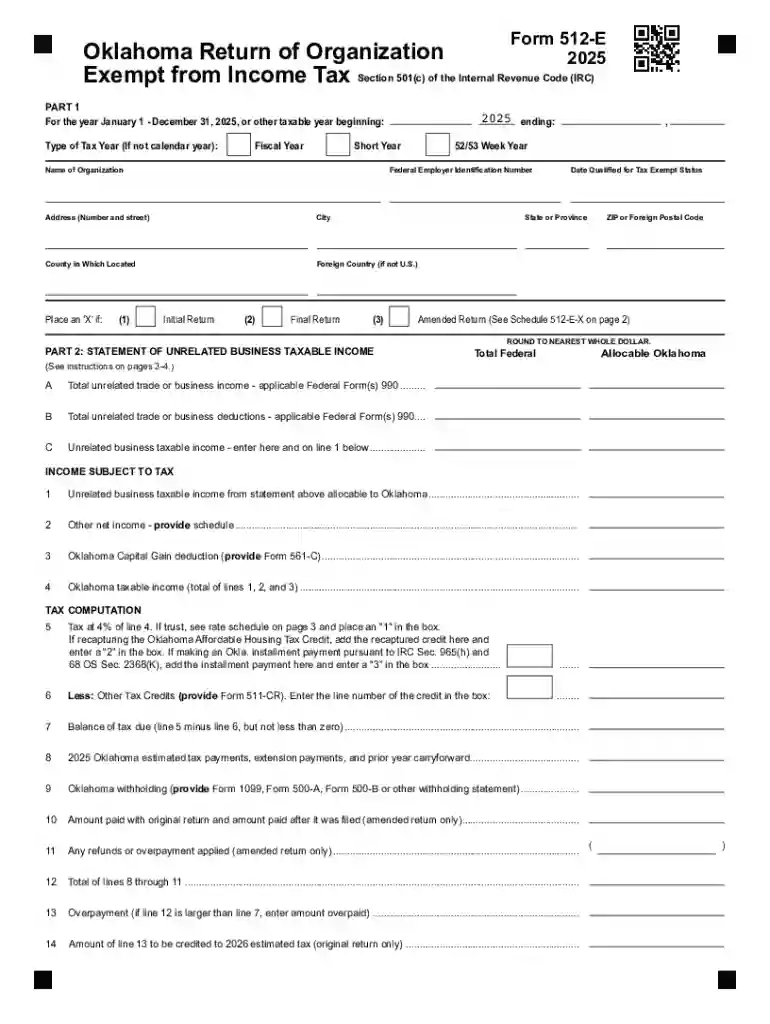
The 2025 Form 512-E, titled the "Oklahoma Return of Organization Exempt from Income Tax," is utilized by tax-exempt organizations to report their income, deductions, and other relevant financial information to the Oklahoma Tax Commission. These organizations, typically exempt under Section 501(c) of the Internal Revenue Code, must file this form to maintain their tax-exempt status and comply with state reporting obligations. By detailing financial activity, it ensures transparency and accountability, aligning with both federal and state regulations.
The form consists of numerous sections that organizations must complete accurately. Each part requires specific details to provide a complete financial overview of the exempt entity.
All eligible organizations must adhere to specific filing timelines to avoid penalties. The filing deadline for the calendar year-end organizations is typically April 15 of the following year.
Filling out the 2025 Form 512-E involves several detailed steps to ensure compliance and accuracy. Organizations must prepare thoroughly before submission.
Understanding the legal and tax implications associated with the 2025 Form 512-E is crucial for compliance. Incorrect submissions can result in penalties and jeopardize an organization's tax-exempt status.
Organizations can choose between digital and paper submissions for the 2025 Form 512-E, each with its advantages.
Many organizations leverage accounting software to aid in completing and filing the 2025 Form 512-E. Integration with existing systems can streamline the process.
Organizations may encounter several challenges when preparing the 2025 Form 512-E. Being proactive can minimize errors and ensure timely filing.
Completing and submitting the 2025 Form 512-E is critical for tax-exempt organizations in Oklahoma. Through thorough preparation, understanding the form's sections, and choosing the right filing method, organizations can maintain compliance and their exempt status. Utilizing appropriate software and professional guidance can further streamline the process, ensuring accuracy and adherence to legal obligations.
We've got more versions of the 2025 Form 512-E Oklahoma Return of Organization Exempt from Income Tax form. Select the right 2025 Form 512-E Oklahoma Return of Organization Exempt from Income Tax version from the list and start editing it straight away!
At DocHub, your data security is our priority. We follow HIPAA, SOC2, GDPR, and other standards, so you can work on your documents with confidence.


Form. (2024). Part I Summary. Signature Block. Part II. 990. Return of Organization Exempt From Income Tax. 990. 2024. Extended to November 17, 2025. Seminole
unrelated business taxable income to a tax-exempt holder. As a result, a tax-exempt holder generally should not be subject to U.S. federal income tax on theRead more
Investment income of exempt organizations subject to federal excise tax is not subject to Oklahoma income tax; however, any income subject to income tax underRead more


