






Definition & Meaning
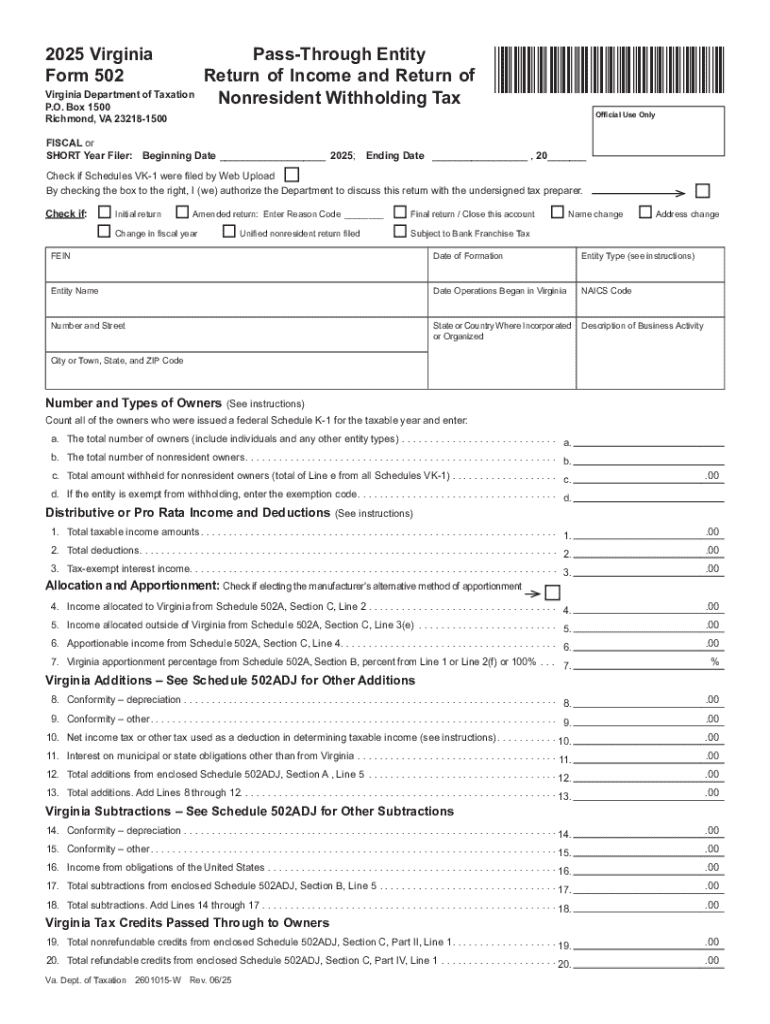
The 2025 Form 502 - Pass-Through Entity Return of Income and Return of Nonresident Withholding Tax is an essential tax document utilized by pass-through entities in Virginia. This form serves dual purposes: it facilitates the reporting of income generated by the entity, and it is instrumental in the withholding of nonresident tax obligations. Understanding this form is crucial for compliance with state tax regulations, as it ensures that income is properly declared and nonresident partners or shareholders meet their tax responsibilities.
Key Functions
- Income Reporting: Pass-through entities such as partnerships, S corporations, and limited liability companies (LLCs) must report their income and distributions to their partners or shareholders.
- Nonresident Withholding Tax: The form ensures that nonresident individuals or entities meet their withholding tax commitments, thereby streamlining tax collection for the state of Virginia.
How to Obtain the 2025 Form 502
Acquiring the 2025 Form 502 is straightforward for entities operating within Virginia. The Virginia Department of Taxation provides several avenues to access this form, ensuring ease of compliance for various types of entities.
Sources for Obtaining the Form
- Virginia Department of Taxation Website: The official site offers downloadable forms and comprehensive instructions.
- Mail Request: Entities may contact the Virginia Department of Taxation for paper forms, which can be mailed upon request.
- In-Person: For entities preferring personal assistance, forms can be obtained by visiting a local tax office in Virginia.
Steps to Complete the 2025 Form 502
Completion of the 2025 Form 502 requires meticulous attention to detail to ensure accurate representation of the entity's financial activities and compliance with tax laws.
Detailed Instructions
- Gather Necessary Information: Collect data on income, deductions, credits, and allocated distributions to all partners or shareholders.
- Complete Income and Deductions Sections: Clearly outline the total income earned by the entity and any allowable deductions.
- Calculate Withholding Tax for Nonresidents: Determine the appropriate withholding tax for nonresident partners or shareholders.
- Sign and Submit: Ensure the form is signed by the authorized representative of the entity and submit it to the Virginia Department of Taxation by the deadline.
Tips for Accurate Completion
- Double-check all figures for accuracy.
- Refer to the most recent guidelines or consult a tax professional if necessary.
Why Use the 2025 Form 502
Utilizing the 2025 Form 502 is not only a legal requirement for relevant entities but also offers several practical benefits. Ensuring compliance with state tax obligations is crucial to avoiding penalties.
Benefits of Compliance
- Avoid Penalties and Interest: Timely and correct filing prevents the accrual of potential penalties and interest on unpaid taxes.
- Streamlined Record-Keeping: Consistent use of the form aids in maintaining organized financial records, simplifying future tax filings.
Who Typically Uses the 2025 Form 502
The 2025 Form 502 predominantly serves a specific group of entities within the Virginia tax landscape. Understanding who needs this form aids in efficient tax planning.


Eligible Entities
- Partnerships: Required for partnerships with income derived in Virginia.
- S Corporations: Must file if they have Virginia-based income or pass through income to nonresident shareholders.
- LLCs: Any limited liability company classified as a partnership or S corporation for federal tax purposes.
Key Elements of the 2025 Form 502
Understanding the critical components of the 2025 Form 502 is vital for accurate completion and submission. Each element has specific requirements essential for compliance.
Essential Sections
- Income Section: Details gross income received or accrued for the year.
- Deductions and Adjustments: Enumerates all applicable deductions and necessary adjustments related to entity income.
- Withholding Tax Information: Includes calculations pertinent to the nonresident withholding tax obligations.
Filing Deadlines and Important Dates
Knowledge of filing deadlines and related dates is crucial to ensure compliance and avoid late fees or interest charges.
Key Dates
- Tax Filing Deadline: Typically aligned with federal tax filing deadlines, generally by April 15, unless otherwise specified by state regulations.
- Extension Periods: Entities may apply for an extension; however, any taxes owed must still be paid by the original filing deadline to avoid interest.
- Estimated Payment Dates: For entities required to make estimated tax payments, these are due quarterly and must be met to avoid penalties.
Required Documents
Proper documentation is necessary when filing the 2025 Form 502 to substantiate reported figures and ensure compliance with taxation rules.
Supporting Materials
- Income Statements: Detailed records of all income types generated by the entity.
- Expense Documentation: Receipts, invoices, and other proof of expenses claimed as deductions.
- Shareholder Information: Documentation of distributions and withholding for nonresident shareholders or partners.