




01. Edit your form online
Type text, add images, blackout confidential details, add comments, highlights and more.

Type text, add images, blackout confidential details, add comments, highlights and more.

Draw your signature, type it, upload its image, or use your mobile device as a signature pad.

Send it via email, link, or fax. You can also download it, export it or print it out.
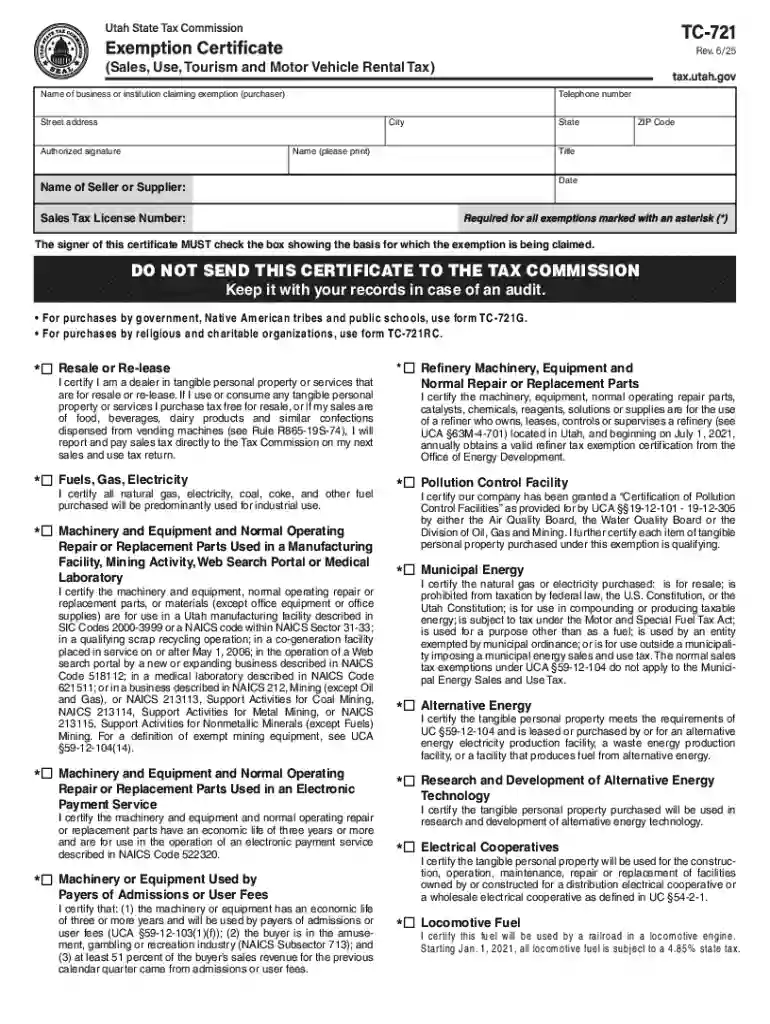
The Utah Tax Exemption Form is a critical document used by businesses and organizations to claim exemption from various state taxes, including sales and use taxes, under specific conditions outlined by the state of Utah. This form allows eligible entities to legally purchase goods and services without paying the state-mandated taxes, thereby reducing operational costs and supporting financial management. The exemption typically applies to qualifying organizations, such as non-profits, certain government entities, and businesses involved in tax-exempt activities, as defined by Utah state law.
Understanding when and how to use this form is crucial. Examples include:
Using the Utah Tax Exemption Form involves a few systematic steps that ensure proper completion and compliance with state regulations.
Obtaining the Utah Tax Exemption Form is an essential step for eligible entities wishing to benefit from tax exemptions.
Ensure you always use the most current form version as tax laws and exemption criteria can regularly change.
Completing the form accurately is crucial for it to be acknowledged and processed by the state tax authorities.
Completing the Utah Tax Exemption Form is significant for eligible entities to ensure compliance with state tax laws and to leverage cost-saving measures legally.
Understanding the key components of the form enhances the likelihood of correct completion and immediate acceptance.
It is vital to keep abreast of any legislative changes that might affect exemptions and to ensure all information provided is factual to avoid legal repercussions.
Utah has specific rules guiding the use of the Tax Exemption Form, which may differ from general or federal rules.
Regularly reviewing state tax guidelines is advisable to ensure ongoing compliance and understanding of all state-specific requirements related to tax exemption forms.
We've got more versions of the Fill Out Your Utah Tax Exemption Form form. Select the right Fill Out Your Utah Tax Exemption Form version from the list and start editing it straight away!
| Versions | Form popularity | Fillable & printable |
|---|---|---|
| 2025 | 4.6 Satisfied (22 Votes) | |
| 2024 | 4.6 Satisfied (48 Votes) | |
| 2022 | 4.4 Satisfied (44 Votes) | |
| 2020 | 4.8 Satisfied (76 Votes) | |
| 2018 | 4.3 Satisfied (156 Votes) | |
| 2018 | 4.3 Satisfied (102 Votes) | |
| 2017 | 4.2 Satisfied (50 Votes) | |
| 2017 | 4.3 Satisfied (45 Votes) | |
| 2015 | 4.3 Satisfied (96 Votes) | |
| 2014 | 4.2 Satisfied (54 Votes) | |
| 2011 | 4.1 Satisfied (70 Votes) | |
| 2010 | 4.4 Satisfied (151 Votes) | |
| 2008 | 4.4 Satisfied (66 Votes) | |
| 2001 | 4.9 Satisfied (45 Votes) |
At DocHub, your data security is our priority. We follow HIPAA, SOC2, GDPR, and other standards, so you can work on your documents with confidence.




Form 940. The total payments in State B that are not exempt from FUTA tax are. $4,000. Since this payment to Employee A does not exceed the $7,000. FUTA wageRead more
If I use or consume any tangible personal property or services I purchase tax free for resale, or if my sales are of food, beverages, dairy products.Read more
The signer of this certificate MUST check the box showing the basis for which the exemption is being claimed. DO NOT SEND THIS CERTIFICATE TO THE TAX COMMISSION.Read more


