
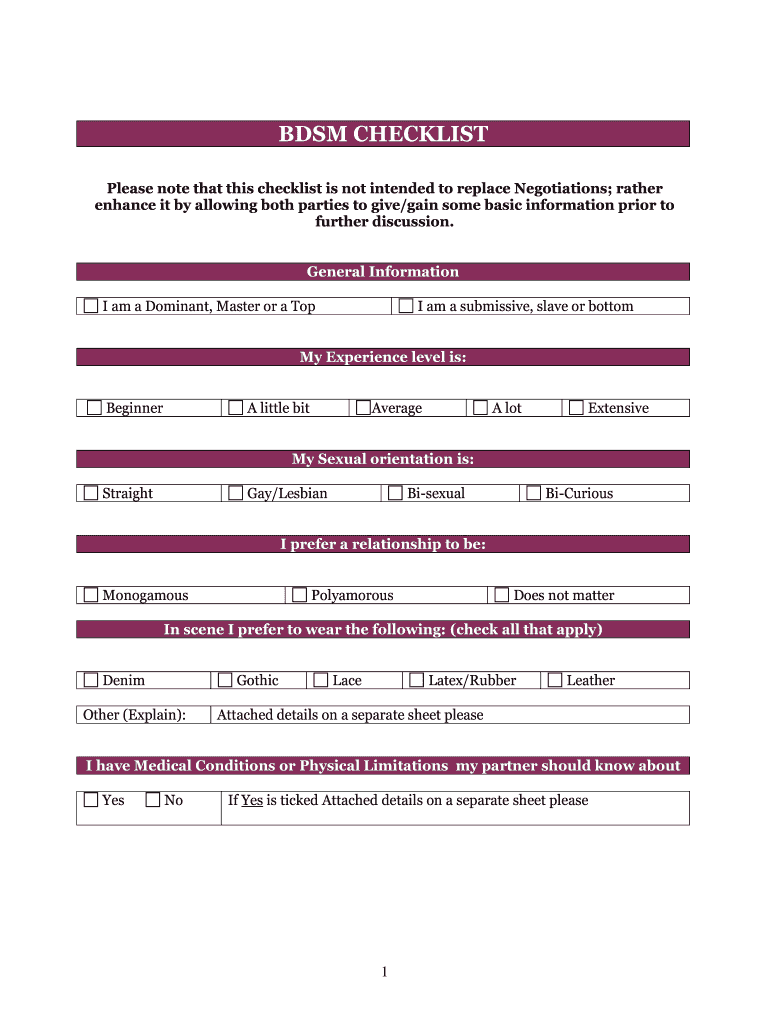







Definition & Purpose of the BDSM Checklist
The BDSM checklist is a valuable tool designed to facilitate communication and negotiation in consensual BDSM (Bondage, Discipline, Dominance, Submission, Sadism, and Masochism) relationships. This checklist allows individuals to outline their preferences, limits, and interests in various BDSM activities, promoting a safer and more enjoyable experience. It is used to establish boundaries and ensure that all parties involved have a clear understanding of each other's desires and restrictions. By providing a structured format, the checklist supports informed consent and helps prevent misunderstandings during BDSM sessions.
How to Use the BDSM Checklist
Using the BDSM checklist involves a few key steps to ensure it is as effective as possible:
- Initial Review: Both parties should review the checklist individually to become familiar with the categories and activities listed.
- Self-Assessment: Each person should fill out the checklist based on their personal comfort level with each activity, marking those they are open to, curious about, or consider hard limits.
- Discussion: Once completed, both individuals should discuss their responses together. This process helps clarify any discrepancies or areas of concern.
- Adjustments: Based on the discussion, adjustments can be made to accommodate new agreements and enhance compatibility.
- Regular Updates: Regular reviews and updates of the checklist are encouraged as preferences may evolve over time.
Steps to Complete the BDSM Checklist
Completing the BDSM checklist involves several methodical steps:
- Set Aside Time: Ensure you allocate enough uninterrupted time to thoughtfully complete the checklist without rushing.
- Evaluate Comfort Levels: Begin by assessing your comfort and interest levels in each activity. Enter responses honestly and consider past experiences or expectations.
- Indicate Preferences: Use categories like 'Limit,' 'Maybe,' 'OK,' and 'Do It' to categorize each activity based on your willingness to participate.
- Note Conditions: Specify any conditions or context in which you might be willing to explore certain activities, such as with increased trust or experience.
- Consider Health & Safety: Factor in any physical or medical limitations you may have, ensuring your partner is aware of these considerations.
Key Elements of the BDSM Checklist
Several essential elements make up the BDSM checklist:
- Activity List: A comprehensive list of potential BDSM activities covering a wide range of dynamics and practices.
- Consent Levels: Options to express varying degrees of consent or interest for each activity, promoting nuanced and clear communication.
- Health Conditions: Sections to note any medical conditions or limitations that may impact participation, ensuring safety.
- Personal Preferences: Space to add personal notes or preferences for activities not explicitly listed on the form.
Who Typically Uses the BDSM Checklist
The BDSM checklist is typically utilized by:
- Individuals New to BDSM: Those exploring BDSM for the first time who seek a structured method to understand and communicate their preferences.
- Experienced Practitioners: Individuals familiar with BDSM wanting to update their preferences or engage with a new partner.
- Couples: Partners interested in incorporating BDSM into their relationship, seeking mutual understanding and consensual boundaries.
- Communities: BDSM communities and workshops may use checklists to educate participants on safety and informed consent.


Important Terms Related to the BDSM Checklist
Understanding key terms is crucial for effective use of the checklist:
- Consent: Explicit mutual agreement to engage in an activity.
- Limits: Clearly defined boundaries; 'hard limits' are non-negotiable, while 'soft limits' may be negotiable under certain conditions.
- Safe Word: A predetermined word used to stop an activity immediately, signaling distress or the need to pause.
- SSC/RACK: Acronyms for safety frameworks; 'Safe, Sane, and Consensual' (SSC) and 'Risk-Aware Consensual Kink' (RACK).
Legal Considerations for the BDSM Checklist
While the BDSM checklist is a personal document used to facilitate communication, it holds no legal authority. Consent documented through the checklist can promote understanding, but it does not provide legal protection in case of disputes or allegations. It's important for participants to understand the legal implications of physical harm, regardless of documented consent. Moreover, the checklist should not be seen as a substitute for legal advice or binding agreement.
Examples of Using the BDSM Checklist
Practical scenarios highlight the effectiveness of the checklist:
- Scenario 1: A couple uses the checklist for the first time to explore BDSM. They find it eye-opening to discover differing interests in activities like bondage and spanking, leading to productive negotiation.
- Scenario 2: An experienced submissive uses a BDSM checklist with a new partner, allowing them to quickly communicate their established hard limits and preferred dynamics, easing initial interactions.
- Scenario 3: During a BDSM workshop, participants complete checklists and discuss them in small groups, fostering open dialogue about safe practices and personal boundaries.




