






Definition and Meaning
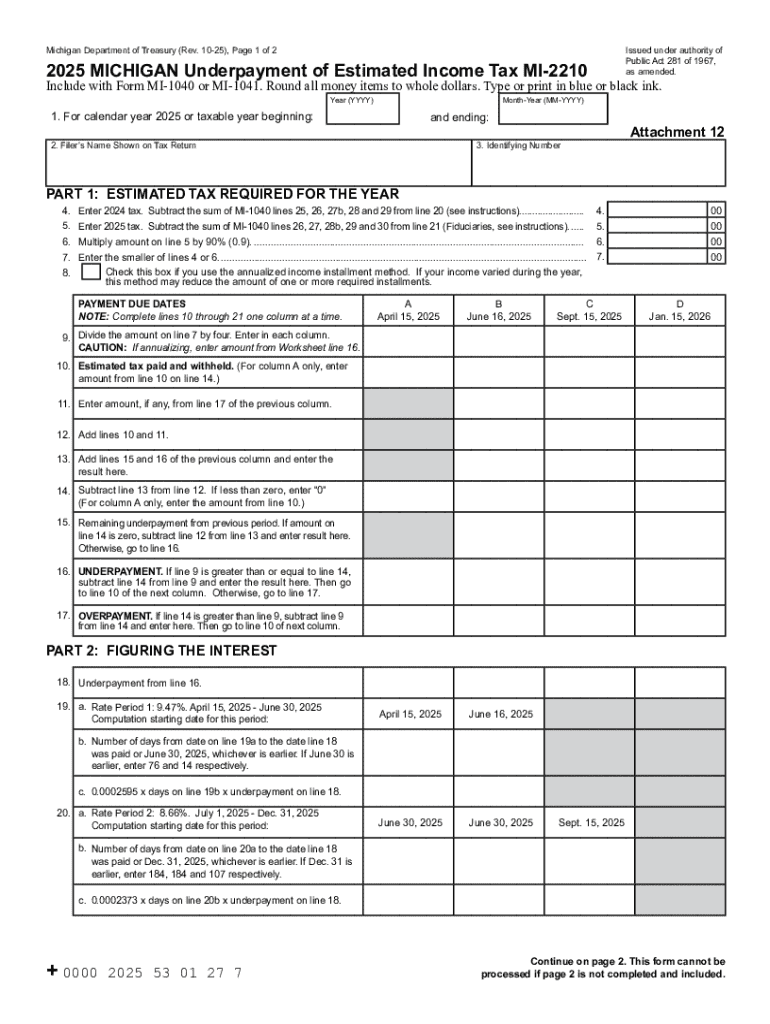
The MI-2210 form, titled "2025 Michigan Underpayment of Estimated Income Tax," is essential for taxpayers who need to report and resolve any underpayment of their estimated income tax within the state of Michigan for the tax year 2025. This form is used to calculate any penalties incurred for not paying the required estimated taxes throughout the year. Taxpayers can assess whether their payments met the state's legal requirements, avoiding penalties associated with late or insufficient payments.
-
Estimated Income Tax: This refers to the tax paid on income not subject to withholding. For many, this includes income from self-employment, interest, dividends, rent, alimony, or other sources.
-
Underpayment Penalty: If estimated taxes are underpaid, a penalty may be imposed by the Michigan Department of Treasury, calculated using this form.
Steps to Complete the MI-2210 Form
Completing the MI-2210 form involves several crucial steps to ensure accuracy and compliance. The following outlines the process:
-
Gather Necessary Information:
- Collect income statements, including W-2 and 1099 forms.
- Obtain records of all estimated tax payments made during the tax year.
-
Calculate Each Quarter's Estimated Tax:
- Determine the total expected income and deductions for the year.
- Calculate the tax due for each quarter based on estimated income.
-
Compare Payments Against Required Amounts:
- Review the payments made during each quarter.
- Use the MI-2210 form to determine if there were any underpayments compared to the required amounts.
-
Calculate Penalties:
- Utilize the form to compute any applicable penalties for underpayment or late payment.
-
Complete the Form Sections:
- Fill in details as per the categories on the form, including taxpayer information, payment records, and penalty calculations.
-
Review and Submit:
- Double-check all entries for accuracy.
- Submit the form along with any penalty payment owed to the Michigan Department of Treasury.
Who Typically Uses the MI-2210 Form
The MI-2210 form is predominantly used by taxpayers with fluctuating or unpredictable income streams. It is particularly relevant for:
-
Self-Employed Individuals: Those who must make quarterly estimated tax payments based on their income.
-
Businesses: Companies that need to ensure they are in compliance with Michigan's state tax requirements for estimated payments.
-
Retirees with Non-Wage Income: Retirees receiving income from pensions or investments may need to manage their tax payments actively.
-
Investors: Individuals receiving significant income from dividends and capital gains.
-
Seasonal Workers: Those whose income may vary significantly throughout the year.


Penalties for Non-Compliance
Non-compliance with estimated tax payments can lead to substantial penalties, and understanding these is critical to avoiding extra charges:
-
Interest on Underpayment: Interest is typically charged on any amount of underpaid tax from the due date of the payment until the due date of the return or when the tax is paid, whichever is earlier.
-
Additional Penalties: Further penalties can be applied if payments are not only under the required amount but also if they are consistently late.
-
Exceptions: In some cases, exceptions to penalties may be available; for example, if income was unequally distributed throughout the year and payments were adjusted accordingly.
State-Specific Rules
The MI-2210 form adheres to specific state guidelines set forth by Michigan law:
-
Quarterly Payment Schedule: Michigan requires taxpayers to pay estimated taxes quarterly, aligning with the federal schedule.
-
Safe Harbor Provisions: Specific rules allow taxpayers to avoid penalties if payments were made based on prior year's tax liability or a calculated safe harbor.
-
Thresholds for Filing: Taxpayers whose underpayment is below a certain threshold may be exempt from penalties.
Important Terms Related to MI-2210
Understanding the terminology associated with the MI-2210 form aids in accurate completion:
-
Safe Harbor: A rule that protects taxpayers from penalties if they pay a certain percentage of last year's tax liability or 90% of the current year's liability.
-
Adjusted Gross Income (AGI): AGI is the individual's total income minus specific deductions and is essential for calculating estimated tax.
-
Installment Agreement: An arrangement allowing taxpayers to pay taxes owed over time.
Filing Deadlines and Important Dates
Knowing the deadlines for the MI-2210 form is vital for compliance:
-
Quarterly Due Dates: Estimated payments are typically due on April 15, June 15, September 15, and January 15 of the following year.
-
Final Submission Date: The completed MI-2210 form should be submitted with the annual tax return, usually by April 15.
Software Compatibility
For accurate calculation and easy filing, the MI-2210 form should be compatible with popular tax software:
-
TurboTax and QuickBooks: These programs generally support the MI-2210 form, allowing for seamless integration and accurate calculations.
-
Online Filing: The form can also be filled out and submitted electronically through certified e-filing services, aligning with the IRS and the State of Michigan's guidelines.
Understanding the requirements, procedures, and intricacies of the MI-2210 form aids taxpayers in fulfilling their tax obligations accurately and efficiently, ensuring compliance and avoiding penalties.