






Definition & Meaning
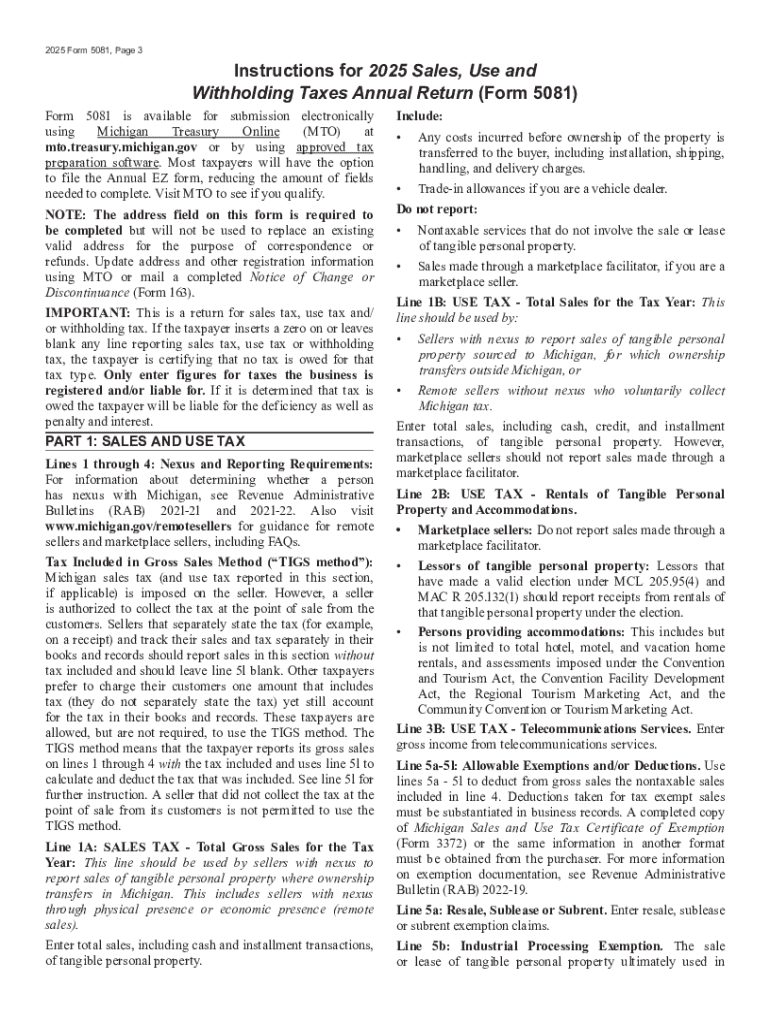
The Instructions for 2025 Sales, Use and Withholding Taxes Annual serve as a comprehensive guide for understanding the completion and submission of Form 5081. This document outlines the procedural and legal requirements necessary for businesses to accurately report sales, use, and withholding taxes for the year 2025. Primarily used in Michigan, these instructions ensure compliance with state tax laws by detailing the form's sections, box-by-box completion tips, and clarification of tax concepts.
Key Components
- Sales Tax: A levy imposed on the sale of goods and services.
- Use Tax: Applied to the use, storage, or consumption of goods within a state.
- Withholding Tax: Money withheld from an employee's wages for tax purposes.
Steps to Complete the Instructions for 2025 Sales, Use and Withholding Taxes Annual
- Gather Required Documentation: Collect financial records, sales reports, and previous tax returns.
- Enter Identifying Information: Input business name, address, and tax identification number.
- Report Sales & Use Tax: Calculate and enter the sales and use tax liabilities.
- Calculate Withholding Tax: Include employee withholding information for accurate calculations.
- Verify Totals: Ensure all sections are complete and totals are accurate before submission.
- Submit Form: Choose between electronic submission via Michigan Treasury Online (MTO) or physical mail.
Practical Tips
- Use available tax software to cross-check calculations.
- Consult with a tax professional if discrepancies arise.
Filing Deadlines / Important Dates
Timeliness is crucial for compliance. The annual filing of Form 5081 must be completed by the specified deadline to avoid penalties:
- Filing Deadline: February 28, 2026, for the 2025 tax year.
- Extension Requests: Must be submitted before the original due date to be considered.
Late Submission Consequences
- Penalties: Financial penalties are levied for late submissions.
- Interest Charges: Accumulate on unpaid tax amounts from the original due date.
Form Submission Methods
Online Submission
- Michigan Treasury Online (MTO): Allows for swift and secure submission of Form 5081. Benefits include immediate confirmation and reduced risk of errors.
Mail Submission
- Physical Mail: Provide a tangible form, though slower and less efficient than electronic submissions.
In-Person Submission
- Direct Mail to Treasury Offices: Utilize official state treasury addresses for in-person submissions.
Legal Use of the Instructions for 2025 Sales, Use and Withholding Taxes Annual
Aligning actions with legal guidelines is pivotal for acceptance and compliance:
- Legally Binding: Following the instructions ensures adherence to Michigan's taxation laws.
- Compliance Verification: The instructions help auditors verify the correct reporting of sales, use, and withholding taxes.
Real-World Applications
- Businesses utilize this guide to navigate complex tax situations and ensure accurate filings.
IRS Guidelines
Although Form 5081 is specific to Michigan, understanding its intersection with IRS requirements is beneficial:
- Concurrent Filing: IRS guidelines on federal taxes should be considered alongside Michigan's state-specific instructions for a comprehensive tax submission strategy.
Coordination Tips
- Review both IRS and Michigan state deadlines to synchronize federal and state tax responsibilities.
State-Specific Rules for the Instructions for 2025 Sales, Use and Withholding Taxes Annual
Michigan-Based Considerations
- State Tax Code Compatibility: Instructions correlate directly with Michigan tax statutes, emphasizing local compliance.
- Regulatory Updates: Businesses must stay informed about legislative changes affecting their filings.
Examples of Using the Instructions for 2025 Sales, Use and Withholding Taxes Annual
Various scenarios illustrate the application of these instructions:
Example Situations
- Retail Business: Calculates sales tax based on daily transactions and ensures withholding tax accuracy for employees.
- Online Reseller: Focuses on use tax calculations for out-of-state purchases used within Michigan.
Case Studies
- Small Businesses: Benefit from straightforward examples of form completion provided in the instructions.
Penalties for Non-Compliance
The importance of adherence is underscored through penalties:
- Financial Implications: Penalties can range significantly depending on the nature and severity of the non-compliance.
- Reputational Risk: Consistent non-compliance can affect future tax filings and business operations.
Avoidance Strategies
- Ensure proper cross-checking of all sections before submission to avoid such penalties.
Digital vs. Paper Version
Differences in submission methods contain significant considerations:
- Digital Submission: Faster processing times, immediate feedback, and access to historical data.
- Paper Version: Traditional approach, but prone to delays and manual errors.
Technological Considerations
- Invest in digital capabilities to enhance accuracy and streamline the tax submission process.