



01. Edit your form online
Type text, add images, blackout confidential details, add comments, highlights and more.

Type text, add images, blackout confidential details, add comments, highlights and more.

Draw your signature, type it, upload its image, or use your mobile device as a signature pad.

Send it via email, link, or fax. You can also download it, export it or print it out.
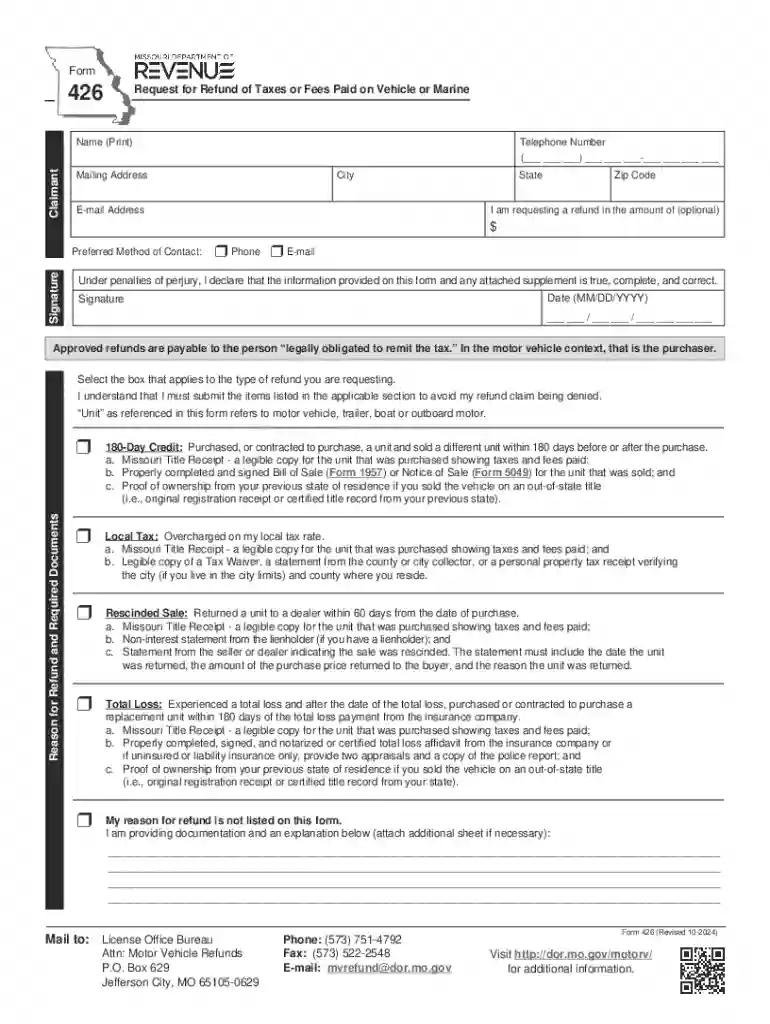
The Form 426, "Request for Refund of Taxes or Fees Paid on Vehicle or Marine," is a standardized document used by individuals in the United States to request refunds related to taxes or fees paid on vehicles, trailers, boats, or outboard motors. This form is essential for individuals or businesses seeking refunds due to specific tax-related issues such as overpayments, miscalculations, rescinded sales, or total losses. Understanding its meaning helps taxpayers navigate the refund process more effectively.
To qualify for a refund using Form 426, applicants must meet specific criteria, which typically include having paid taxes or fees in error or excess on applicable vehicles or marine assets. Common scenarios include corrected tax rates, sale rescissions, or situations where the vehicle or boat is deemed a total loss. Taxpayers must ensure they provide accurate and comprehensive information in line with these eligibility requirements to enhance the likelihood of approval.


Submitting Form 426 requires several supporting documents to validate the refund claim. These documents may include proof of payment, copies of registration or title, and any correspondence indicating tax miscalculations. Depending on the case, additional documentation such as accident reports or sale contracts may be necessary to provide evidence for claims related to total losses or rescinded sales.
Adhering to filing deadlines is crucial for the success of refund requests. Generally, taxpayers must file Form 426 within a specific period after identifying the payable error or receiving the transaction leading to the refund request. It is advisable to consult the issuance guidelines or state-specific regulations to ensure compliance with applicable deadlines and avoid unnecessary delays or rejections.
Form 426 serves as a legal instrument for taxpayers to claim refunds for various eligible scenarios. Its use is based on specific state and federal laws governing tax reclaims for vehicles and marine equipment, reinforcing its legitimacy in legal settings. Taxpayers must ensure accurate and truthful information in their applications to uphold the form's integrity and their credibility during the refund process.
The form consists of key elements including personal details, vehicle or marine asset information, reason for the request, and the amount of refund sought. Each section must be completed meticulously, reflecting honest and accurate data to support the refund claim. The inclusion of comprehensive details about the payable error or transaction disparity is essential to justify the refund request.
Taxpayers have multiple avenues to submit Form 426, offering flexibility and convenience. While many prefer online submissions for their ease and traceability, others might choose traditional mail or in-person submissions for direct engagement with tax authorities. Each method has specific instructions and requirements, and taxpayers should select the one best suited for their circumstances, considering factors like processing time and method reliability.
Real-world scenarios for Form 426 usage include situations like correcting erroneous tax assessments on a recently purchased vehicle or obtaining reimbursement due to the total loss of a marine vessel following an accident. These examples demonstrate the form’s practical application in safeguarding taxpayer rights, ensuring they are not unduly burdened by incorrect or excess tax payments. Providing illustrative scenarios benefits individuals unfamiliar with tax refund processes, offering clearer guidance and expectations.
At DocHub, your data security is our priority. We follow HIPAA, SOC2, GDPR, and other standards, so you can work on your documents with confidence.




Oct 19, 2017 Use this publication as a guide to figure your taxes and complete your farm tax return. If you need more information on a subject, get theRead more
A claim for a rescinded sale must be filed within one year after payment of the tax pursuant to Section 144.071.1 RSMo. Form 426 (Revised 10-2024). 1. If IRead more
by MJ McMahon Jr 2009 Cited by 5 of Federal Claims seeking a refund of taxes paid between 1994 and 1996, but did not file any claim for those taxes with the IRS, because any such claim would.Read more


