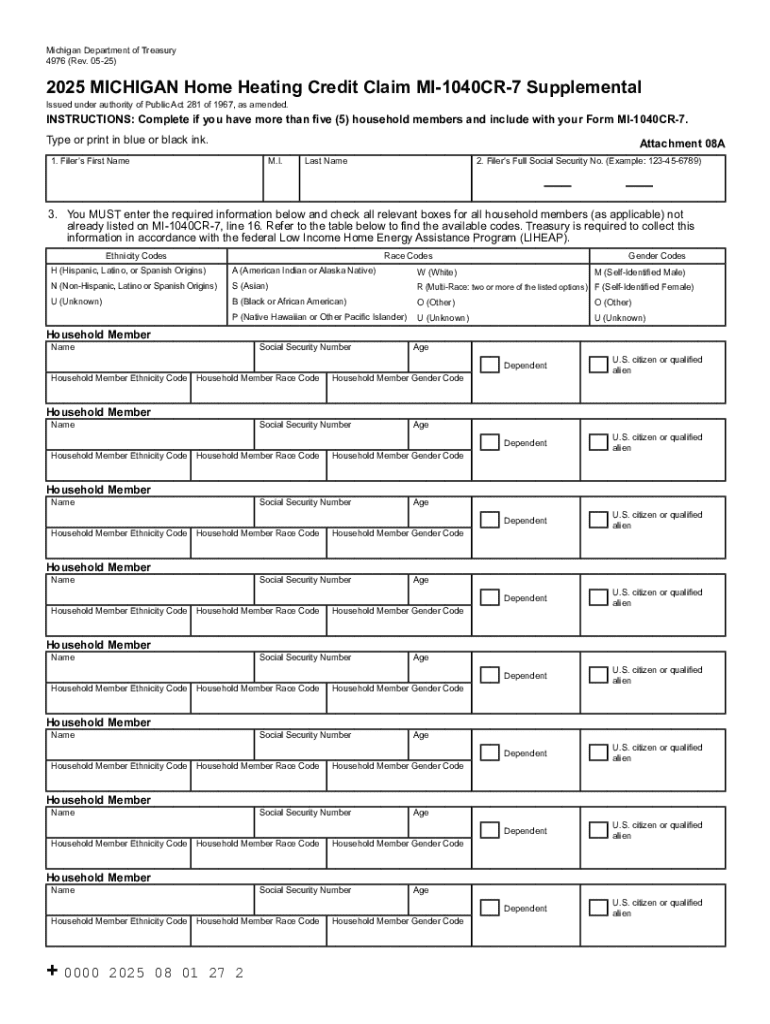







Definition and Purpose of the Michigan Home Heating Credit Claim MI-1040CR-7
The Michigan Home Heating Credit Claim MI-1040CR-7 is a form used by residents of Michigan to apply for a home heating credit. This credit is designed to assist low-income individuals and families with their heating costs in Michigan's cold winter months. Form MI-1040CR-7 Supplemental 4976 enables residents to claim this credit, providing relief for those who meet specific eligibility requirements. Michigan's Department of Treasury oversees the issuance and management of these forms, which are part of a broader state initiative to support vulnerable households.
Steps to Complete the MI-1040CR-7 Form
-
Gather Required Information: Before beginning, collect all necessary documents, such as income statements, personal identification, and previous year’s tax credits.
-
Obtain the Form: Access the MI-1040CR-7 form either online from the Michigan Department of Treasury's website or through other authorized outlets.
-
Fill in Personal Information: Include personal details, such as name, address, and Social Security number.
-
Enter Income Details: Accurately record all sources of income, ensuring every field is completed to avoid processing delays.
-
Determine Eligibility for Credit: Follow the instructions to assess eligibility based on income and household size.
-
Complete Supplemental Section 4976: Address any additional requirements or information needed for supplemental filing.
-
Review and Submit: Double-check all entries for accuracy before submission. Forms can typically be submitted online or via mail to designated treasury locations.
Eligibility Criteria for MI-1040CR-7
To qualify for the Michigan Home Heating Credit, applicants must meet several criteria:
- Residency: Must be a legal resident of Michigan during the tax year.
- Income Requirements: Total household resources must fall below a specified threshold, adjusted annually based on the cost of living.
- Exclusions: Individuals residing in homes where heating costs are included in rent or provided for free do not qualify.
Applicants should refer to the specific income brackets published yearly by the Michigan Department of Treasury to verify eligibility.


Important Terms Related to Form MI-1040CR-7
- Household Income: Includes wages, social security benefits, pensions, and other income sources.
- Heating Costs: Expenses directly paid by the household for maintaining heating in the residence.
- Supplemental Section 4976: An additional section for individuals with unique circumstances or additional information not covered in the main form.
Understanding these terms ensures accurate completion and maximizes the chance of claiming the credit successfully.
State-Specific Rules and Considerations
Each Michigan resident should be aware of:
- Filing Deadlines: Typically aligns with the state tax filing deadlines; however, specific dates can vary.
- Income Calculation: Use state guidelines to calculate income as certain federal exclusions may not apply.
- Submission Method: Both digital and paper submissions are accepted though digital is often faster and more secure.
Examples and Scenarios for Claiming the Credit
Consider these practical examples to better understand the application:
-
Single Parent Scenarios: A single parent with two children earning below $25,000 can qualify for the credit, significantly reducing heating expenses across the winter.
-
Retired Individuals: Retirees relying on social security and pensions can claim the credit if their income falls under Michigan's eligibility threshold.
These examples underline the credit's potential impact on alleviating financial burdens for diverse demographic groups.
Penalties for Non-Compliance
Failure to comply with submission guidelines or fraudulent reporting can result in:
- Fines and Penalties: Monetary fines imposed for incorrect or deceptive information.
- Ineligibility: Future disqualification from receiving state credits or benefits.
Understanding compliance requirements and adhering strictly to them helps avert such consequences.
Differences Between Digital and Paper Versions
While both versions are available:
-
Digital Version: Quick submission and faster processing time. It includes features for auto-checking errors and confirming receipt.
-
Paper Version: Traditional method, susceptible to manual errors and postal delays.
Deciding which version to use depends largely on the applicant's access to digital tools and familiarity with online submissions.