






Definition & Meaning
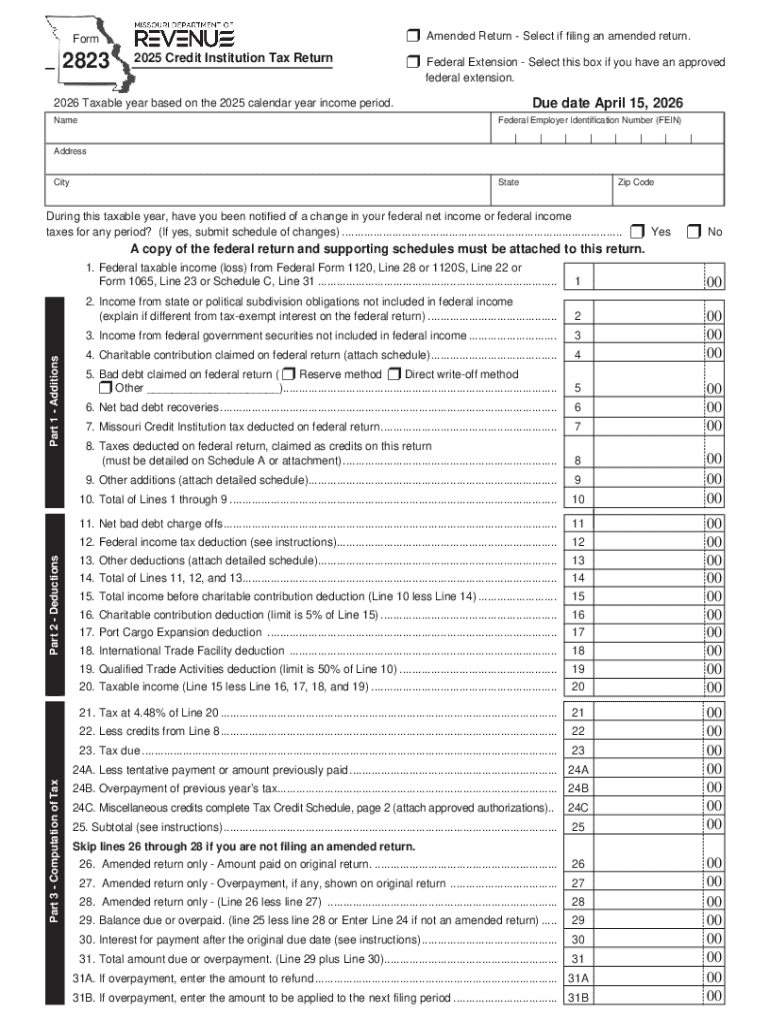
Form 2823 - 2025 Credit Institution Tax Return is used by credit institutions in the United States to report their tax obligations for the year 2025. This form is crucial for ensuring compliance with federal tax laws, allowing institutions to accurately detail their financial activities and obligations to the Internal Revenue Service (IRS). Specifically tailored for credit institutions, the form addresses unique financial aspects such as interest income, loan portfolios, and other relevant financial data.
Key Elements
- Interest Income Reporting: Institutions must provide a detailed account of interest earned throughout the fiscal year.
- Loan Portfolio: Documentation of loan assets, including types and values.
- Deductions and Credits: Information on applicable tax deductions and credits specific to credit institutions.
- Financial Summary: Overall financial performance and taxation metrics for the institution.
How to Use the Form 2823 - 2025 Credit Institution Tax Return
Completion of Form 2823 involves gathering a comprehensive set of financial information pertinent to the operations of a credit institution for the tax year 2025. It is essential to ensure that all figures reported are accurate and derived from well-documented records.
- Gather Financial Records: Collect all relevant financial documentation, including income statements, balance sheets, and previous tax returns.
- Data Entry: Accurately input gathered data into the designated sections of the form.
- Review and Verify: Double-check entries for accuracy and completeness to avoid errors that may lead to penalties.
- Consultation: Engage tax professionals to ensure compliance with applicable laws and to identify potential tax-saving opportunities.
Steps to Complete the Form 2823 - 2025 Credit Institution Tax Return
The process of completing the form involves several structured steps. Accuracy and thoroughness in each step are critical for compliance and accurate tax reporting.
- Input Organizational Details: Start with the name, address, and employer identification number of the institution.
- Calculate Gross Income: Document all sources of income, primarily focusing on interest and loan transactions.
- Detail Expenses and Deductions: Include both operational expenses and allowable deductions.
- Determine Taxable Income: Subtract total expenses and deductions from gross income to ascertain taxable income.
- Compute Tax Owed: Use relevant tax rates to compute the amount owed.
- Finalize and Review: Double-check all calculations and entries for errors.
Important Terms Related to Form 2823
Understanding certain terms is crucial for accurately completing Form 2823:
- Interest Income: Income earned from lending activities.
- Loan Portfolios: A collection of loans held by the institution, affecting income calculations.
- Tax Deductions: Specific expenses allowable to reduce taxable income.
- Compliance: Meeting all legal requirements for tax filing.
Filing Deadlines / Important Dates
For Form 2823, adhering to critical deadlines is essential to maintain compliance and avoid penalties.
- Filing Deadline: Typically due by March 15 for institutions with a calendar year-end.
- Extension Filing: An extension may be requested, commonly through Federal Form 7004, potentially extending the deadline to September 15.
- Payment Deadlines: Tax payments are often due concurrently with the filing, except for approved extensions, which only delay the paperwork, not the financial responsibility.
Legal Use of the Form 2823
The form is a legal requirement for credit institutions to fulfill federal tax obligations and avoid legal consequences, such as audits or penalties.
- Compliance-Driven: Ensures institutions adhere to federal tax laws.
- Documentation: Provides official documentation of financial position and compliance status.
- Audit Trail: Forms part of the institution's audit trail, useful for future references during audits.
Digital vs. Paper Version
Though traditionally available in paper, the digital version of Form 2823 offers convenience and efficiency.
- Digital Benefits: Allows for easier data entry, error checking, and documentation management.
- Paper Format: Still available for those who prefer traditional submission methods or have limited internet access.
- Filing Efficiency: Electronic submissions can prompt faster processing times compared to paper filings.
Examples of Using the Form 2823 - 2025 Credit Institution Tax Return
Practical scenarios where Form 2823 is utilized involve credit institutions of varying sizes and reporting complexities.
- Small Community Banks: Completing the form to report on collected interest and service fees.
- Large National Credit Unions: Detailing extensive loan portfolios and multifaceted income streams.
- Niche Lending Firms: Reporting specialized financial operations and their tax implications.
This comprehensive approach to Form 2823 ensures all necessary aspects are addressed thoroughly, accommodating both straightforward and complex tax scenarios credit institutions may face.