






Definition & Meaning
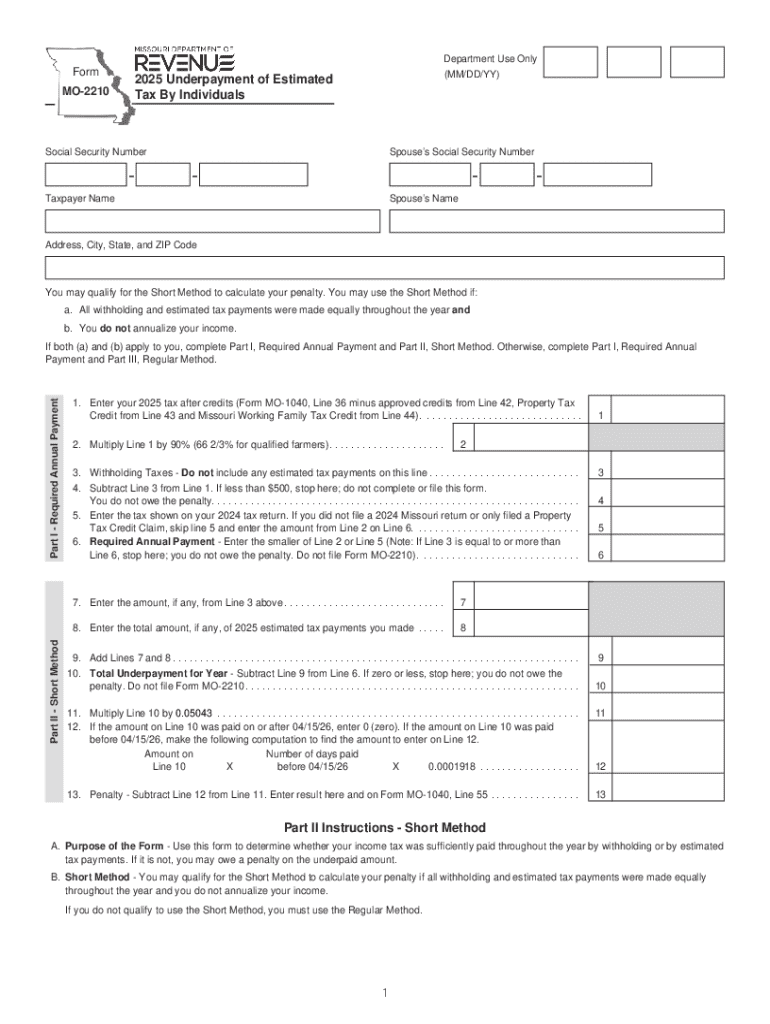
Form MO-2210 - 2025 Underpayment of Estimated Tax By is a tax document utilized primarily by individuals who have underpaid their quarterly estimated taxes throughout the financial year. This form assists taxpayers in determining any underpayment penalties they may owe. It's essential for individuals who prefer to pay their taxes in installments rather than a lump sum at the year's end. The form calculates how much tax was underpaid and what penalties apply, adhering to Missouri's state-specific guidelines for tax payments.
How to Use the Form MO-2210 - 2025 Underpayment of Estimated Tax By
To effectively use Form MO-2210, individuals must first gather all necessary financial records from the tax year in question. This includes income documentation, payment receipts, and any other relevant tax documents. Once gathered, the taxpayer will:
- Enter any pre-paid estimated tax amounts.
- Calculate their total yearly tax liability.
- Compute the difference to determine if there was an underpayment.
- Follow the form's instructions to apply the appropriate penalty rates.
Each part of the form provides a detailed breakdown of sections requiring completion, ensuring that users accurately compute the underpayment and associated charges.
Steps to Complete the Form MO-2210 - 2025 Underpayment of Estimated Tax By
Completing Form MO-2210 involves several key steps:
- Gathering Documentation: Collect all income statements, receipts for estimated tax payments, and any applicable deduction records.
- Filling Initial Sections: Enter personal identification details, including social security numbers.
- Calculating Tax Due: Use the form to compute expected taxes against estimated tax payments.
- Penalty Assessment: Follow guidelines to determine applicable penalties on underpayments.
- Review and Submit: Double-check computations for accuracy, then prepare to submit either electronically or by mail.
Taxpayers should consult additional guidelines or a tax professional for complex cases to ensure all information is correctly entered.
Legal Use of the Form MO-2210 - 2025 Underpayment of Estimated Tax By
Form MO-2210 is legally mandated for any taxpayer who falls below the required threshold for estimated payments. It is particularly relevant in cases where individuals anticipate owing more than $500 in taxes. The form ensures compliance with Missouri tax laws, safeguarding the taxpayer against future audits or penalty disputes. Accurate completion of the form aids in mitigating any legal repercussions for underestimated tax payments.
State-Specific Rules for the Form MO-2210 - 2025 Underpayment of Estimated Tax By
Missouri state regulations dictate the use of Form MO-2210. Taxpayers are bound to follow specific guidelines when reporting state-level underpayments. Some points include:
- Thresholds: Underpayment penalties apply when tax owed surpasses $500.
- Penalty Rates: Missouri applies its penalty rates separate from federal standards.
- Filing Dates: Variations may occur annually, highlighting the importance of checking current year deadlines.
Knowing these rules aids taxpayers in staying compliant with state laws, different from federal tax obligations.
IRS Guidelines
Though Form MO-2210 is a state-specific document, aligning it with IRS guidelines is crucial. Key IRS guidelines include:
- Calculating taxes using both federal and state requirements to determine if you're eligible for broader exemptions or reduced penalty rates.
- Recognizing federal penalty exceptions, which can occasionally override state penalties if federal regulations provide pardons or reductions.
Individuals should cross-reference MO-2210 computations with IRS standards for accurate tax fillings.
Penalties for Non-Compliance
Non-compliance with completing and submitting Form MO-2210 can lead to several consequences:
- Monetary Penalties: Additional fines are imposed for late submissions or inaccuracies.
- Legal Implications: Repeated non-compliance can lead to legal action by state taxation bodies.
- Interest Accrual: Interest on unpaid taxes could accumulate until the due amount is cleared.
Understanding the importance of timely and precise submissions helps avoid these adverse outcomes.
Filing Deadlines / Important Dates
For taxpayers in Missouri using Form MO-2210, adhering to deadlines is crucial. Standard filing deadlines often align with federal deadlines, typically April 15 but may differ based on extensions or state-specific directives. To maintain compliance:
- Check Annually: Tax deadlines can fluctuate; verify each tax year.
- Extensions: Missouri might offer expanded deadlines; knowing eligibility for extensions can provide relief.
- Quarterly Estimates: Familiarize yourself with quarterly deadlines to ensure estimated taxes are timely and correct.
Complete and filed accurately by due dates, the form secures the taxpayer’s standing with state tax regulations.