






Definition & Meaning
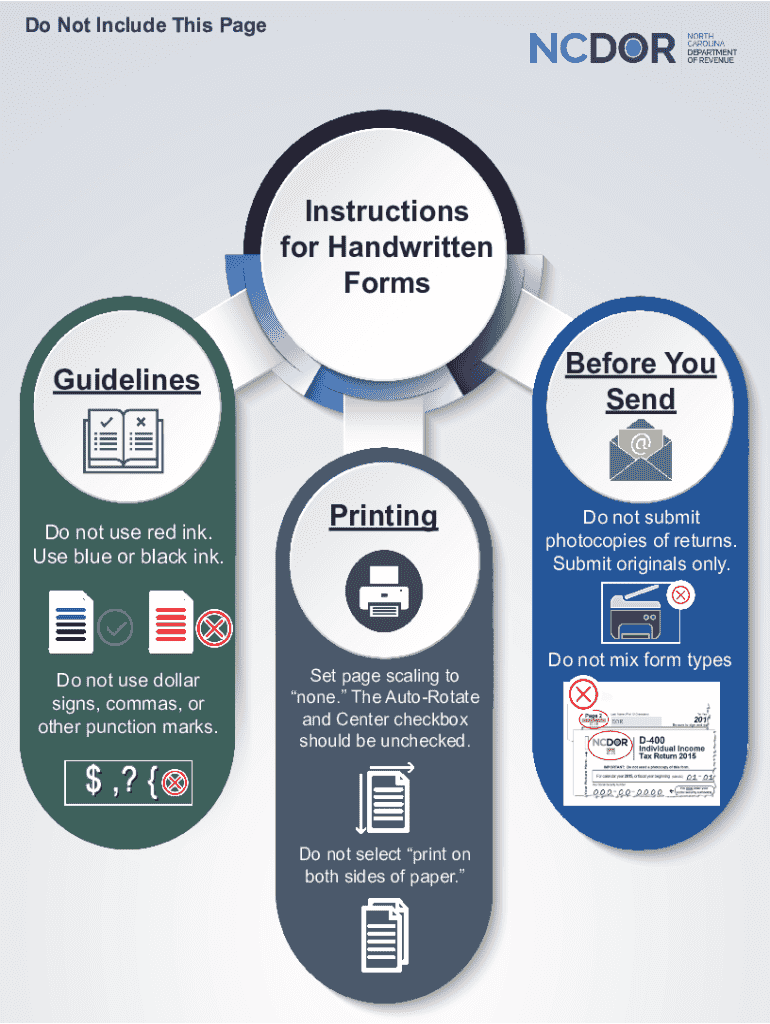
The "Instructions for Handwritten Forms Guidelines" are comprehensive directives aimed at ensuring that handwritten forms are filled out correctly and efficiently. These guidelines help standardize the process of filling forms to minimize errors, enhance readability, and ensure compliance with legal requirements. By following these guidelines, users can ensure that their forms are processed smoothly and accurately, avoiding delays or rejections due to misinterpretations.
Key Elements of the Instructions for Handwritten Forms Guidelines
Properly completing handwritten forms requires adherence to key elements outlined in the guidelines. These elements focus on ensuring legibility, accuracy, and completeness.
- Ink Color: Use blue or black ink exclusively, as they provide the best contrast for digitization and photocopying.
- Avoiding Special Characters: Do not include dollar signs, commas, or other punctuation marks in numeric fields to prevent misinterpretation.
- Legibility: Ensure that all letters and numbers are clearly printed, not cursive. Distinct characters reduce errors in data entry and processing.
Steps to Complete the Instructions for Handwritten Forms Guidelines
Properly completing a handwritten form involves a series of systematic steps designed to minimize errors and ensure clarity.
- Read the Entire Form: Before you start, review the entire form to understand what information is required.
- Gather Necessary Information: Collect all required data and documents, ensuring you have the needed details at hand.
- Fill Out Personal Information First: Input your personal details carefully, as mistakes in these fundamentals can cause processing issues.
- Follow Field-Specific Instructions: Adhere to specific guidance such as capitalizing all letters in certain fields if instructed.
- Double-Check Before Submission: Review your entries for accuracy and ensure all required fields are completed.
Who Typically Uses the Instructions for Handwritten Forms Guidelines
These guidelines are commonly utilized by individuals and organizations that must submit standardized forms for various official purposes. They are essential for:
- Governmental Agencies: Employees and applicants filling out tax forms, permit applications, or other regulatory paperwork.
- Educational Institutions: Students and staff completing applications or requests that require manual input.
- Healthcare Providers: Completing patient intake forms or insurance documentation by hand.


Legal Use of the Instructions for Handwritten Forms Guidelines
Understanding the legal implications of handwritten form guidelines is crucial for compliance and authenticity.
- Compliance with Regulations: Forms filled according to these guidelines are usually compliant with relevant federal and state regulations, ensuring they are legally valid.
- Authentication: Properly filled forms serve as legally binding documents and are recognized in official records and proceedings.
Examples of Using the Instructions for Handwritten Forms Guidelines
Real-world applications of these guidelines illustrate their importance in various scenarios.
- Tax Documents: Following guidelines ensures the IRS processes tax returns more efficiently, preventing delays due to illegible handwriting.
- Permit Applications: Local government permits are often filled out manually, and adhering to guidelines ensures speedy approval.
- Medical Records: Accurately filling out forms minimizes errors in patient data, essential for proper medical care.
Important Terms Related to Instructions for Handwritten Forms Guidelines
To effectively navigate and apply the guidelines, familiarity with relevant terminology is beneficial.
- Legibility: The clarity with which information is written.
- Validation: The process of checking the completeness and correctness of form entries.
- Compliance: Adherence to prescribed rules and standards in documentation.
Form Submission Methods (Online / Mail / In-Person)
Understanding different form submission methods ensures the correct process is followed.
- Online Submission: Some forms can be scanned and submitted online, provided they meet digital criteria.
- Mail: Traditional mailing remains a common submission method, especially where original copies are needed.
- In-Person: Direct submission to an office or institution is preferred for high-priority or sensitive documents.
Digital vs. Paper Version
Deciding between digital and handwritten versions of forms depends on several factors, such as convenience, speed, and format acceptance.
- Digital Advantages: Forms can be filled electronically, offering speed and error correction capabilities, but may require additional software.
- Paper Advantages: Handwritten forms are useful in environments lacking technology infrastructure or where originals are necessary.
Penalties for Non-Compliance
Failure to comply with the guidelines can lead to several consequences, highlighting the importance of adherence.
- Form Rejection: Incomplete or incorrectly filled forms are often rejected, necessitating resubmission.
- Delays: Non-compliance can cause significant processing delays, affecting deadlines or service access.
- Fines or Legal Action: In cases requiring stringent adherence, non-compliance could lead to penalties or legal repercussions.