




01. Edit your form online
Type text, add images, blackout confidential details, add comments, highlights and more.

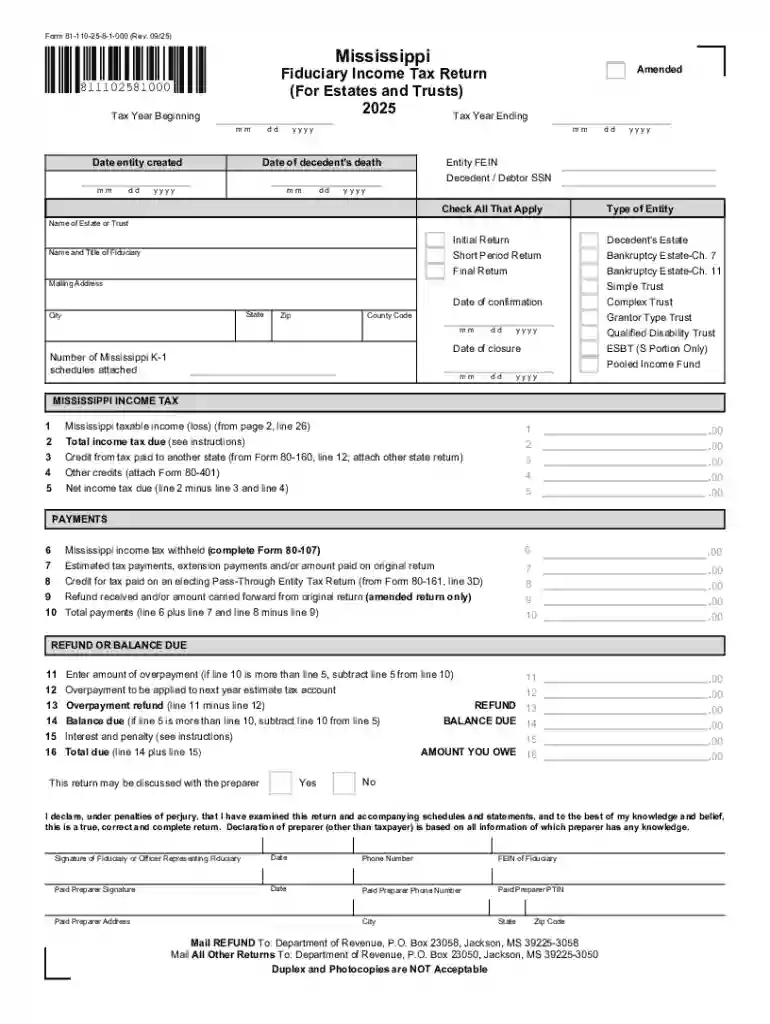
Type text, add images, blackout confidential details, add comments, highlights and more.

Draw your signature, type it, upload its image, or use your mobile device as a signature pad.

Send it via email, link, or fax. You can also download it, export it or print it out.
The Mississippi -MS form is typically associated with fiduciary responsibilities and is used to report income for estates and trusts in the state of Mississippi. It is an integral part of state tax filing requirements for fiduciaries, ensuring all parties involved in an estate or trust comply with Mississippi tax laws. Understanding this form is crucial for accurate financial reporting and fulfilling legal obligations associated with estate and trust management.
Using the Mississippi -MS involves several steps to ensure accuracy and compliance. The process is centered around reporting income, deductions, and distributing assets as per legal and tax guidelines.
An executor managing a family trust collects all related financial documentation throughout the year. By carefully entering this data into the Mississippi -MS form, they ensure compliance with Mississippi tax laws and proper distribution to beneficiaries.
Accessing the Mississippi -MS form is straightforward and can be acquired through the Mississippi Department of Revenue or authorized online platforms.
A trustee prefers digital documentation for efficiency. They download the form directly from the revenue department's website, allowing for easy integration into their digital records system, and ensuring all updates and changes are immediately reflected.
Completing the Mississippi -MS requires attention to detail and following a precise sequence to ensure all required data is accurately represented.
The Mississippi -MS form is predominantly used by those managing estates and trusts within the state, including executors, trustees, and estate attorneys.


The Mississippi -MS is a legal document requiring accurate representation of estate or trust financial activities, adhering to Mississippi laws.
Understanding key terms is crucial for correctly managing the Mississippi -MS form.
Timely filing of the Mississippi -MS form is critical for compliance and avoiding penalties.
Understanding these aspects ensures the Mississippi -MS form is used effectively, fulfilling all state-specific legal and tax obligations, thereby minimizing legal risks and optimizing financial management for estates and trusts.
We've got more versions of the Mississippi -MS form. Select the right Mississippi -MS version from the list and start editing it straight away!
| Versions | Form popularity | Fillable & printable |
|---|---|---|
| 2025 | 4.6 Satisfied (38 Votes) | |
| 2024 | 4.9 Satisfied (59 Votes) | |
| 2023 | 4.3 Satisfied (60 Votes) | |
| 2022 | 4.3 Satisfied (29 Votes) | |
| 2021 | 4.8 Satisfied (95 Votes) | |
| 2020 | 4.4 Satisfied (134 Votes) | |
| 2019 | 4.2 Satisfied (73 Votes) | |
| 2018 | 4.2 Satisfied (59 Votes) | |
| 2017 | 4.3 Satisfied (240 Votes) | |
| 2016 | 4.3 Satisfied (257 Votes) | |
| 2014 | 4.2 Satisfied (74 Votes) | |
| 2012 | 4.4 Satisfied (404 Votes) |
At DocHub, your data security is our priority. We follow HIPAA, SOC2, GDPR, and other standards, so you can work on your documents with confidence.


Jul 21, 2025 This 72 mile long river park offers quiet stretches for fishing, boating and canoeing. Other spots are excellent for birdwatching, bicycling and hiking.Read more
By 1800, the Mississippi Valley was home to some of the most complex cultural, commercial, and diplomatic activity in North America.Read more


