




01. Edit your form online
Type text, add images, blackout confidential details, add comments, highlights and more.

Type text, add images, blackout confidential details, add comments, highlights and more.

Draw your signature, type it, upload its image, or use your mobile device as a signature pad.

Send it via email, link, or fax. You can also download it, export it or print it out.
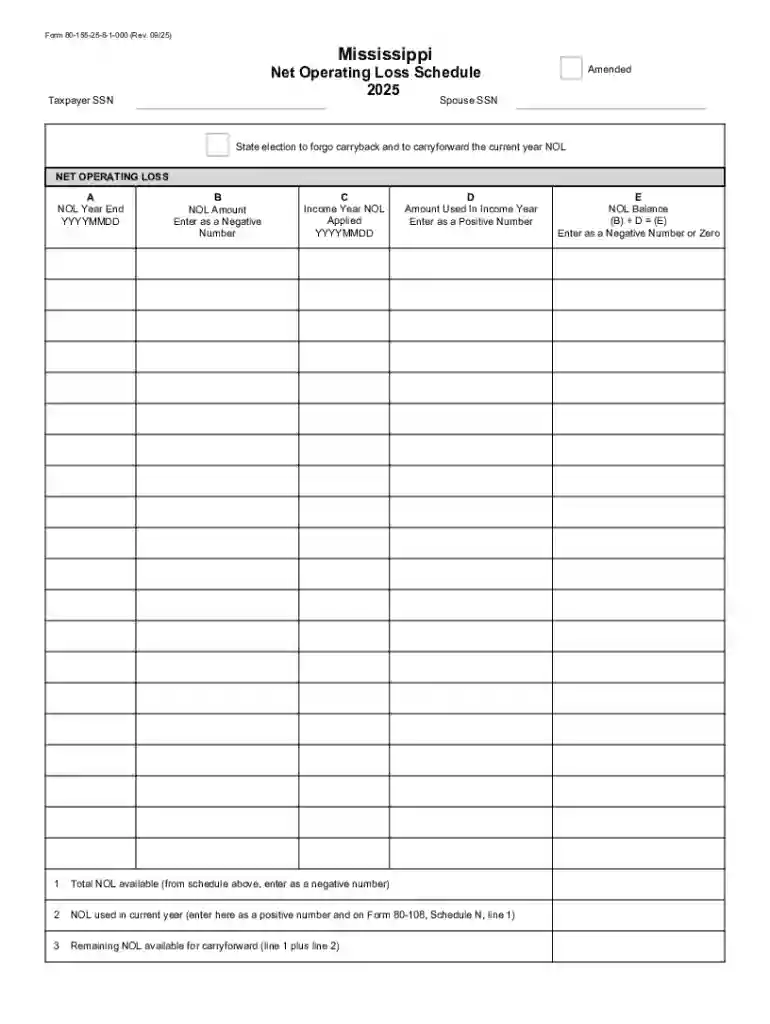
The Mississippi Form 80-155, also known as the Net Operating Loss Schedule, is a tax document used by individuals and businesses to report net operating losses (NOLs) on Mississippi state taxes. An NOL occurs when allowable deductions exceed taxable income within a tax year, creating the potential to offset future taxable income. This form aids taxpayers in carrying forward or carrying back losses to reduce tax liabilities in other years, following state-specific guidelines.
Using the Mississippi Form 80-155 involves documenting and calculating your NOLs from previous tax years that can be applied to offset income in future years.
Completing the Mississippi Form 80-155 involves several precise steps to ensure accurate reporting of NOLs:
Understanding key terms is essential for accurate and compliant filling of this form:
Mississippi has specific regulations regarding the application of NOLs, differing from federal guidelines:
Carryback Period: Mississippi may allow different periods compared to federal rules.
Carryforward Period: Generally allows a set number of years to apply NOLs against future income.
Forfeiture: Failure to adhere to state-specific rules may result in forfeiture of the ability to apply NOLs.
Regulatory Updates: Regularly check for legislative changes that may impact NOL application.
Different taxpayers use this form based on varying scenarios:
Self-Employed Individuals: Entrepreneurs experiencing fluctuating income due to market dynamics.
Corporations: Large entities with significant operating costs that exceed income in certain years.
Start-Ups: Businesses in initial growth phases facing high start-up costs exceeding early revenues.
Real-World Application: Each taxpayer’s scenario will impact whether to carryback or carryforward an NOL.


Certain businesses significantly benefit from utilizing this form:
Corporations: Typically experience cycles of profits and losses due to market variability.
Small Businesses and Start-Ups: Often invest heavily in development before achieving profitable status.
Agricultural Enterprises: Subject to income variability based on seasonal change and market conditions.
Long-Term Financial Planning: Helps these entities plan for future financial stability and tax efficiency.
Failure to correctly file the Mississippi Form 80-155 can result in penalties:
Monetary Penalties: Financial penalties may apply for underpayment or incorrect reporting.
Loss of NOL Opportunities: Incorrect filing can lead to forfeiture of NOL usage in future years.
Audit Risk: Increased likelihood of audits from state tax authorities.
Compliance Assurance: Regular consultation with tax professionals is advised to avoid penalties.
We've got more versions of the Mississippi Form 80-155 - Net Operating Loss Schedule form. Select the right Mississippi Form 80-155 - Net Operating Loss Schedule version from the list and start editing it straight away!
At DocHub, your data security is our priority. We follow HIPAA, SOC2, GDPR, and other standards, so you can work on your documents with confidence.





Jul 30, 1980 The information in these articles is presented so as to reflect generally in the areas in which the legislative interests were centered during
Form Year. 2023. Form Number. 80-155. Form PDF. 80155238.pdf. Form type. Individual Income Tax Forms Home. Main navigation. Individual; |Read more


