






Definition & Meaning
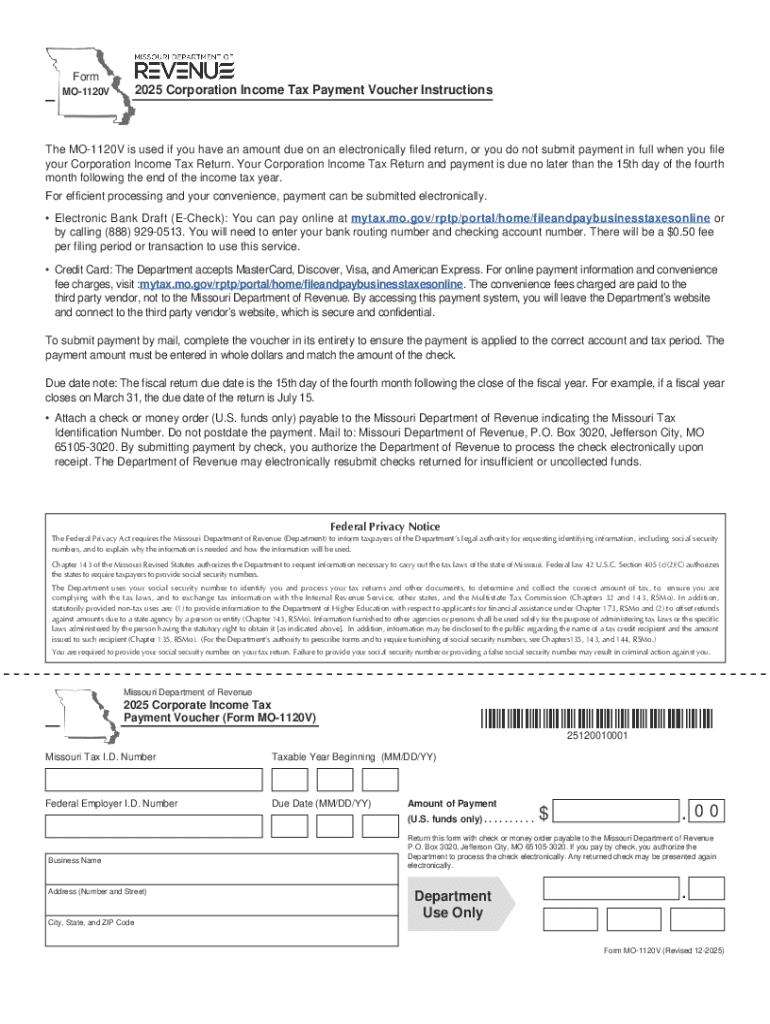
Form MO-1120V - Corporation Income and Franchise Tax is a payment voucher used by corporations in Missouri to remit any tax dues when either electronic returns indicate a balance due or when full payment is not submitted at the time of filing. This form ensures that corporations comply with the state's tax payment obligations by accompanying any payments owed for their corporate income and franchise taxes.
Who Typically Uses the Form MO-1120V
The primary users of Form MO-1120V are corporations operating within the state of Missouri, including domestic and foreign corporations. These entities are required to submit this form when there is a tax due at the time of filing their corporate tax returns. This encompasses a wide variety of business structures such as C corporations and closely-held corporations that conduct transactions or have physical presence in Missouri.


Steps to Complete the Form MO-1120V
-
Obtain the Form: Ensure you have the latest version of Form MO-1120V, which can be downloaded from the Missouri Department of Revenue’s official website.
-
Enter Corporation Details: Fill in the corporation name, address, and Federal Employer Identification Number (FEIN). Accurate information here is critical to ensure the proper allocation of your payment.
-
Indicate Tax Year: Specify the tax year for which the payment is applicable. This is usually the same period as mentioned in the accompanying corporate income and franchise tax return.
-
Amount Owed: Enter the total payment due as computed on the corporation's tax return. This amount should reflect any penalties or interest as applicable.
-
Payment Submission: Attach your check or money order made payable to the Missouri Department of Revenue with the form and mail to the address provided in the filing instructions. Mark the payment with FEIN and tax year to ensure processing accuracy.
Important Terms Related to the Form MO-1120V
-
Franchise Tax: A levy on corporations for the privilege of doing business within the state, assessed in addition to income tax on overall business revenue.
-
FEIN (Federal Employer Identification Number): A unique nine-digit number assigned to business entities for identification purposes by the IRS. Required for tax forms.
-
Electronic Filing: The process of submitting tax returns to the IRS via electronic methods (e-file), facilitating faster processing and cost-saving.
Required Documents
-
Completed Corporate Tax Return: Used to determine any outstanding dues.
-
Supporting Financial Statements: Required to verify income, deductions, and credits claimed.
-
Payment Confirmation: In cases of electronic payment, retain proof in the form of bank confirmations to ensure that your payment is recorded accurately.
Filing Deadlines / Important Dates
Corporations must file and remit payments using Form MO-1120V by the 15th day of the fourth month following the close of their tax year. For calendar-year taxpayers, this typically falls on April 15. Meeting these deadlines is critical to avoid penalties and interest charges.
Penalties for Non-Compliance
Failure to timely file Form MO-1120V or remit due payments can result in severe penalties. These may include:
- Late Payment Penalties: Additional charges for each month or part of a month payment is late, compounded periodically.
- Interest on Unpaid Amounts: Accrual of interest on taxes owed at a rate determined by the state.
- Potential Legal Actions: Persistent non-compliance may result in further collection actions, impacting business operations.
Digital vs. Paper Version
Missouri encourages the digital filing of tax returns and payment vouchers, which offers several advantages:
-
Faster Processing Times: Electronic submissions are processed quicker than paper, reducing the risk of errors.
-
Immediate Confirmation: Digital submissions provide instant confirmation receipts, offering peace of mind.
For those preferring traditional methods, paper versions can still be printed and mailed, but anticipation of longer processing times is necessary.
State-Specific Rules for the Form MO-1120V
Certain nuances apply to Missouri tax filings, including credits and deductions that are specific to the state. It is essential for corporations to familiarize themselves with state-specific tax incentives, as these can significantly impact total tax liabilities and obligations. Additionally, variations in tax brackets and franchise tax calculations necessitate a thorough understanding of Missouri's corporation tax framework.