






Definition and Importance of Form MO-C
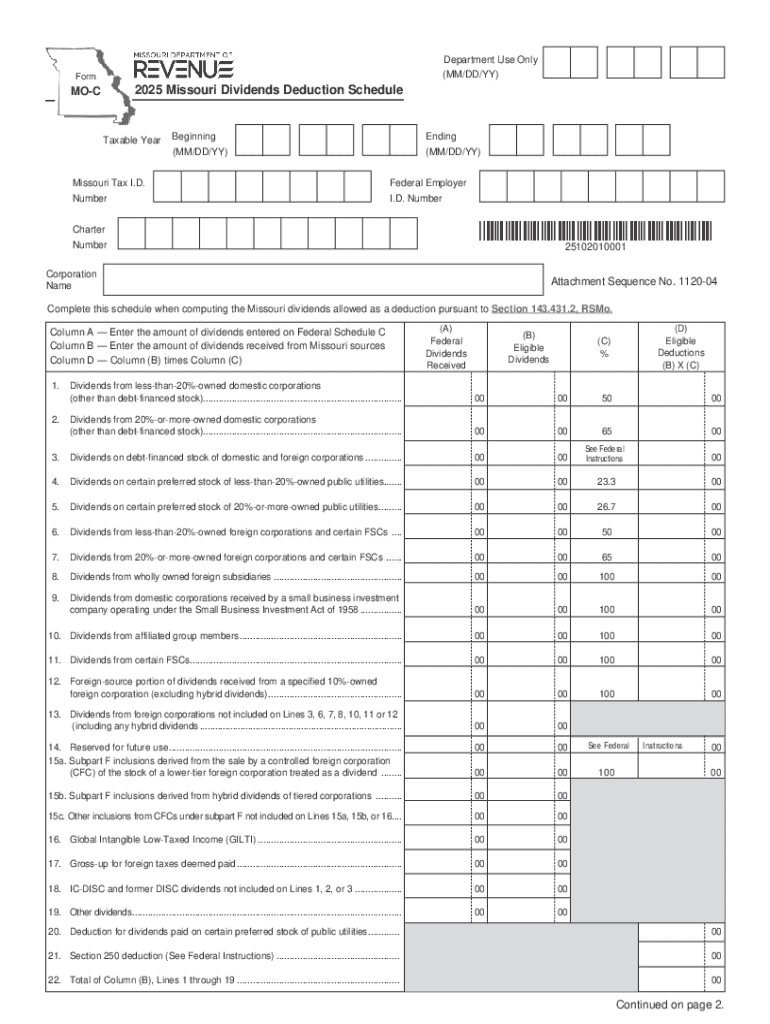
Form MO-C - 2022 Missouri Dividends Deduction Schedule is a tax document used by corporations in Missouri to report dividends deductions. It is essential for businesses that receive dividend income, enabling them to calculate deductions accurately and ensure compliance with state tax regulations. This form plays a crucial role in minimizing taxable income, thus lowering the overall tax liability for businesses.
Purpose of the Form
- Allows corporations to deduct dividends received from taxable income
- Ensures accurate reporting of dividends for tax purposes
- Helps corporations comply with Missouri tax laws
- Contributes to potential tax savings through allowable deductions
How to Obtain Form MO-C
To obtain the Form MO-C - 2022 Missouri Dividends Deduction Schedule, businesses can access the Missouri Department of Revenue website. The form is available for download in PDF format. It can also be requested from the Missouri Department of Revenue by mail or obtained through tax preparation software that supports Missouri state forms.
Online Availability
- Download from the Missouri Department of Revenue website
- Accessible through tax preparation software platforms
Request by Mail
- Submit a request to the Missouri Department of Revenue for a physical copy
- Allow time for postal delivery when planning your tax filing process
Steps to Complete Form MO-C
Completing the Form MO-C involves several steps, each crucial for ensuring accurate filing. Here is a detailed guide on how to fill out the form effectively:
-
Provide Business Information:
- Enter the corporation name, Missouri Tax ID number, and Federal Employer Identification Number (FEIN).
-
List of Dividend Payers:
- Include all entities from which the corporation has received dividends.
-
Calculate Dividends Deduction:
- Use available fields to compute any applicable deductions based on the dividends received.
-
Review for Accuracy:
- Double-check all entries for numerical correctness and completeness.
-
Submit the Completed Form:
- Attach the form to the Missouri corporate income tax return and submit by the filing deadline.
Considerations for Complete and Accurate Filing
- Ensure all taxpayer identification numbers are correct
- Consider professional assistance for complex cases involving multiple sources of dividends
Who Typically Uses Form MO-C
The Form MO-C is predominantly used by corporations operating within Missouri that have dividend income. These entities include but are not limited to C-corporations and S-corporations that need to report dividends received in a structured format to claim deductions appropriately.
Business Entity Types
- C-Corporations
- S-Corporations
- Potential applicability to partnerships depending on dividend income structure
Important Terms Related to Form MO-C
Understanding specific terminology used in Form MO-C is critical for accurate completion. Here are some key terms:
- Dividends: Corporate earnings distributed to shareholders, often taxed at both corporate and individual levels.
- Deduction: An amount subtracted from gross income when calculating taxable income.
- Taxable Income: The portion of income that is subject to taxes.
Practical Contexts for Terminology
- Dividends: Only those specific to Missouri tax rules apply
- Deduction: Pertains to authorized reductions in taxable earnings as outlined by the state
Legal Use of Form MO-C
Ensuring the lawful and ethical use of Form MO-C is paramount. Corporations must follow state guidelines precisely to uphold compliance and avoid penalties. This adherence helps maintain reputational integrity and financial standing.
Compliance Measures
- Accurate and honest reporting of dividend income
- Deductions calculated according to Missouri tax statutes
Filing Deadlines and Important Dates
The deadline for submitting Form MO-C typically aligns with the Missouri corporate tax return filing deadline. Corporations should ensure timely filing to avoid penalties and interest. It is essential to keep track of any updates or changes to these deadlines as announced by the Missouri Department of Revenue.
Key Dates to Remember
- Standard filing deadline: April 15 (subject to change by the state for specific circumstances)
- Extension filing options may be available
Required Documents for Completion of Form MO-C
Compiling the necessary documentation is crucial for completing Form MO-C effectively. This generally includes records of dividends received, financial statements, and prior year tax returns.
Essential Documentation
- Dividend statements from relevant payers
- Financial records illustrating dividends and deductions
- Prior year Missouri tax returns for reference
Software Compatibility with Form MO-C
Form MO-C is compatible with various tax preparation software, allowing for streamlined entry and calculation. Platforms like TurboTax and QuickBooks support this form, simplifying the filing process for businesses that prefer digital solutions.
Supported Platforms
- TurboTax
- QuickBooks
- Other state-compliant tax software
By following the structured approach detailed above, businesses can ensure comprehensive, accurate completion and filing of Form MO-C, aligning with both regulatory requirements and their fiscal planning objectives.