




01. Edit your form online
Type text, add images, blackout confidential details, add comments, highlights and more.

Type text, add images, blackout confidential details, add comments, highlights and more.

Draw your signature, type it, upload its image, or use your mobile device as a signature pad.

Send it via email, link, or fax. You can also download it, export it or print it out.
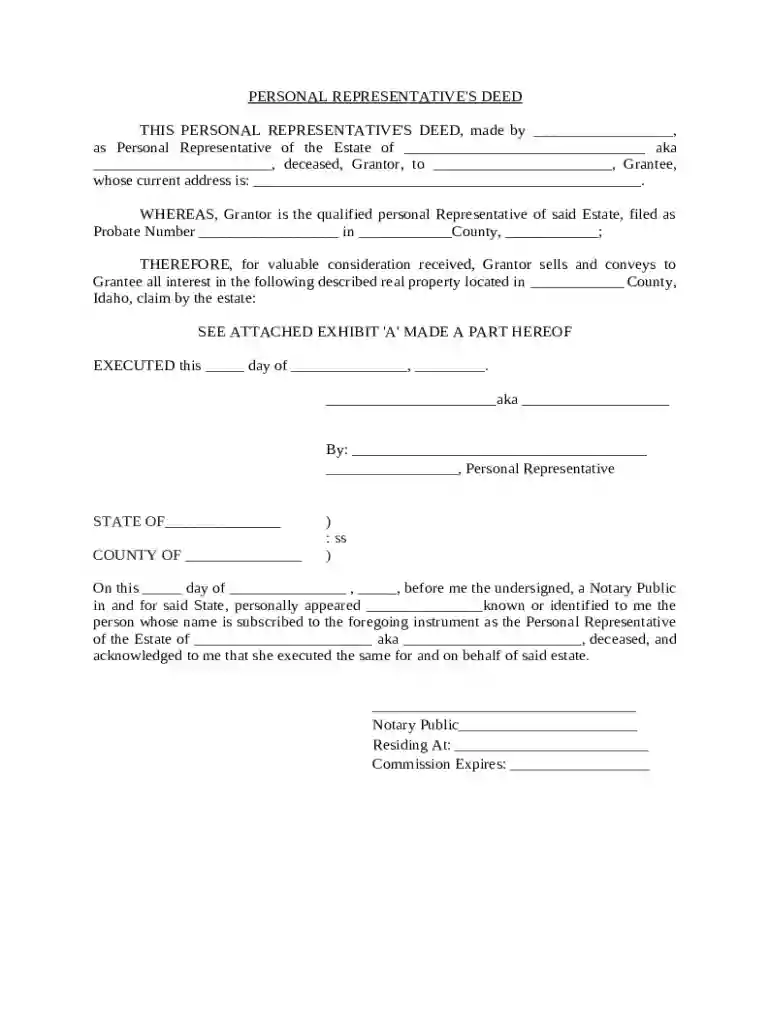
The Personal Representative's Deed is a legal instrument primarily used in estate planning and administration. This document allows a personal representative, either an executor or administrator, to transfer the decedent’s property title to the rightful heirs or beneficiaries. It signifies the transfer of ownership rights, clarifying the legal title from the decedent to the recipient. This deed is essential for managing estate settlements efficiently, providing a clear record of property conveyance.
The acquisition of a Personal Representative's Deed is a structured process involving both legal and administrative steps. Understanding the prerequisites can streamline the process and ensure compliance.
Probate Process Initiation: Begin the probate process through the court system to officially appoint the personal representative.
Appointment of Personal Representative: The court designates an executor or administrator based on a will or state intestacy laws.
Gather Necessary Documents: Prepare all relevant documents needed to support the deed application.
Filing with the Court: Submit the prepared deed and supporting documentation to the probate court.
Successfully completing a Personal Representative's Deed requires careful attention to detail and adherence to legal standards.
Verify Legal Compliance: Ensure the deed complies with state laws and probate requirements.
Accurate Property Description: Include a precise legal description of the property in question to avoid any ambiguity.
Complete the Deed Form: Fill out the deed form accurately, ensuring all sections are thoroughly completed.
Notarization and Witnessing: Have the deed notarized and witnessed as per state-specific requirements.
Filing with Recorder's Office: File the deed with the county recorder to perpetuate the transfer.
The Personal Representative’s Deed must include several specific elements to fulfill legal standards and effectively transfer property titles.
The Personal Representative’s Deed serves several legal functions that facilitate estate management and property rights transfer.
Understanding key terminology in estate law and the Personal Representative’s Deed is vital for effective navigation and application.
Procedural and legal requirements for creating and filing a Personal Representative’s Deed can vary significantly across states.
In summary, the Personal Representative’s Deed is a crucial legal instrument facilitating property transfer within estate administration. Each step, from understanding its definition and use cases to obtaining and legally completing the deed, is integral for a smooth transition from a decedent's estate to their heirs or beneficiaries. Being aware of key elements, legal uses, and state-specific variations ensures compliance and protection of all parties' rights involved.
At DocHub, your data security is our priority. We follow HIPAA, SOC2, GDPR, and other standards, so you can work on your documents with confidence.





Use a personal representatives deed to transfer real estate. After expenses of the estate and claims are paid, the PR must distribute assets according toRead more
To be used when there were no assets belonging to the decedent, and none were located (or came in) thereafter. (For attorneys use only).Read more
Jan 26, 2017 Under certain conditions, when a person dies the executor or personal representative of that persons estate can choose to value the quali fiedRead more


