





Definition & Meaning
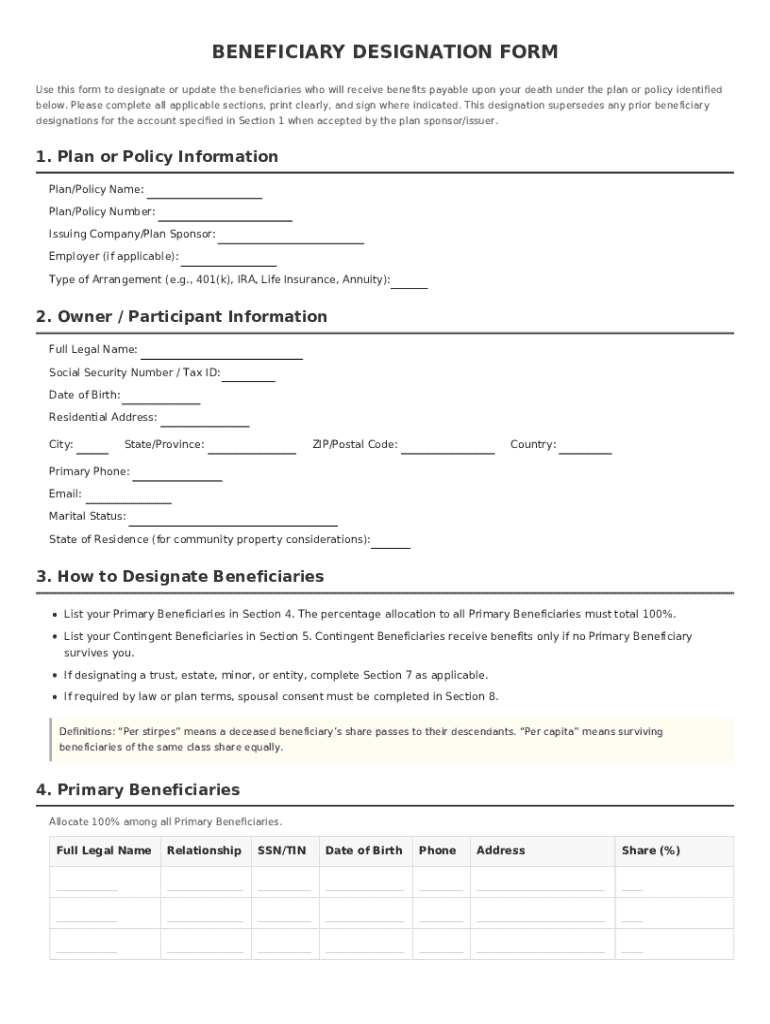
A Beneficiary Designation Form is a critical legal document utilized to specify individuals or entities entitled to receive the assets of an account holder upon their death. This form generally pertains to assets such as life insurance payouts, retirement accounts, or other financial holdings. By completing this form, account holders ensure that their assets are distributed according to their wishes, rather than defaulting to state inheritance laws.
Importance and Function
- Asset Distribution: The primary function is to direct the transfer of assets without the delays of probate.
- Legal Clarity: Provides a clear and binding record of an account holder's wishes.
- Avoids Conflicts: Minimizes potential disputes among heirs by clearly delineating beneficiaries.
Required Documents
Completing a Beneficiary Designation Form often necessitates providing supporting documentation to validate identity and asset ownership.
Typical Documents Needed
- Identification: A government-issued ID such as a driver’s license or passport for the account holder.
- Account Details: Documentation verifying the account for which the beneficiary is being designated.
- Beneficiary Information: Full names, contact information, and Social Security numbers (if applicable) of the beneficiaries.
How to Obtain the Beneficiary Designation Form
There are multiple avenues to access a Beneficiary Designation Form, depending on the financial institution or legal entity managing the account.
Common Sources
- Financial Institutions: Most banks or financial firms provide these forms directly through their customer service or online platforms.
- Insurance Companies: Insurers often have specific forms for policy beneficiaries.
- Online Access: Many institutions offer downloadable forms from their official websites for ease of access.
Steps to Complete the Beneficiary Designation Form
Completing this form accurately is paramount to ensure one's assets are managed according to personal wishes. Here’s a step-by-step guide:
- Gather Information: Collect all necessary personal and account details, including those of intended beneficiaries.
- Fill Out the Form: Enter all required information accurately, paying special attention to names and relationships.
- Specify Allocation: Indicate the percentage or assets each beneficiary is to receive.
- Review and Sign: Double-check all entries for accuracy, then sign the document as required.
- Submit: Return the completed document to the appropriate institution, following the submission guidelines provided.
Examples of Specific Steps
- Allocation Methods: Choose between per stirpes (by branch) or per capita (by head) distribution if applicable.
- Conditional Beneficiaries: Designate alternate beneficiaries in case primary beneficiaries cannot or do not wish to claim the assets.
Legal Use of the Beneficiary Designation Form
The legal implications of a Beneficiary Designation Form are significant, ensuring that the designated assets bypass probate and are distributed directly to the named beneficiaries.
Compliance and Regulations
- Adherence to State Laws: While generally standardized, specific legal interpretations can vary by state.
- Impact of Federal Laws: Compliance with ERISA and other federal regulations may be necessary for certain retirement accounts.
Key Elements of the Beneficiary Designation Form
Understanding the core components of this form can facilitate its accurate completion.
Primary Components
- Identification Section: Includes information about the account holder and account type.
- Beneficiary Details: Capture full details of each beneficiary, including percentage shares of the estate.
- Contingent Beneficiaries: Options for secondary beneficiaries, ensuring continued asset distribution plans.
State-Specific Rules for the Beneficiary Designation Form
Certain states have specific requirements or allowances regarding the completion and enforcement of these forms.
Examples of Variations
- Community Property States: May have unique stipulations for married account holders.
- Probate Laws: Differences in probate laws can affect how beneficiary forms are respected in estate planning.
Examples of Using the Beneficiary Designation Form
The utility of this form can be observed in various real-world scenarios, each serving different needs.
Practical Applications
- Insurance Policies: Directing life insurance proceeds to beneficiaries without tax implications.
- Retirement Accounts: Ensuring 401(k) or IRA assets are transferred effortlessly into beneficiaries’ accounts.
These examples highlight the versatility and necessity of Beneficiary Designation Forms in estate and financial planning, offering peace of mind and clarity for account holders and their heirs.