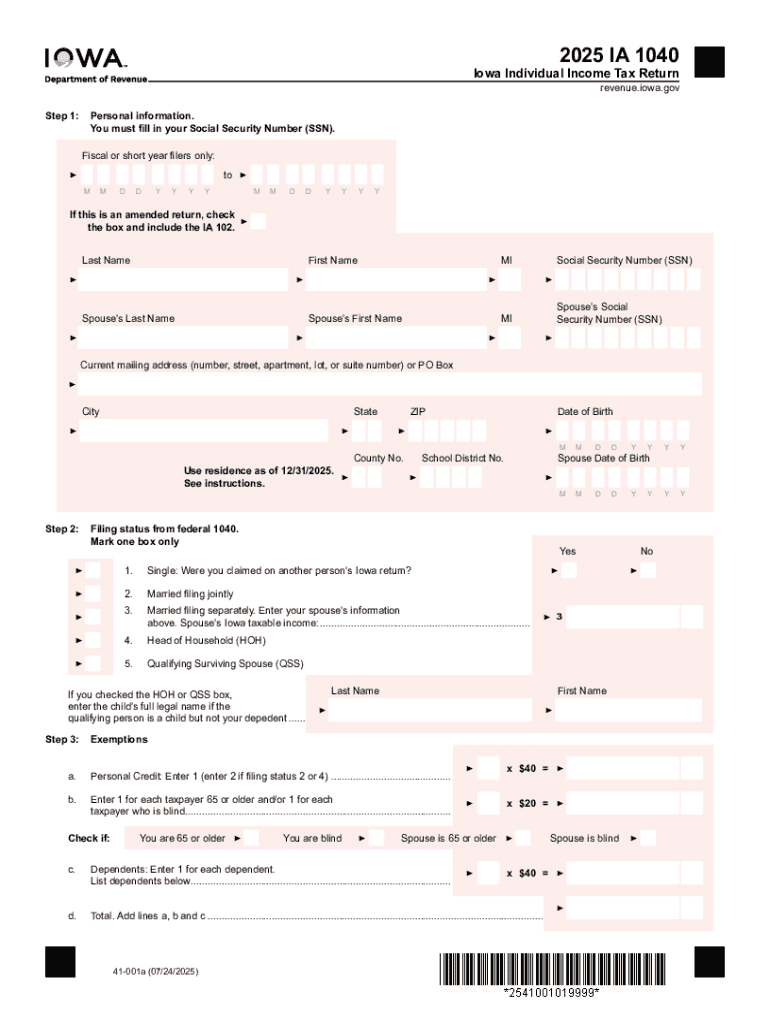







Definition and Purpose of the 2025 IA 1040 - Iowa Department of Revenue
The 2025 IA 1040 form, commonly known as the Iowa Individual Income Tax Return, is a critical document used by residents of Iowa to report their annual income and calculate their state income tax liability. This form is essential for taxpayers to determine any taxes owed or refunds due for the fiscal year. It collects detailed financial information, including income, deductions, credits, and tax payments already made. The form serves as an official record for the Iowa Department of Revenue to assess and verify the accuracy of a taxpayer's financial declarations.
How to Obtain the 2025 IA 1040 Form
To acquire the 2025 IA 1040 form, taxpayers have several options. The form can be downloaded directly from the Iowa Department of Revenue's website, ensuring easy access to the most recent version. Additionally, physical copies may be available at local libraries, post offices, and government buildings. For those who prefer digital solutions, tax preparation software like TurboTax or QuickBooks often includes the form as part of their package, allowing taxpayers to file electronically. Ensure you access the correct form version to avoid filing errors or discrepancies.
Steps to Complete the 2025 IA 1040 - Iowa Department of Revenue
Completing the 2025 IA 1040 involves a multi-step process that requires attention to detail.
-
Gather Necessary Documents: Before starting, collect all relevant documents, such as W-2s, 1099s, previous year's tax returns, and receipts for deductible expenses.
-
Personal Information: Enter your personal details, including your full name, Social Security Number, and filing status to verify your identity and filing conditions.
-
Income Reporting: Accurately report all sources of income, including wages, interest, dividends, and income from self-employment.
-
Deductions and Credits: Determine applicable deductions and tax credits. This may include student loan interest deductions, education credits, and dependent care credits.
-
Calculate Taxes and Payments: Calculate your total tax obligation, taking into account any state tax withholdings or prepayments you've already made.
-
Review and Sign: Carefully review your entries for accuracy. Once verified, sign and date the form as required.
-
Submission: Submit the completed form through your chosen method — electronically via e-filing services or by mailing a physical copy to the Iowa Department of Revenue.
Filing Deadlines and Important Dates for the 2025 IA 1040
The standard deadline for submitting the 2025 IA 1040 is April 15, 2026. Taxpayers need to file by this date to avoid late penalties. If April 15 falls on a weekend or holiday, the deadline is typically extended to the next business day. Taxpayers needing more time can request an extension, usually up to October 15, 2026, but it's important to note that any taxes owed are still due by the original April deadline to prevent interest charges.
Required Documents for Filing the 2025 IA 1040
Filing the IA 1040 requires a comprehensive set of documents, which helps ensure accurate and complete reporting of income and expenses.
- Income Statements: W-2s from employers, 1099s for freelance work, interest, and dividend statements.
- Proof of Payments: Documentation of estimated taxes paid or state tax withholdings.
- Deduction Records: Receipts for deductible expenses, such as medical costs, charitable contributions, and mortgage interest documentation.
- Credits Documentation: Eligibility documentation for any applicable credits like education credits or child tax credits.
Compile these documents in advance to streamline the filing process and help prevent mistakes.
Different Methods to Submit the 2025 IA 1040
Taxpayers can choose from various submission methods for their IA 1040 form:
-
Electronic Filing (e-Filing): This is the most popular method because it offers quicker processing times and faster refunds. Programs like TurboTax and H&R Block simplify this option.
-
Mailing a Paper Form: For those preferring traditional methods, forms can be mailed to the designated Iowa Department of Revenue address, ensuring they are postmarked by the filing deadline.
-
In-Person Submission: Some taxpayers may prefer the assurance of hand-delivering their forms to a local revenue office, where they can receive immediate confirmation of receipt.
Selecting the right submission method depends on individual preferences for convenience, speed, and security.
Key Elements of the 2025 IA 1040 Form
The IA 1040 form consists of several key elements critical to its completion:
-
Filing Status: Identifying whether you are single, married filing jointly, head of household, etc.
-
Income Section: Breakdown of income from various sources, including specific allocations for adjustments.
-
Deductions and Credits: Accurate reporting of claimable deductions and credits, with detailed instructions to ensure proper application and calculations.
-
Signatures: Mandatory section where the taxpayer must validate their filing with a signature, confirming all information to be accurate and complete to their knowledge.
Understanding these components is essential to successful form completion, as each affects the final tax obligation.
Common Taxpayer Scenarios for the IA 1040
Different scenarios impact how taxpayers file their IA 1040:
-
Self-Employed Individuals: Must report business income and expenses, often necessitating Schedule C completion.
-
Retired Taxpayers: May need to include social security, pension income, and manage IRA distributions for accurate reporting.
-
Students: Will benefit from understanding education credits and deductions that apply specifically to them.
-
Homeowners: Can deduct mortgage interest and property taxes if eligible.
These typical scenarios show the need for personalized approaches depending on individual circumstances, which impact deductions, credits, and overall tax liabilities.
Comprehensive understanding of these elements ensures that taxpayers can accurately file their returns, mitigate potential errors, and maximize any possible refunds.