






Definition & Purpose of the Texas Homestead Exemption
The Texas Homestead Exemption is a legal provision that allows homeowners to reduce the amount of property tax owed on their principal residence. This exemption is primarily designed to offer financial relief by lowering the taxable value of the home, thus decreasing the annual property taxes. More broadly, it serves to encourage home ownership and maintain property affordability for residents across Texas.
Included within this exemption are specific protections against creditors, although these do not extend to obligations such as mortgages, tax liens, or homeowners association fees. The exemption can vary in percentage, contingent on factors like the county of residence and any additional qualification criteria.
Steps to Complete the Texas Homestead Exemption Form
-
Collect Required Documents:
- Obtain documentation that verifies your ownership and primary residency, such as the deed or a recent utility bill.
-
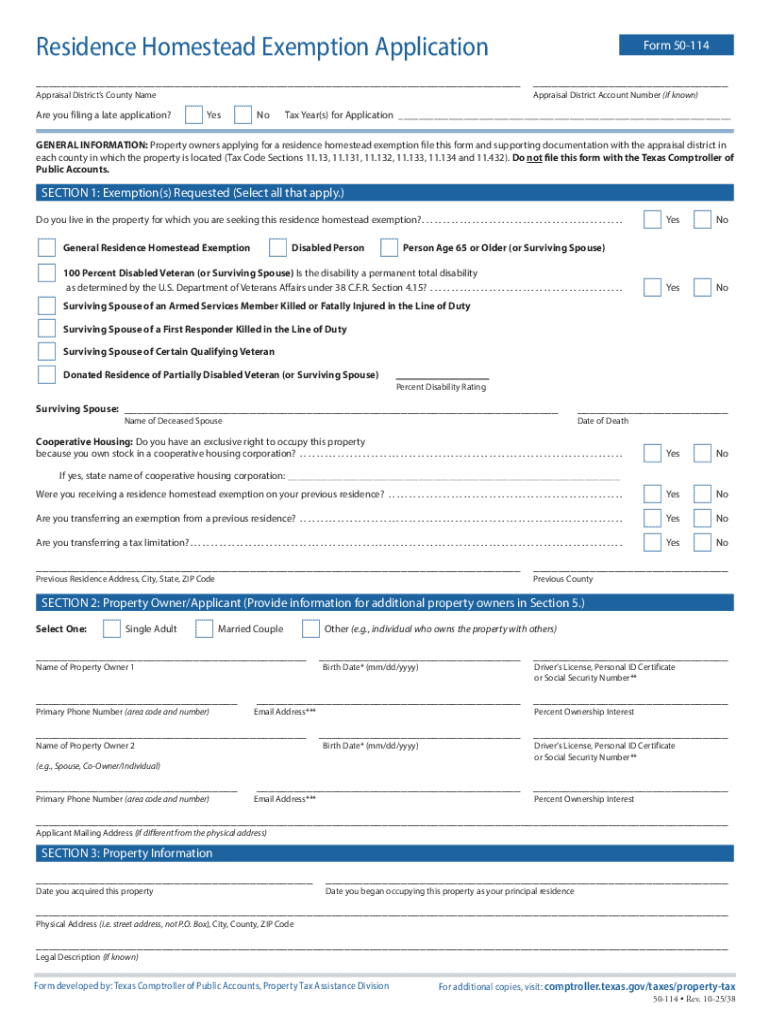
Fill Out the Application:
- Start with Form 50114 or its equivalent, paying careful attention to fields like Appraisal District Account Number and County Name.
-
Provide Additional Information:
- Specify whether you are filing a late application, and include any applicable tax year(s).
-
Verify and Submit:
- Double-check all information provided, ensuring accuracy before submitting the form. You may file the form online, via mail, or in person, depending on county options.
Eligibility Criteria for the Texas Homestead Exemption
To qualify for the Texas Homestead Exemption, homeowners must meet several essential criteria:
-
Primary Residence Requirement: The property must serve as the homeowner’s primary residence.
-
Ownership Proof: The homeowner must provide evidence of ownership, such as a title deed or tax statement.
-
Age and Disability Considerations: Additional exemptions are available for those over 65 or permanently disabled, often requiring supplementary documentation.


Required Documents for the Texas Homestead Exemption Application
Completing the Texas Homestead Exemption application necessitates several key documents:
-
Proof of Ownership: Legal documents like the title deed or a property tax bill asserting ownership status.
-
Proof of Residency: Current utility bills or a driver's license that matches the home's address.
-
Supplementary Documents: Any additional credentials for age-related or disability-based exemptions, like medical certificates or birth records.
State-Specific Rules for the Texas Homestead Exemption
There are particular state-centric regulations that impact the application and continuation of the Homestead Exemption in Texas:
-
Application Deadline: Generally, applications must be filed before April 30 of the tax year for which the exemption is sought.
-
Renewal Process: Once approved, homeowners typically do not need to renew annually unless their qualifying conditions change.
-
County Variations: Some counties may have specific additional rules or percentages concerning exemption calculations.
Processing and Approval Timeframe
Homestead Exemption applications benefit from a generally swift approval process:
-
Review Period: Applications are typically reviewed within one to two months from the filing date.
-
Notification: Approval or denial notifications are communicated by mail, detailing the effective tax year.
-
Reassessment: Any denied claims can usually be reassessed by providing additional documentation or clarification.
Important Terms and Definitions
Understanding key terms associated with the Texas Homestead Exemption can enhance the application process:
-
Appraisal District: The local governmental body responsible for appraising property values for tax purposes.
-
Exemption Percentage: The percentage by which the property’s assessed value is reduced to calculate tax liability.
-
Account Number: A unique identifier assigned by the appraisal district for property tracking and identification.
Differences Between Digital and Paper Forms
Both digital and paper applications are available for the Texas Homestead Exemption, each with its own advantages:
-
Digital Forms: Allow for ease of filing and potentially faster processing times due to electronic submission.
-
Paper Forms: Preferred by some for their simplicity and ease of access without digital resource requirements.
-
Hybrid Approaches: Some homeowners opt for digital and physical document retention, ensuring comprehensive records in both formats.
Examples of Using This Exemption
Real-world scenarios help illustrate typical applications of the Texas Homestead Exemption:
-
Scenario 1: Retirees: Retirees with fixed incomes often utilize the exemption to alleviate financial burdens from property taxes.
-
Scenario 2: Families: Homes as primary residences of growing families benefit from lower annual property taxes, aiding budget management.
-
Scenario 3: First-Time Homeowners: New homeowners can leverage the exemption to offset initial homeownership costs, making home ownership more achievable.
These sections cover a range of aspects related to the Texas Homestead Exemption, ensuring that homeowners are well-informed about the application process, eligibility requirements, and benefits involved.