






Definition and Meaning
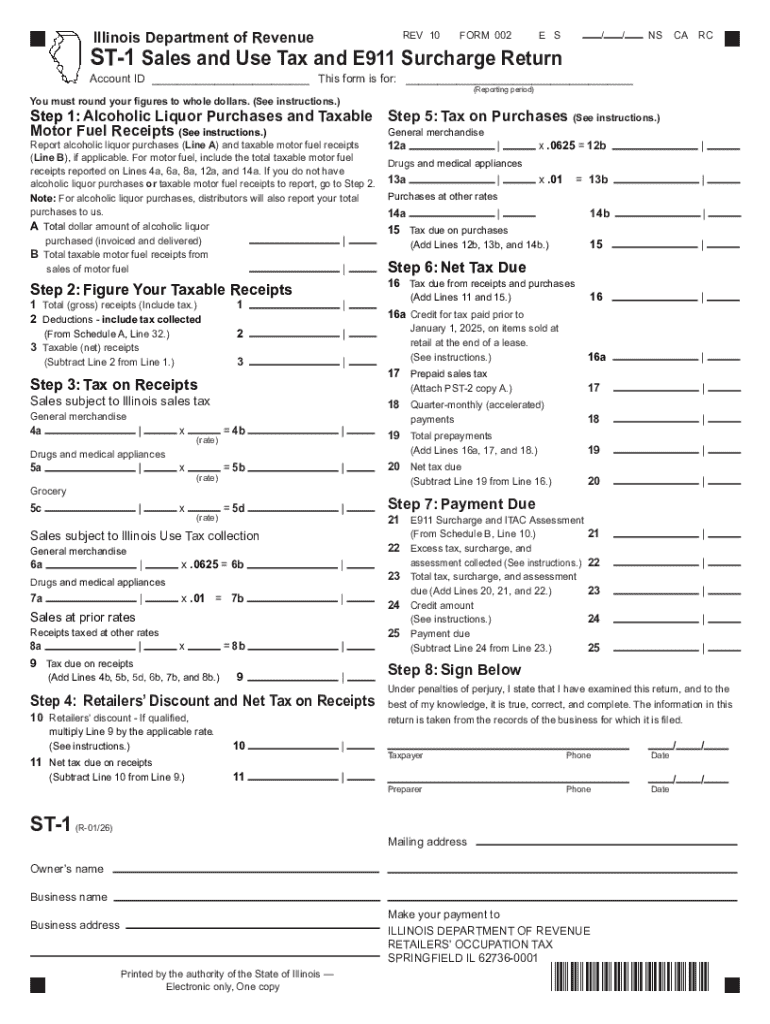
The ST-1, Sales and Use Tax and E911 Surcharge Return form is a crucial document used by businesses to report and remit sales and use taxes alongside the E911 surcharge. This form is primarily used within the United States to ensure compliance with state tax regulations and contribute to emergency services funding through the E911 surcharge. The form ensures that businesses accurately report their taxable sales and use activities, reflecting their obligation to collect and remit taxes in accordance with state laws.
Key Aspects
- Sales Tax: This is a tax levied on the sale of goods and services. Businesses collect this tax from consumers at the point of sale and remit it to the state.
- Use Tax: This refers to a tax imposed on the use, storage, or consumption of taxable goods and services when sales tax has not been collected.
- E911 Surcharge: An additional charge collected to fund emergency services infrastructure, primarily focusing on enhancing the 911 system.
How to Use the ST-1 Form
Filing the ST-1 form involves a structured approach to ensure accuracy and compliance. The process includes gathering necessary sales data, calculating taxes owed, and completing each section of the form meticulously.
Step-by-Step Process
- Gather Documentation: Collect records of all taxable sales, purchases, and any exemptions.
- Calculate Tax Owed: Use appropriate state tax rates to determine the sales tax, use tax, and E911 surcharge.
- Complete the Form: Carefully fill in each section with the required information. Use the 'Mouse' or 'Tab' key for navigation and input.
- Review and Sign: Verify all entries for accuracy. Authorized personnel should sign the form.
- Submit the Form: Depending on the state, submission can be done online, via mail, or in-person.
How to Obtain the ST-1 Form
The ST-1 form can be easily accessed through various channels, ensuring businesses can acquire it without hassle.
Acquisition Methods
- State Revenue Department Websites: Most state revenue departments provide downloadable PDFs of the ST-1 form.
- Tax Software Platforms: Tools like TurboTax and QuickBooks often have integrated access to required tax forms.
- Professional Tax Services: Tax professionals can supply clients with the necessary forms.
Steps to Complete the ST-1 Form
Ensuring the ST-1 form is filled out correctly is essential for maintaining compliance and avoiding penalties.
Detailed Instructions
- Identify the Filing Period: Mark the reporting period for which the taxes are being filed.
- Declare Total Sales: Enter the total sales amount collected during the period.
- Deduct Exempt Sales: Subtract any sales that are tax-exempt as per state guidelines.
- Compute Taxable Sales: Calculate the taxable amount after exemptions.
- Apply Tax Rates: Use stated tax rates to compute sales tax, use tax, and E911 surcharge owed.
- Complete Additional Sections: Fill out any supplementary information, like business details and payment method.
- Finalize and Submit: Ensure the form is duly signed and submitted by the deadline to avoid penalties.
Legal Use of the ST-1 Form
Using the ST-1 form correctly assures compliance with state regulations and contributes to infrastructure funding.
Points to Consider
- Legal Compliance: The ST-1 form must be completed and submitted as per state regulations to ensure compliance.
- Record Keeping: Maintain copies of submitted forms and corresponding records for audit purposes.
- Exemptions and Deductions: Accurately apply exemptions to prevent overpayment and disputes.
Filing Deadlines and Important Dates
Adhering to filing deadlines is critical to avoid penalties and interest charges on late payments.
Important Considerations
- Monthly, Quarterly, or Annually: Determine the filing frequency based on the business's sales volume and state requirements.
- State-Specific Deadlines: Each state has distinct filing deadlines; businesses must ascertain these dates to ensure timely compliance.
- Use of Reminders: Automated tools in DocHub and similar platforms can help track deadlines and send notifications.
Business Entity Types and Taxpayer Scenarios
Certain types of businesses, based on structure and operations, are required to file the ST-1 form.


Typical Users
- LLCs and Corporations: Businesses structured as Limited Liability Companies or Corporations are typically required to file.
- Partnerships and Sole Proprietorships: Depending on the state, these entities may also need to file an ST-1 form.
- Retail Businesses: Entities engaged in retail requiring frequent tax reporting.
State-Specific Rules for the ST-1 Form
Understanding state-specific regulations can aid businesses in meeting compliance requirements effectively.
Variations to Consider
- Different Tax Rates and Surcharge Amounts: Rates can vary between states and even between local jurisdictions.
- Unique Filing Requirements: Some states may have additional sections or documentation required.
- Additional State-Level Surcharge: Apart from the E911 surcharge, states may impose other surcharges relevant to disaster or emergency services funding.
Each of these sections ensures that the ST-1 form is used properly and compliance is maintained, providing thorough information that addresses practical needs and regulatory obligations.