






Definition & Meaning
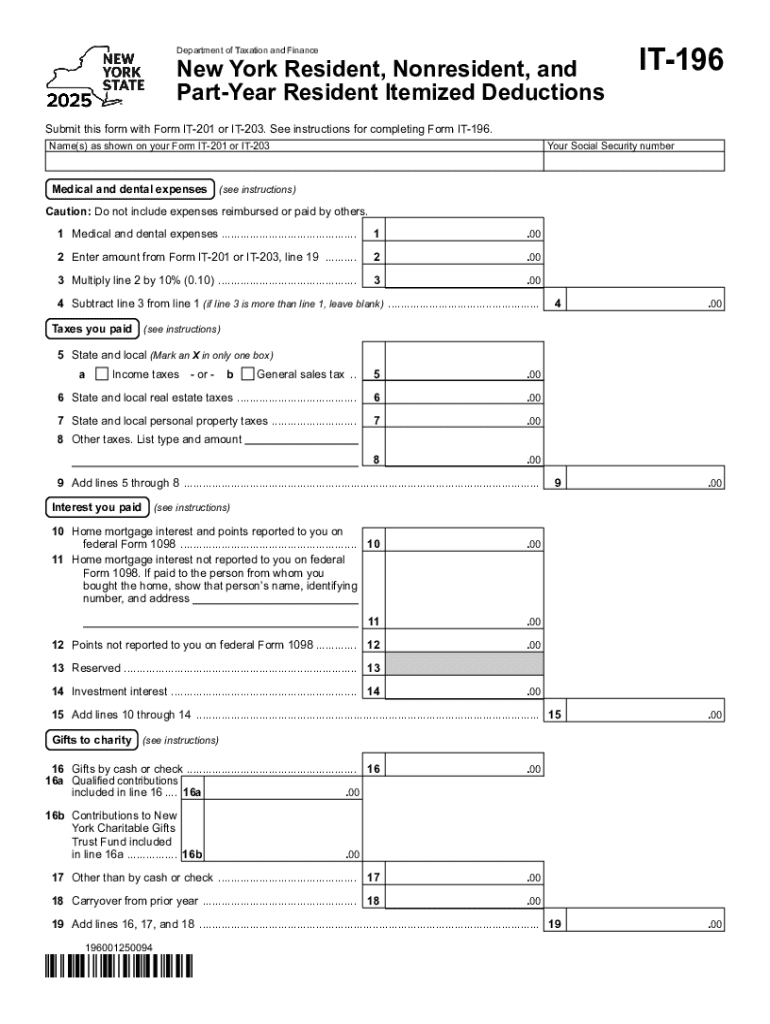
Form IT-196, also known as the New York Resident, Nonresident, and Part-Year Resident Itemized Deductions form, is used to itemize deductions for New York State tax purposes. This form is relevant for individuals who are subject to New York tax laws and prefer to itemize deductions rather than taking the standard deduction. It applies to residents, nonresidents, and part-year residents for the 2025 tax year. The primary purpose is to help taxpayers accurately calculate their taxable income by listing deductions that reduce their overall tax liability.
Examples of Itemized Deductions
- Medical and Dental Expenses: Deductible costs exceeding a specific percentage of your adjusted gross income.
- Taxes You Paid: Includes local real estate taxes and personal property taxes.
- Interest: Deductible mortgage interest and investment interest expenses.
- Charitable Contributions: Donations to qualified organizations, including cash and non-cash contributions.
Steps to Complete the Form IT-196
Completing Form IT-196 involves several steps that require careful attention to detail. Accurate information ensures proper calculation of deductions and tax liability.
- Gather Required Documents: Collect all necessary financial documents, such as receipts for deductible expenses, mortgage statements, and charitable donation confirmations.
- Fill Personal Information: Enter your full name, Social Security number, and filing status at the top of the form.
- List Itemized Deductions: Complete each section of the form to list deductions, ensuring that each entry corresponds to a valid tax-deductible expense.
- Calculate Totals: Add all itemized deductions to determine the total amount, which will offset taxable income.
- Submit with Relevant Forms: Attach Form IT-196 to your state tax return (Form IT-201 or IT-203) and mail or submit electronically by the filing deadline.
Common Errors to Avoid
- Incorrect Totals: Double-check arithmetic when adding deductions.
- Missed Deadlines: File before the deadline to avoid penalties.
- Documentation Errors: Ensure all supporting documents are accurate and complete.
Who Typically Uses the Form IT-196
Form IT-196 is utilized by a diverse group of taxpayers. Understanding who should use this form can help in determining its applicability to individual tax situations.
- New York Residents: Fully residing in New York during the tax year.
- Nonresidents with NY Income: Individuals living outside but earning income in New York.
- Part-Year Residents: Persons who moved in or out of New York within the tax year.
- Taxpayers Exceeding Standard Deduction: Those with itemized deductions surpassing the standard deduction amount.


Taxpayer Scenarios
- Self-Employed Individuals: May have business expenses deductible under state law.
- Retirees: Often have unique deductions related to retirement income.
- High-Income Earners: Likely to exceed standard deduction limits with higher charitable contributions or mortgage interest expenses.

Legal Use of the Form IT-196
Using Form IT-196 legally requires adherence to state guidelines and regulations for itemized deductions. It's critical for taxpayers to understand and comply with these laws to avoid legal issues.
Compliance Requirements
- Accurate Reporting: All information must be correct and supported by documentation.
- Adherence to State Limits: Ensure deductions align with New York State guidelines for itemized/specified deductibles.
- Proper Filing: File Form IT-196 with the appropriate New York tax return (IT-201 or IT-203).
Penalties for Non-Compliance
- Underreporting Deductions: Can lead to penalties and interest on unpaid taxes.
- Filing Late: May incur late fees and penalties unless a valid extension is filed.
Key Elements of the Form IT-196
The structure and content of Form IT-196 are pivotal in itemizing deductions efficiently. Key elements ensure the form serves its intended purpose effectively.
- Detailed Sections: Each deduction category has its own section, requiring specific entries.
- Summary Totals: A final section that aggregates all deductions into a comprehensive total.
- Instructions and Guidelines: Accompanying instructions clarify form completion and submission.
Important Sections
- Medical Expenses: Capture eligible health-related costs.
- Interest and Mortgage Deductions: Record deductible interest from loans.
- Charitable Contributions: Detail donations made to recognized entities.
- Miscellaneous Deductions: Capture any deductions that do not fit standard categories.
State-Specific Rules for Form IT-196
New York State maintains distinct rules for the deduction items listed on Form IT-196, influencing how taxpayers complete the form.
Unique Considerations
- Local Taxes: Differences in how state and local taxes are itemized compared to federal returns.
- Mortgage Deductions: Specificities in mortgage interest deductibility due to state regulations.
- Charitable Contributions: Rules regarding accepted types of charitable organizations.
Exemptions and Exceptions
- Tax Thresholds: New York may have lower/higher thresholds than federal standards.
- Local Tax Law Variations: Changes in laws may affect deductions from year to year.
Filing Deadlines / Important Dates
Timely filing of Form IT-196 is essential to avoid interest and penalties. Familiarity with relevant dates can ensure compliance.
- Filing Deadline: Generally aligns with the federal deadline of April 15th unless otherwise specified.
- Extension Requests: File for an extension if additional time is required, usually granting a six-month period.
Consequences of Missing Deadlines
- Late filings may result in penalties.
- Missed deadlines without extensions lead to accrued interest.
Required Documents
Completing Form IT-196 necessitates certain documents, which must be collected and verified before submission.
Essential Documentation
- Mortgage Interest Statements: 1098 forms from lenders.
- Charitable Donation Receipts: Proof of contributions.
- Medical Bills: Statements covering eligible medical costs.
Importance of Documentation
- Verification: Supports information provided on the form.
- Record-Keeping: Essential for audits and future tax filings.
Digital vs. Paper Version
Choosing between a digital or paper version of Form IT-196 depends on personal preference and technological resources.
Digital Submission
- Ease of Use: Complete and submit online.
- Faster Processing: Typically results in quicker confirmation and refund processing.
Paper Submission
- Traditional Approach: Preferred by those uncomfortable with electronic filing.
- Physical Records: Maintains a hard copy for personal records.
Both digital and paper submissions require the same attention to detail and accuracy to ensure proper processing and approval.