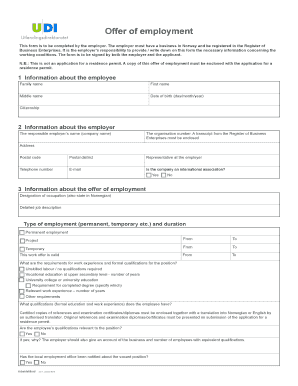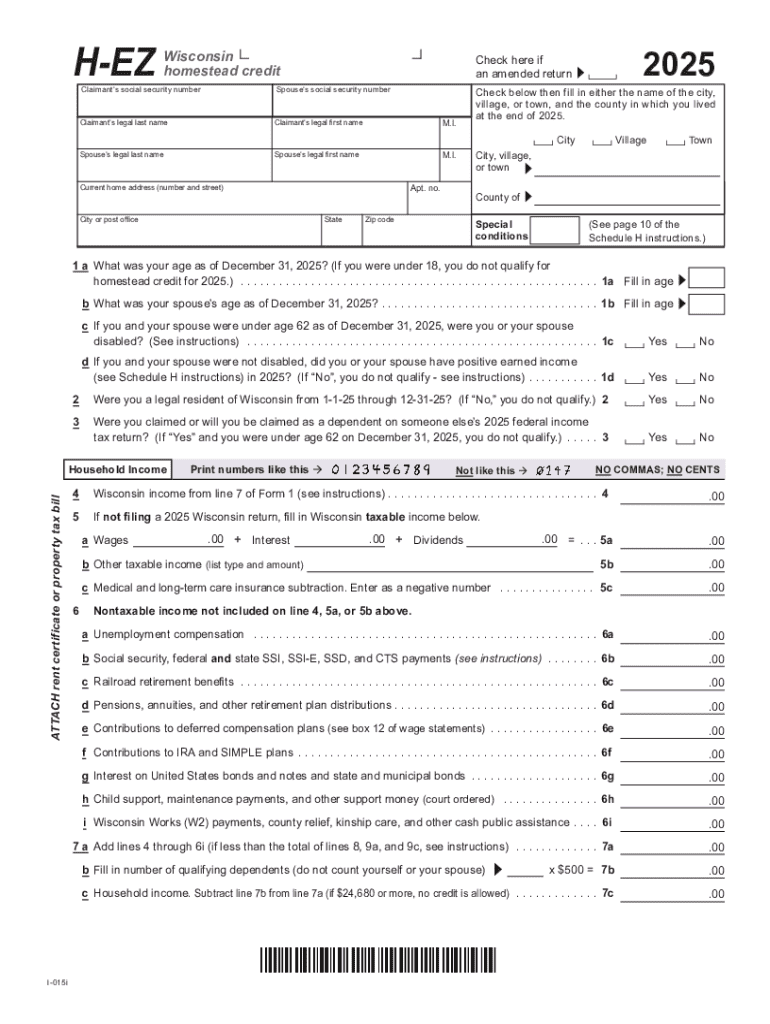





Homestead Credit Tax Year 2024 - Fact Sheet 1116 revenue-2026

Get Form
Homestead Credit Tax Year 2024 - Fact Sheet 1116 revenue Preview on Page 1

Here's how it works

01. Edit your form online
Type text, add images, blackout confidential details, add comments, highlights and more.
02. Sign it in a few clicks
Draw your signature, type it, upload its image, or use your mobile device as a signature pad.
03. Share your form with others
Send it via email, link, or fax. You can also download it, export it or print it out.

Definition & Meaning

The Homestead Credit Tax Year 2024 - Fact Sheet 1116 revenue refers to a tax form designed to assist eligible homeowners with property tax relief. This credit is typically linked to the homeowner’s income and property taxes paid, offering a reduction in tax liability to ease the financial burden of homeownership. It underscores the importance of property tax credits in managing the costs associated with owning a home, particularly for low- to middle-income individuals and families.

Eligibility Criteria

Eligibility for the Homestead Credit involves key factors such as income level, residency requirements, and property ownership status. Typically, applicants must meet the following criteria:

  • Be a legal resident of the state where the credit is claimed.
  • Own and occupy the home as the primary residence.
  • Meet specific income thresholds, which may vary by state or locality.

Each state may have its variations on these criteria, necessitating detailed attention to local requirements.


decoration image ratings of Dochub

Steps to Complete the Homestead Credit Tax Year 2024 - Fact Sheet 1116 Revenue

  1. Gather Required Documents: Collect all necessary financial documents, such as proof of income, property tax statements, and identification proving residency and homeownership.
  2. Review State Guidelines: Familiarize yourself with specific state instructions and requirements for the credit.
  3. Fill Out the Form: Complete Fact Sheet 1116 by accurately entering all relevant information, ensuring compliance with instructions.
  4. Double-Check for Accuracy: Verify that all details are correct to prevent delays or rejections.
  5. Submit the Form: Choose the correct submission method, either online or via mail.

Required Documents

  • Proof of homeownership (e.g., deed or mortgage statement)
  • Income documentation (e.g., W-2s, pay stubs)
  • Residency confirmation (e.g., driver’s license, utility bills)
  • Prior year’s state and federal tax returns
  • Property tax payment receipts

These documents are essential to validate eligibility and ensure proper credit calculation.

Filing Deadlines / Important Dates

The filing deadline typically aligns with the state’s tax filing deadlines, often falling on April 15, unless extensions apply. It is vital to check state-specific dates to avoid missed opportunities for claiming the credit. Late submissions may result in denial or delayed processing.

Form Submission Methods (Online / Mail / In-Person)

The form can be submitted in several ways to accommodate different preferences and technological access:

  • Online: Many states offer digital submissions via their tax departments’ websites.
  • Mail: For those preferring paper submissions, forms can be mailed to the designated state tax office.
  • In-Person: Some locations may allow direct submission at local tax offices, especially for complex cases needing further assistance.

State-Specific Rules for the Homestead Credit Tax Year 2024

Individual states may implement unique rules affecting the application process and eligibility for the Homestead Credit. This can include:

  • Specific income limits
  • Additional documentation requirements
  • Variations in property or residency qualifications

Understanding these differences is crucial for accurate and successful application.

Legal Use of the Homestead Credit Tax Year 2024 - Fact Sheet 1116 Revenue

This form is legally used to claim a reduction in state property taxes. It ensures that homeowners receive entitled benefits aimed at reducing the effective tax rate they owe based on their income and living situation. Misuse or falsification of information on this form can result in penalties, making accuracy and honesty paramount for compliance.

Key Elements of the Homestead Credit Tax Year 2024

Several essential components make up the Homestead Credit process:

  • Income Calculation: Determines eligibility based on total household income.
  • Property Tax Documentation: Supports the calculation of the credit amount.
  • Residency Verification: Ensures that the credit is applied only to primary residences.

Understanding and accurately completing each element is necessary for obtaining the full benefit of the credit.

be ready to get more

Complete this form in 5 minutes or less

Get form

Got questions?

We have answers to the most popular questions from our customers. If you can't find an answer to your question, please contact us.
Contact us
Who qualifies for a homestead exemption? You must own the home. It must be your primary residence. You usually need to apply within a set time frame. Some states allow doubling. Aug 21, 2025
In Arkansas, a homestead qualifies as your principal residence, with specific acreage limits and value caps for tax exemption (up to $2,500 equity, max 1 acre urban or 160 acres rural, with minimums of 1/4 acre or 80 acres) and a property tax credit (up to $500-$600 depending on year) on your home and lot, requiring application to the county assessor. Eligibility depends on ownership (including life estates or trusts), occupancy as your main home, and applying annually for credits, with potential extra relief for seniors or disabled persons. Key Qualification Factors Principal Residence: It must be your primary, legal residence, not a rental or second home. Ownership: You must be the record owner, have a recorded life estate, or be a buyer under a recorded sales contract. Dwellings in trusts can also qualify. Occupancy: You must actually live there. Application: You must apply for the credit with your county assessors office. Types of Exemptions Credits Homestead Tax Credit: A direct credit on your property tax bill (up to $500 or $600 for 2026+), applied to the home and up to one acre. Homestead Exemption (Bankruptcy/Creditor Protection): Urban: Up to 1 acre (minimum 1/4 acre), with a $2,500 equity limit (but not reduced below the minimum acreage). Rural: Up to 160 acres (minimum 80 acres), with a $2,500 equity limit (but not reduced below the minimum acreage). Additional Benefits: Special benefits (like a tax freeze) may be available for disabled individuals or those 65 and older. What Doesnt Qualify Commercial properties Investment properties Rental properties Second homes For legal advice, consult a professional. Property Tax Relief Arkansas Department of Finance and Homeowners in Arkansas may receive a homestead property tax credit of up to $500 per year. Beginning with the 2026 tax bills the gArkansas Department of Finance and Administration (.gov)Arkansas Homestead Tax Credit: How It Works and How to Claim It in 2026Feb 4, 2026 A buyers interest in the property under a recorded purchase agreement. A life estate in the property. The credit does RMP Law
Bipartisan American Homeownership Opportunity Act of 2025 First-time homebuyers may claim a tax credit equal to the amount of the down payment up to $50,000, subject to income limitations.
In Wisconsin, a homestead is your primary residence (owned or rented) and up to one acre of land, or up to 120 acres if its a farm, serving as a key concept for property tax relief (Homestead Credit) and creditor protection (Homestead Exemption). The property must be occupied by you as your home, and it can be a house, mobile home, apartment, or even a nursing home room, but generally excludes business-used portions or separate units rented out. Homestead for Property Tax Relief (Homestead Credit) Purpose: Reduces property tax burden for low-to-moderate-income residents. Definition: Your dwelling and up to one acre (or up to 120 acres if a farm) that you occupy, rent, or own. Eligibility: Requires meeting income, residency, age, and other criteria, with benefits calculated based on income and property taxes/rent paid. Homestead for Creditor Protection (Homestead Exemption) Purpose: Protects a portion of your homes equity from certain creditors. Definition: Your dwelling and surrounding land (up to 40 acres) necessary for its use. Exemption Amount: Protects up to $75,000 in equity per person, with spouses able to combine exemptions for up to $150,000 in equity. Requirements: Both spouses must generally sign documents for homestead property, and the exemption doesnt cover mortgages, mechanics liens, or taxes. In essence, homestead refers to your primary home for both state tax benefits and legal protection, with slightly different acreage rules for the credit versus the exemption. For financial advice, consult a professional. DOR Homestead Credit - Definitions - Wisconsin Department of RevenueYour homestead is the Wisconsin home you occupy, whether you own it or rent it, and up to one acre of land adjoining it (or up to Wisconsin Department of Revenue (.gov)Homestead Credit Tax Year 2025 - Wisconsin Department of RevenueQualifications. You may be able to claim homestead credit if: You occupied and owned or rented a home, apartment, or other dwellWisconsin Department of Revenue (.gov)
One of the key requirements is occupancy status homestead exemptions are typically only available for primary residences. Some other factors that may impact eligibility include your age and income, as well as your marital, veteran or disability status.

Security and compliance

At DocHub, your data security is our priority. We follow HIPAA, SOC2, GDPR, and other standards, so you can work on your documents with confidence.

Learn more
ccpa2
pci-dss
gdpr-compliance
hipaa
soc-compliance

People also ask

$24,680
A $6,000 tax credit/deduction refers to a new, temporary federal benefit for seniors (age 65+) for tax years 2025-2028, allowing an extra deduction up to $6,000 per person ($12,000 for couples) on top of standard deductions, reducing taxable income if Modified Adjusted Gross Income (MAGI) is below specific limits (phasing out above $75k single/$150k joint). This is an additional deduction, not a credit, available for both itemizers and standard filers who meet age and income requirements, requiring their SSN on the return. Who Qualifies? Age: Must be 65 or older by the end of the tax year. Filing Status: If married, must file jointly. Income Limits (MAGI): Starts phasing out at $75,000 (single) / $150,000 (joint). Phases out completely at $175,000 (single) / $250,000 (joint). Requirement: Must include the Social Security Number (SSN). How It Works (Its a Deduction, Not a Credit) Its an extra deduction, not a tax credit, meaning it lowers your taxable income, not your tax bill dollar-for-dollar. Its in addition to the existing extra standard deduction for seniors (e.g., $2,000 for single seniors). It stacks with the basic standard deduction. Example for a Single Senior (2025) Basic Standard Deduction: $15,750 Existing Senior Standard Deduction: +$2,000 New $6,000 Senior Deduction: +$6,000 Total Potential Deduction: $23,750 (if income allows). Key Takeaway: This temporary senior bonus deduction, available for tax years 2025 through 2028, provides a DocHub income reduction for eligible seniors by adding to existing age-related tax breaks, say Kiplinger, the Peter G. Peterson Foundation, Investopedia, and the IRS. For financial advice, consult a professional. One, Big, Beautiful Bill Act: Tax deductions for working Americans Jul 14, 2025 Deduction for Seniors * New deduction: Effective for 2025 through 2028, individuals who are age 65 and older may claiIRS (.gov)Understanding the New Senior Deduction in OBBBAJan 22, 2026 The new senior deduction allows seniors to deduct from taxable income, up to $6,000 individually or $12,000 if marriedPeter G. Peterson Foundation
Ohios Homestead Exemption offers property tax relief for seniors (65+), permanently disabled homeowners, and qualifying disabled veterans, exempting a portion of their homes value (e.g., $29,000 standard, $58,000 enhanced for veterans) from taxation, providing a credit on tax bills for their primary residence, with income limits for new applicants and applications submitted to the county auditor. Who Qualifies? Senior Citizens: Own and occupy as primary residence, age 65+, with income under $40,000 (for new 2024 filers). Disabled Homeowners: Permanently and totally disabled, own/occupy as primary residence, income limits apply for new filers. Disabled Veterans: 100% service-connected disability or receiving compensation at 100% rate. Surviving Spouses: Of a qualifying disabled person or a public safety officer killed in the line of duty. How it Works Value Exemption: The program shields a portion of your homes market value from property taxes (e.g., $29,000 for standard, $58,000 for veterans). Tax Credit: This reduction appears as a credit on your property tax bill, lowering your tax amount. Primary Residence: Must own and live in the home as your main residence as of January 1st of the application year. How to Apply Forms: Obtain the DTE 105A (Homestead Application) and possibly a DTE 105E (Disability Certificate) from your Butler County Auditor website. File: Submit the application and forms to your County Auditors office by mail or online by December 31st of the year you want the exemption to start. No Annual Re-application: Once approved, youll receive a continuing application each year. Key Points Income: For new senior/disabled applicants (first filing in 2024), theres an income limit of $40,000 or less. Veterans: Receive an enhanced exemption ($58,000 value) regardless of income if 100% disabled. Contact: Check with your specific Butler County, Stark County, or Lake County auditor for local details and forms. Homestead Exemption - Stark CountyThe homestead exemption allows senior citizens and permanently and totally disabled Ohioans with previous years household income Stark County, Ohio (.gov)Homestead Exemption Program | Greene County, OH - Official WebsiteThe Homestead Exemption Program is a real estate tax reduction available to senior citizens, disabled persons, or a surviving spouGreene County (.gov)

Related links