






Definition and Meaning of the 2025 Schedule 2 (Form 1040) (sp) Additional Taxes (Spanish Version)
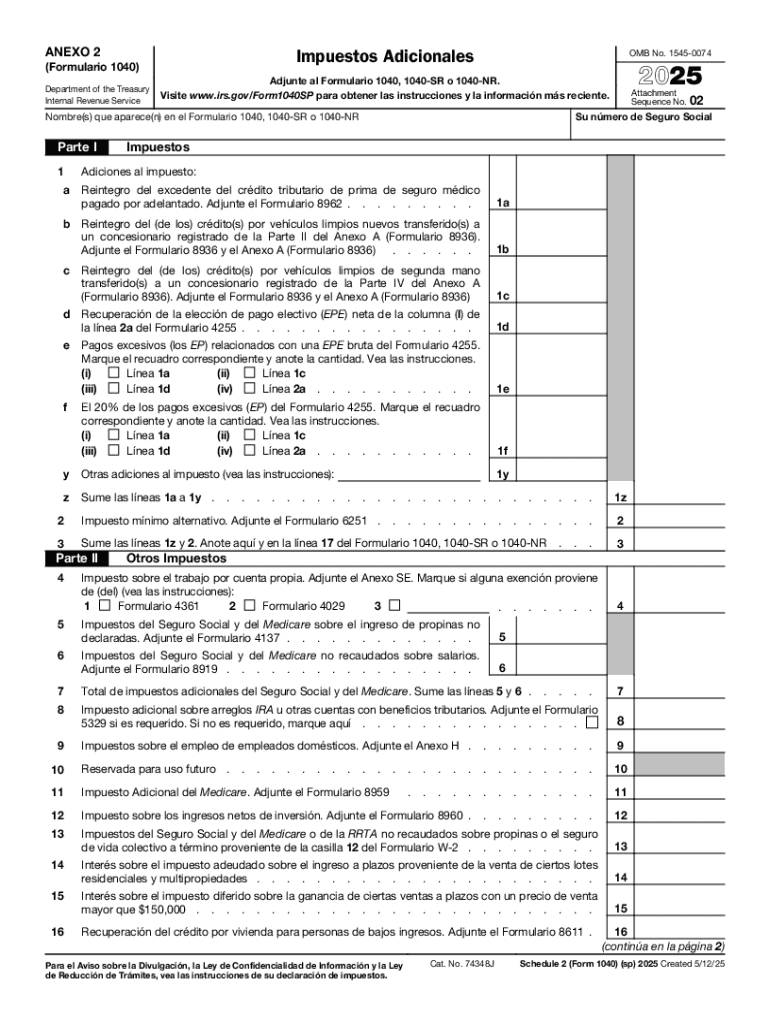
The 2025 Schedule 2 (Form 1040) (sp) titled "Impuestos Adicionales" is a supplemental form to the primary IRS Form 1040. This form is used by taxpayers to report additional taxes they are liable for, which are not covered on the main Form 1040. These can include alternative minimum tax, excess advance premium tax credit repayments, and certain other types of taxes that require itemized reporting.
Key Components of the Form
- Alternative Minimum Tax (AMT): This section captures AMT which ensures that taxpayers with certain tax benefits pay at least a minimum amount of tax.
- Excess Advance Premium Tax Credit Repayment: Applicable to those who have received more premium tax credits than they qualify for and must repay the difference.
- Self-Employment Tax: This portion is crucial for self-employed individuals, capturing their social security and Medicare tax obligations.
- Household Employment Taxes: Relevant if you've employed household workers and need to report associated taxes.
How to Use the 2025 Schedule 2 (Form 1040) (sp) Additional Taxes (Spanish Version)
For accurate form completion, users should familiarize themselves with the potential taxes that could apply to their situation. The form's purpose is to detail additional tax liabilities that can affect the taxpayer's total tax obligation.
Step-by-Step Instructions
- Identify Applicable Taxes: Review each item on Schedule 2 to determine which taxes affect you.
- Gather Financial Data: Have all necessary financial documents ready, including previous tax returns, relevant income statements, and any records of tax credits received.
- Accurate Entry: Using your financial data, fill in the amounts for each applicable tax section.
- Carry Forward Totals: Ensure that values inputted on Schedule 2 are accurately incorporated into the primary Form 1040 to finalize your tax liability.
Steps to Complete the 2025 Schedule 2 (Form 1040) (sp) Additional Taxes (Spanish Version)
Completing Schedule 2 is methodical, necessitating careful documentation and precision. The form's structured layout helps guide taxpayers through the various additional tax obligations.
Detailed Process
- Line-by-Line Completion: Address each line item individually, ensuring that calculations for taxes like AMT or self-employment taxes are accurately performed.
- Verification: Double-check figures with financial records to confirm accuracy.
- Transfer: Integrate totals from Schedule 2 into Form 1040, ensuring no discrepancies between forms.
Key Elements of the 2025 Schedule 2 (Form 1040) (sp) Additional Taxes (Spanish Version)
Accurate reflection of additional taxes is paramount when utilizing Schedule 2.
Critical Sections
- AMT Calculations: Ensure correct computation of AMT using provided formulas or software assistance.
- Repayment Calculations: For those paying back excess credits, ensure proper calculations to avoid penalties.
- Documentation of Business-Related Taxes: If self-employed, ensure all relevant taxes are compiled accurately.
Important Terms Related to 2025 Schedule 2 (Form 1040) (sp) Additional Taxes (Spanish Version)
Understanding specific terminology aids compliance and accuracy.
Frequently Used Terms
- Premium Tax Credit (PTC): A subsidy for insurance premiums; excess credits must be repaid.
- Itemized Reporting: Detailed documentation of specific transactions or items necessary for particular taxes.
- Tax Liability: The total amount owed by a taxpayer, including regular and additional taxes.
IRS Guidelines for the 2025 Schedule 2 (Form 1040) (sp) Additional Taxes (Spanish Version)
The IRS provides detailed guidelines to assist taxpayers in understanding and utilizing Schedule 2 effectively.
Understanding IRS Regulations
- Publication References: IRS provides publications outlining specific instructions for taxes associated with Schedule 2.
- Updates and Changes: Annually, IRS updates forms and publications; ensure you're utilizing the current year's version.
- Compliance Requirements: Comply with outlined IRS guidelines to avoid errors and potential audits.
Who Typically Uses the 2025 Schedule 2 (Form 1040) (sp) Additional Taxes (Spanish Version)
While many taxpayers use Form 1040, certain situations necessitate the additional use of Schedule 2.


Eligible Taxpayer Scenarios
- Self-Employed Individuals: Often owe self-employment taxes captured on Schedule 2.
- High-Income Taxpayers: More likely to incur AMT, requiring detailed reporting.
- Recipients of Excess PTC: Must use this form to report repayment obligations.

Penalties for Non-Compliance with 2025 Schedule 2 (Form 1040) (sp) Additional Taxes (Spanish Version)
Failure to accurately report taxes via Schedule 2 can lead to significant penalties.
Potential Penalties
- Filing Penalties: Imposed for late or incorrect filing.
- Underpayment Penalties: Arise from inaccurate tax payments due to incorrect reporting of additional taxes.
- Audit Risks: Inaccuracies may trigger IRS audits, leading to further scrutiny and potential penalties.
Software Compatibility with 2025 Schedule 2 (Form 1040) (sp) Additional Taxes (Spanish Version)
Specific tax software solutions are equipped to support tax preparation, including Schedule 2.
Compatible Tax Software
- TurboTax and QuickBooks: These programs seamlessly integrate Schedule 2, providing guidance and error-checking capabilities.
- Software Benefits: Automation of calculations, simple amendment processes, and user support for complex entries.
State-by-State Differences for the 2025 Schedule 2 (Form 1040) (sp) Additional Taxes (Spanish Version)
Although federal in focus, state tax obligations can influence Schedule 2.
How States Impact Schedule 2
- State Taxes vs. Federal Taxes: Understand differences in state-specific tax regulations that might affect federal reporting.
- Dual Reporting Requirements: Some states may have parallel forms for additional taxes; awareness is crucial for comprehensive compliance.
Business Types that Benefit Most from the 2025 Schedule 2 (Form 1040) (sp) Additional Taxes (Spanish Version)
Certain business structures frequently utilize Schedule 2 due to specific tax liabilities.
Applicable Business Entities
- LLCs and Sole Proprietorships: These entities often have self-employed individuals who must fulfill Schedule 2 reporting requirements.
- C and S Corporations: Businesses may have AMT obligations, necessitating this form.