






Definition & Meaning
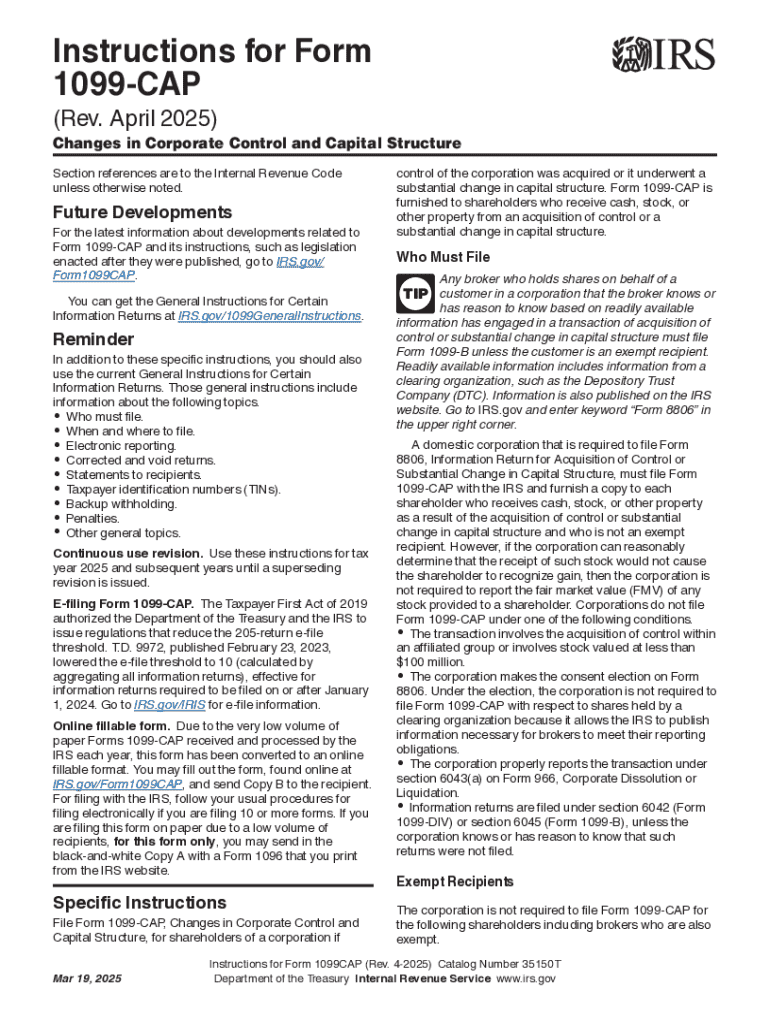
Form 1099-CAP, changes in corporate control and capital, is a document used to report changes in the control or capital structure of a corporation that affects shareholders. This form is issued when certain transactions result in either significant changes in ownership or capital adjustments impacting shareholders' financial interests. It ensures transparency and helps both the IRS and shareholders keep track of corporate changes that might influence tax obligations or investment decisions.
Key Elements of Form 1099-CAP
- Issuer Information: Provides the name and contact details of the corporation initiating the changes.
- Shareholder Details: Includes personal information about the shareholders affected by the changes.
- Corporate Event Description: Details the nature of the change or transaction, such as mergers or recapitalizations.
- Impact Summary: Describes how changes impact shareholder value or cost basis.
How to Use Form 1099-CAP
Shareholders use Form 1099-CAP to understand how changes in a corporation’s capital structure affect their investments. It's crucial for identifying potential tax obligations resulting from corporate actions. Shareholders must retain this form for record-keeping and reporting purposes during tax filing.
Application Examples
- Mergers: When two corporations combine, resulting in a shift of control.
- Stock Acquisitions: When a significant number of shares are bought, altering corporate control.
- Corporate Restructuring: Including spin-offs that affect shareholder equity.
Who Typically Uses the Form 1099-CAP
Typically, corporations involved in significant ownership or capital structure changes issue Form 1099-CAP to their shareholders. Shareholders receiving this form include individual investors, institutional investors, and entities like trusts or estates with a stake in the affected corporation.


Business Types Benefitting Most
- Corporations undergoing mergers or acquisitions.
- Companies with active restructuring plans.
- Firms experiencing significant shifts in investor ownership.
Steps to Complete Form 1099-CAP
- Filling Out Corporate Information: Provide accurate company details including EIN, name, and address.
- Describing the Event: Clearly explain the nature of the corporate change.
- Detailing Shareholder Impacts: List affected shareholders and describe changes to their investments.
- Verification and Submission: Ensure accuracy before submitting the form to both the IRS and shareholders.
Submission Methods
- Online: Through the IRS e-file system.
- Mail: Directly to shareholders and the IRS.
- In-Person: Less common but possible through direct mailing services.
Key Terms Related to Form 1099-CAP
Understanding specific terminology is vital for accurate form completion and compliance:
- Change in Control: Situations where ownership shifts significantly.
- Capital Structure: The composition of corporate equity and debt.
- Shareholder of Record: Individuals or entities registered as current shareholders.
Common Terms
- Recapitalization: Reorganization of a company’s capital structure.
- Leveraged Buyout (LBO): Acquisition of a company using borrowed funds.
- Equity Swap: Exchange of ownership positions.
Why Use Form 1099-CAP
Form 1099-CAP ensures legal compliance with federal regulations concerning corporate changes. It provides transparency to shareholders and the IRS, affirming the corporation’s commitment to honesty in financial reporting. This is essential not only for compliance but also for maintaining investor confidence.
Legal Use and Compliance
- Required by law for reporting qualifying corporate changes.
- Helps mitigate tax liabilities resulting from investment fluctuations.
IRS Guidelines & Filing Deadlines
The IRS provides specific guidelines for completing and distributing Form 1099-CAP to ensure accurate record-keeping across stakeholders. Compliance with filing deadlines is critical to avoid penalties.
Important Deadlines
- General Filing: Due to the IRS and shareholders by January 31 of the year following the transaction.
- Extensions: Possible, but must be requested before the initial deadline.
Penalties for Non-Compliance
Failure to properly file Form 1099-CAP can lead to penalties. These can vary based on the severity and duration of the delay, with escalating fines for intentional disregard.
Avoiding Penalties
- Ensure timely and accurate filing.
- Maintain rigorous internal checks on document accuracy before submission.
Form Submission Methods
The IRS accommodates both electronic and paper filing submissions for Form 1099-CAP, helping to ensure compliance through various methods.
Digital vs. Paper Versions
- Digital Submission: Faster processing and confirmation.
- Paper Filing: Traditional method requiring physical mailing, prone to postal delays.
Understanding the intricacies of Form 1099-CAP, changes in corporate control and capital, and adherence to vibrant compliance traditions ensures both corporations and affected shareholders maintain alignment with IRS regulations.