
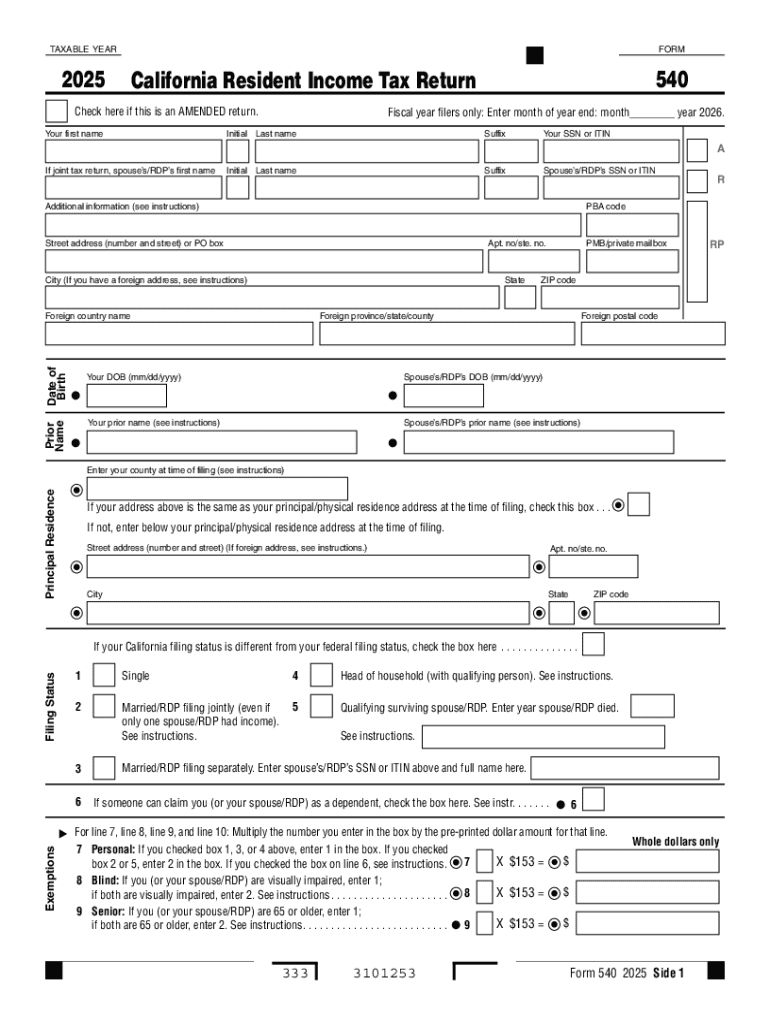







Introduction to 2025 Form 540 California Resident Income Tax Return
The 2025 Form 540 serves as the California Resident Income Tax Return, a mandatory document for California residents who meet specific income thresholds. This form helps determine a taxpayer's state tax liability, incorporates various deductions and credits, and ensures compliance with state tax regulations.
How to Use the 2025 Form 540
To correctly use Form 540, residents must complete several sections that account for their total income, adjustments, deductions, and tax credits:
- Enter your total worldwide income earned during the taxable year.
- Adjust your income using California-specific deductions and credits that may differ from federal calculations.
- Report your withholding taxes from W-2s and other withholdings in order to calculate any owed taxes or refunds.
Understanding Deductions and Credits
- Taxpayers can claim standard deductions or itemize deductions such as medical expenses and mortgage interest.
- Available credits may include the renter's credit, child and dependent care credit, and others specific to California.
Steps to Complete the 2025 Form 540
- Personal Information: Fill in your name, address, and Social Security Number.
- Income: Report total federal adjusted gross income from your federal tax return.
- Adjustments: Apply any state adjustments to your income.
- Deductions: Choose between standard or itemized deductions.
- Tax Calculation: Compute California taxable income to determine tax owed.
- Payments & Credits: Enter tax payments and credits, including those from withholding or estimated tax payments.
- Refund or Payment Due: Calculate whether you owe additional taxes or are entitled to a refund.
How to Obtain the 2025 Form 540
The form is available from multiple sources:
- Online: Downloadable from the California Franchise Tax Board (FTB) website.
- Physical Copies: Available at public libraries or request via mail from the FTB.
- Tax Software: Most major tax software services include Form 540 and assist with auto-completion based on your federal return inputs.
Filing Deadlines and Important Dates
California residents must submit Form 540 by April 15, 2026, unless an extension is granted. Extensions allow taxpayers until October 15, 2026, but only extend the filing time, not the payment deadline. Filing electronically is often faster and can provide quicker refund processing.
State-Specific Rules for Form 540
California has unique requirements, including:
- Community Property Laws: Joint filers must consider community property rules when reporting income.
- Non-conformity with Federal Law: California does not always follow federal changes to tax law, requiring careful attention to state-specific regulations.
- Minimum Filing Requirements: Ensure income meets the state threshold that mandates filing; failure to file can result in penalties.
Required Documents for Completing Form 540
Having the following documents on hand will streamline the process:
- Federal tax return (e.g., 1040 form).
- W-2 forms from employers.
- 1099 forms for other income.
- Receipts for deductible expenses if itemizing.
- Previous years' state returns as references.
Penalties for Non-Compliance
Failing to file by the deadline or omitting critical information can lead to:
- Late filing and payment penalties, typically a percentage of the unpaid tax.
- Interest on unpaid taxes compounded monthly.
- Increased scrutiny on future returns.
Digital vs. Paper Submission
While both digital and paper submissions are accepted:
- Digital Advantages: Faster processing time, immediate confirmation of submission, and reduced risk of errors through e-filing software.
- Paper Submission: Useful for those without internet access but risk longer processing times and potential errors.
Understanding these aspects of the 2025 Form 540 ensures proper filing, maximizes refunds, and mitigates any potential penalties for California residents.




