






Definition and Purpose of Schedule D (Form 1065)
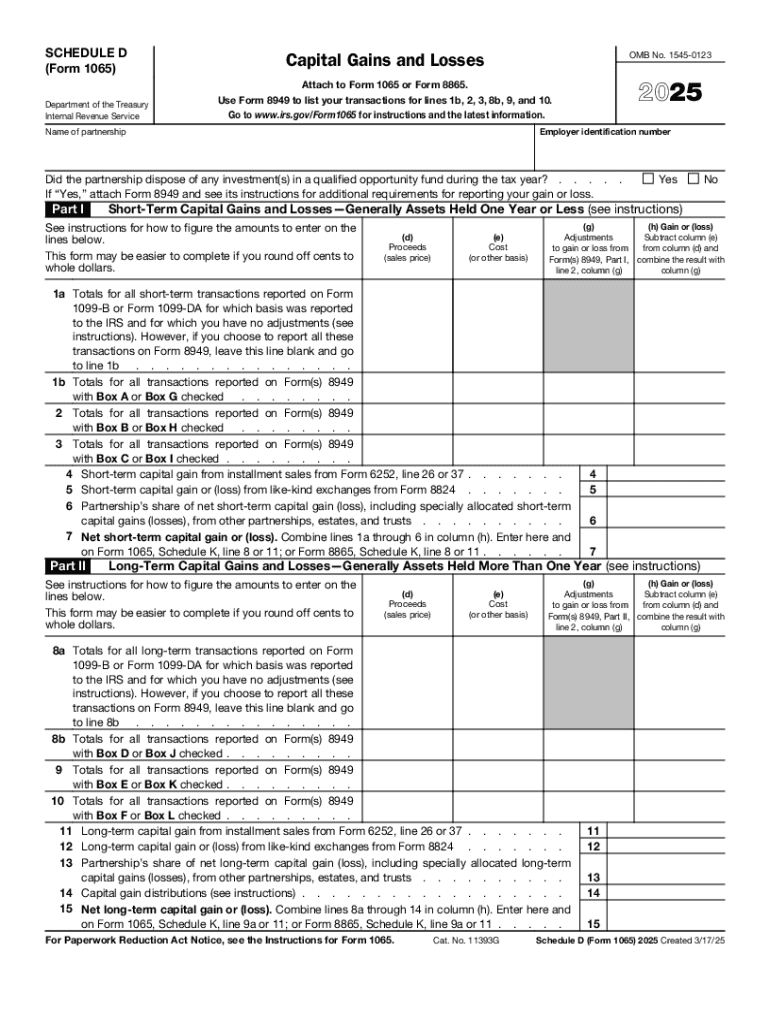
Schedule D (Form 1065), Capital Gains and Losses, is a critical document used by partnerships in the United States to report capital gains and losses incurred during the tax year. This form is part of the broader Form 1065, also known as the U.S. Return of Partnership Income. Partnerships use Schedule D to detail transactions involving capital assets, which can include stocks, bonds, and real estate.
Types of Transactions
- Capital Assets: Transactions involving stocks, bonds, or real estate.
- Short-term Gains: Assets held for one year or less.
- Long-term Gains: Assets held for more than one year.
By reporting on Schedule D, partnerships ensure compliance with IRS regulations, accurately reflecting their taxable income.
How to Use Schedule D (Form 1065)
Steps for Completion
-
Gather Necessary Documents:
- Collect all records of capital transactions, including purchase and sale receipts.
-
Complete Form 8949:
- Transactions must first be detailed on Form 8949, Sales and Other Dispositions of Capital Assets.
-
Transfer Information:
- Sum up totals from Form 8949 and transfer to Schedule D.
-
Calculate Totals:
- Determine total short-term and long-term gains or losses.
-
Attach to Form 1065:
- Ensure Schedule D is attached to the completed Form 1065.
Practical Example
A partnership sells stock in a company. The details, including purchase date, sale date, and profit or loss, are recorded on Form 8949. These totals are then transferred to Schedule D to determine the total capital gains or losses for the tax year.
Important Terms Related to Schedule D (Form 1065)
Key Terminology
- Capital Gain: Profit from the sale of a capital asset.
- Capital Loss: Loss incurred when a capital asset is sold for less than its purchase price.
- Basis: Original cost of the asset, adjusted for various factors.
- Holding Period: The duration the asset was held before sale.
Understanding these terms is essential for correctly completing Schedule D and ensuring accurate tax reporting.
IRS Guidelines for Schedule D (Form 1065)
Compliance Requirements
- Recordkeeping: Maintain thorough documentation for each transaction reported.
- Accuracy: Ensure calculations are correct to avoid discrepancies.
- Filing Deadline: Submit along with Form 1065 by the fifteenth day of the third month following the end of the tax year (typically March 15).
Failure to comply with IRS guidelines can lead to audits and potential penalties.
Filing Deadlines and Important Dates
Key Deadlines
- Filing Deadline: Generally by March 15 of the following year.
- Extensions: Partnerships may file for an extension, typically until September 15.
Keeping track of these deadlines is crucial to avoid late filing penalties and ensure proper reporting of capital gains.
Form Submission Methods: Online, Mail, and In-Person
Options for Filing
- Online Submission: Fastest method using the IRS e-file system.
- Mail: Traditional paper filing via postal service.
- In-Person: Direct submission at an IRS office if necessary.
Each method has its pros and cons, but electronic filing is preferred for its speed and reliability.
Penalties for Non-Compliance
Consequences of Errors
- Late Filing Penalty: Generally $200 per month for each month (or part of a month) the return is late, multiplied by the number of partners.
- Incorrect Information: Can lead to increased scrutiny and possible fines.
- Audit Risk: Incorrect or incomplete forms increase the chance of an IRS audit.
Understanding these penalties underscores the importance of accurate and timely filing of Schedule D.
Software Compatibility with Schedule D (Form 1065)
Supported Software
- TurboTax: Popular for individual and small business filings.
- QuickBooks: Offers features for partnerships managing extensive records.
These software solutions provide tools to streamline the preparation and submission of Schedule D, enabling partnerships to maintain compliance with IRS regulations while minimizing errors.