
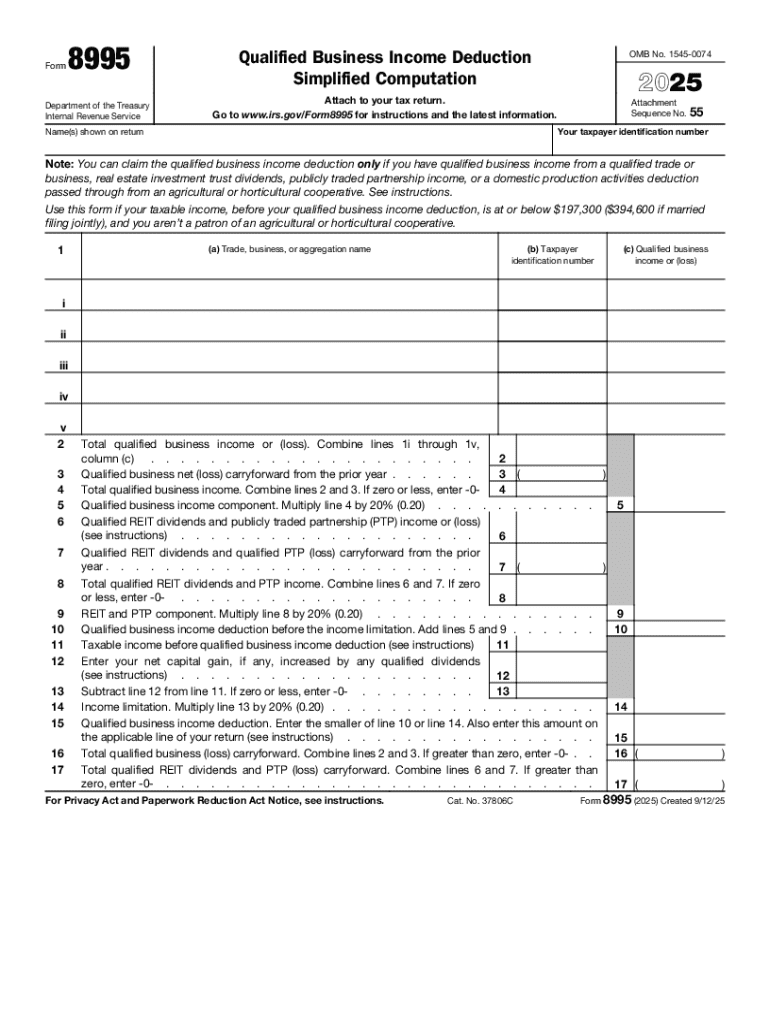







Definition & Meaning
The 2025 Form 8995, used for the Qualified Business Income Deduction Simplified Computation, is a tax document issued by the Internal Revenue Service (IRS) in the United States. This form is primarily designed to assist eligible taxpayers in calculating their qualified business income (QBI) deduction. The QBI deduction is a notable provision under the Tax Cuts and Jobs Act, allowing individuals, trusts, and estates who have income from partnerships, S corporations, or sole proprietorships to potentially deduct up to 20% of their QBI. The form simplifies the computation process, providing guidance on determining the correct deduction amount.
Eligibility Criteria
To be eligible to use the 2025 Form 8995, taxpayers must meet specific criteria:
- Income Thresholds: Taxpayers must have total taxable income below set thresholds. For the 2025 tax year, these limits are expected to be adjusted for inflation.
- Business Types: The deduction applies to income generated from business activities, which include sole proprietorships, partnerships, and S corporations.
- Exclusions: Certain specified service trades or businesses (SSTBs) may be subject to limitations or exclusions based on income levels.


Steps to Complete the 2025 Form 8995 Qualified Business Income Deduction Simplified Computation
Completing Form 8995 involves several key steps:
-
Gather Required Information: Collect all relevant financial documents, including business income statements, past tax returns, and documentation of any real estate investment trusts (REITs) or publicly traded partnerships (PTPs).
-
Calculate Qualified Business Income: Determine the total qualified business income by reducing gross business income by any related deductions, such as allocations for business expenses.
-
Determine Applicable Deductions and Limitations: Identify any applicable deductions and income ceiling tests that may impact the deduction amount.
-
Complete the Form: Accurately fill out each section of Form 8995, ensuring calculations are correct and supportive documentation is prepared for verification.
-
Attach to Tax Return: Once the form is completed, attach it to your tax return (Form 1040) for submission to the IRS.
Important Terms Related to 2025 Form 8995
-
Qualified Business Income (QBI): Refers to the net income derived from a qualified trade or business, excluding investment income and wages.
-
Sole Proprietorship: A business operated by a single individual where the income is reported directly on the taxpayer’s Form 1040.
-
Specified Service Trade or Business (SSTB): Certain types of businesses (e.g., law, consulting) that may face limitations in claiming the QBI deduction.
-
Phase-out Range: The income range within which the QBI deduction begins to phase out, impacting high-income taxpayers.
IRS Guidelines
The IRS provides specific guidelines on using Form 8995, emphasizing accuracy and compliance:
- Accuracy of Calculations: The IRS requires all calculations on the form to be precise, with taxpayers ensuring proper completion to avoid audit risks.
- Documentation: Taxpayers must maintain comprehensive documentation of QBI and any applicable deductions for potential IRS reviews or audits.
- Deadlines: The form must be submitted along with the taxpayer's annual tax filing, typically due by April 15th of the following tax year.
Filing Deadlines / Important Dates
For tax year 2025, the typical deadline to file Form 8995 and your overall tax return is April 15, 2026. However, deadlines may differ due to weekends or public holidays, in which case the filing date is extended to the next business day. Taxpayers who require additional time can file for an extension, pushing their deadline to October 15, 2026.
Taxpayer Scenarios
Various taxpayer scenarios illustrate the utility of the 2025 Form 8995:
-
Self-Employed Individuals: Those who run sole proprietorships and report earnings on Schedule C can employ Form 8995 to determine QBI deductions.
-
Partnerships and S Corporations: Partners and shareholders can apply the form to ascertain share-based income deductions from applicable business entities.
-
Real Estate Investors: Investors benefiting from REIT dividents and PTP income need Form 8995 to precisely account for deduction opportunities.

Software Compatibility (TurboTax, QuickBooks, etc.)
The 2025 Form 8995 is supported by numerous tax software platforms to streamline filing:
-
TurboTax: Users can enter business income details, and the platform assists with QBI calculations as well as complete the form automatically.
-
QuickBooks: Facilitates tracking of all business-related transactions throughout the year, simplifying the information gathering needed for Form 8995.
-
H&R Block Software: Offers in-depth guidance to taxpayers completing the QBI deduction, incorporating Form 8995 as part of its suite.
These digital solutions enhance accuracy and efficiency, reducing the likelihood of errors when calculating complex tax deductions.
Penalties for Non-Compliance
Failing to properly complete and file the 2025 Form 8995 can lead to several consequences:
-
IRS Penalties: Inaccurate provided information may result in IRS-imposed penalties or interest on any unpaid taxes.
-
Audit Risks: Non-compliance increases the likelihood of an audit, which could further uncover discrepancies in business income reporting.
Taxpayers should ensure meticulous completion of the form to mitigate these risks and remain in compliance with IRS requirements.




