




01. Edit your form online
Type text, add images, blackout confidential details, add comments, highlights and more.

Type text, add images, blackout confidential details, add comments, highlights and more.

Draw your signature, type it, upload its image, or use your mobile device as a signature pad.

Send it via email, link, or fax. You can also download it, export it or print it out.
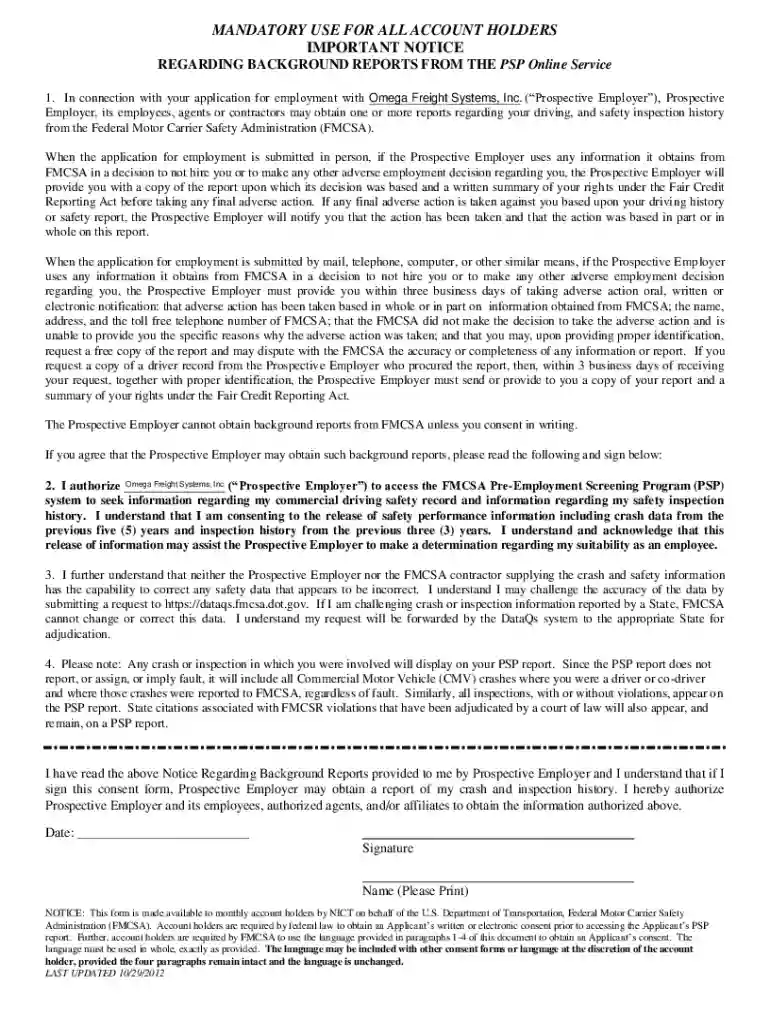
The PSP Disclosure and Authorization FormPerformance primarily facilitates the acquisition of a Pre-Employment Screening Program (PSP) report, mandated by the Federal Motor Carrier Safety Administration (FMCSA). This report is vital for companies to evaluate potential hires in the transportation industry, specifically for roles that involve driving commercial vehicles. The form outlines the necessary consent and procedural steps to obtain a candidate's driving record and safety inspection history, which assists employers in making informed hiring decisions.
Using the PSP Disclosure and Authorization FormPerformance is crucial for companies aiming to enhance safety and compliance within their transportation operations. By harnessing this form, employers ensure they do not hire individuals with disqualifying records, thus reducing risks associated with unsafe driving behaviors. This not only ensures regulatory compliance but also enhances overall safety on the roads, which is particularly significant in the highly regulated U.S. trucking industry.
Successfully filling out the PSP Disclosure and Authorization FormPerformance involves several key steps:
Understanding Employer Obligations: Employers must first ensure that they understand their responsibilities related to obtaining and using PSP reports. This includes adhering to FMCSA guidelines and ensuring the confidentiality of the applicant's information.
Acquiring Applicant Consent: Applicants should be informed of what the PSP report entails and provide written consent before any data retrieval. This consent is crucial as it complies with privacy requirements and legal frameworks.
Detailed Information Submission: The form requires specific information, including personal details of the candidate, the consenting period, and acknowledgment of data use terms. It's pivotal to ensure accuracy to prevent delays or compliance issues.
Keeping Accurate Records: Employers should maintain a record of completed forms and obtained reports as part of their compliance documentation. This record helps in audits or any legal proceedings that might arise concerning hiring practices.
The legal use of the PSP Disclosure and Authorization FormPerformance is tightly regulated to ensure the privacy and accurate representation of applicants. Employers must conform to the FMCSA stipulations which govern the scope of information that can be retrieved. The document also details the procedural rights of applicants, including their entitlement to be notified if an employment decision is adversely affected by the report's findings.
The PSP Disclosure and Authorization FormPerformance is predominantly used by companies involved in the transportation and logistics sectors. Organizations such as freight carriers, logistics providers, and companies with substantial in-house fleet operations frequently rely on this form to vet their potential driving workforce. This reliance ensures that fleet safety standards are met and maintained.
While the general application of the PSP Disclosure and Authorization FormPerformance is consistent across the United States, some state-specific regulations might impact its implementation. It's crucial for employers to be aware of any additional state-level requirements that may affect the use of PSP reports.
Modern practices often prefer digital submissions of the PSP Disclosure and Authorization FormPerformance due to efficiency and ease of record-keeping. While paper submissions are still possible, digital forms offer quicker processing times and reduce the chances of errors that typically occur in manual submissions.
Understanding the variations and alternatives to the PSP Disclosure and Authorization FormPerformance is essential for businesses looking for comprehensive options. Although the FMCSA primarily dictates the use of this standard form, companies might encounter similar screening tools specific to other federal or state departments catering to their regional requirements.
Not adhering to the procedures and legal requirements related to the PSP Disclosure and Authorization FormPerformance can result in severe consequences. Penalties may range from fines to revocation of transportation licenses, depending on the gravity of the compliance failure and the regulatory body involved.
By delving into these detailed sections, businesses and applicants gain a deeper understanding of the PSP Disclosure and Authorization FormPerformance, its use, and its significance within the transportation industry. The thorough exploration of each critical aspect ensures that all parties involved are equipped to handle the form competently and compliantly.
At DocHub, your data security is our priority. We follow HIPAA, SOC2, GDPR, and other standards, so you can work on your documents with confidence.



Feb 22, 2016 It describes Californias highway safety problems, identifies countermeasures, provides qualitative and quantitative measurements to determine.Read more
If you have questions about the Pennsylvania State Police Request for Criminal History Record Check form for employment (SP4 164) or to volunteer (SP4-164A),Read more


