






Definition and Meaning
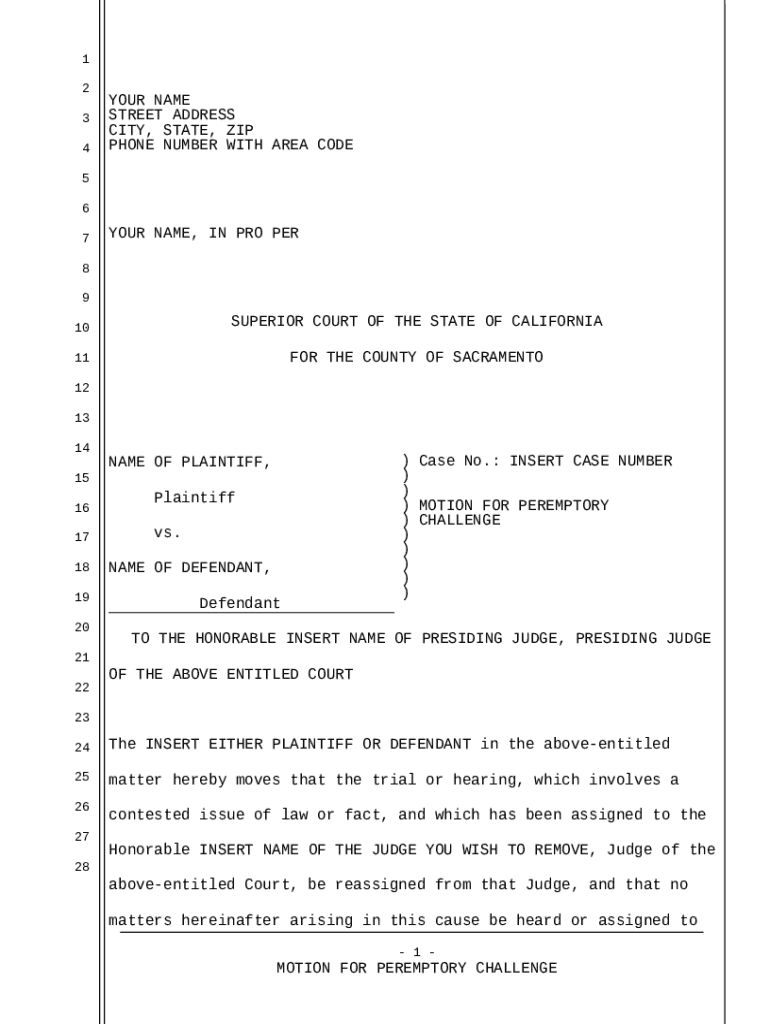
A "Declaration - Template - Sacramento County Public Law Library" is a formal document used in legal proceedings within California's Sacramento County. It is primarily a written statement provided under oath, detailing facts pertinent to a court case. This document serves as a way for individuals representing themselves, known as pro per litigants, to present their version of events or to support a motion, such as a peremptory challenge or other legal submissions. Declarations can contain factual assertions based on direct knowledge and are often submitted with supporting evidence to substantiate claims made therein.
How to Use the Declaration Template
To effectively use a Declaration - Template, follow these steps:
-
Opening Statement: Begin with your full name and explain your relationship to the case. Mention that you are submitting the declaration under penalty of perjury.
-
Statement of Facts: Clearly outline the facts you wish to declare. Use numbered paragraphs for clarity and conciseness. Each fact should be a separate point and stated with precision.
-
Incorporate Evidence: Include references to attached documents or evidence that support your statements. Clearly label all evidence as exhibits and refer to them in the declaration.
-
Conclusion: End with a statement affirming the truthfulness and personal knowledge of the information provided.
-
Signature and Date: Sign and date the declaration. If required, it may need to be notarized or accompanied by a proof of service demonstrating it was filed and served to all parties involved.
Steps to Complete the Declaration Template
Completing the Declaration - Template involves several critical steps:
-
Gather Information: Compile all necessary facts and evidence related to your case. Ensure that you have access to all documents, dates, and other pertinent information.
-
Draft the Declaration: Use clear language to articulate the facts. Organize information logically, often beginning with a chronological account of events.
-
Review for Accuracy: Double-check all details against supporting documents. Ensure that dates, names, and pivotal facts align precisely.
-
Proofread for Clarity and Grammar: A well-proofed document minimizes misunderstandings. Review grammar and syntax to prevent misinterpretation.
-
Submit and Serve: File the declaration with the appropriate court per local rules. Ensure all parties in the case receive a copy, providing a proof of service when necessary.
Legal Use of the Declaration Template
Declarations are primarily used in California legal proceedings for:
- Supporting or Opposing Motions: Declarations often accompany motions to provide factual evidence supporting or opposing a legal request.
- Presenting Evidence: They allow litigants to submit firsthand accounts or expert opinions as evidence without requiring the declarant's in-court testimony.
- Establishing Context: Informs the court about specific circumstances through verified statements to assist in decision-making processes.
Important Terms Related to the Declaration Template
Understanding the following terms is crucial when working with a Declaration - Template:
- Affiant: The individual making the declaration.
- Perjury: The criminal act of lying under oath, applicable to false declarations.
- Exhibit: An attachment or document referenced within the declaration to support claims.
- Pro Per: A person who represents themselves in court without an attorney, short for "in propria persona."
Key Elements of the Declaration Template
Key elements include:
- Title of the Case and Court Information: Displayed at the top to identify the relevant court and parties involved.
- Declarant Information: Name and contact information of the person making the declaration.
- Statement of Truth: Assertion made under penalty of perjury affirming the truth of the information.
- Detailed Factual Statements: Organized with clarity to communicate comprehensively without unnecessary embellishments.
State-Specific Rules for the Declaration Template
California-specific rules govern the formatting and submission of declarations:
- Formatting Requirements: Documents must adhere to specific formatting styles, including margin sizes and font types.
- Local Court Rules: Courts may have unique requirements regarding how and when declarations should be filed.
- Filing Deadlines: Declarations must be submitted by deadlines specific to the type of motion or proceeding they pertain to; late submissions may negatively impact the case.
Examples of Using the Declaration Template
The Declaration - Template can be instrumental in various legal scenarios:
- Peremptory Challenge: When a party seeks to disqualify a judge, the declaration asserts factual grounds for such disqualification.
- Summary Judgment Motions: Declarations provide crucial evidentiary support, demonstrating that there is no genuine dispute of material fact.
- Spousal Support Cases: Declaration offers insights into financial arrangements, living conditions, and relevant expenditures impacting support decisions.