




01. Edit your form online
Type text, add images, blackout confidential details, add comments, highlights and more.

Type text, add images, blackout confidential details, add comments, highlights and more.

Draw your signature, type it, upload its image, or use your mobile device as a signature pad.

Send it via email, link, or fax. You can also download it, export it or print it out.
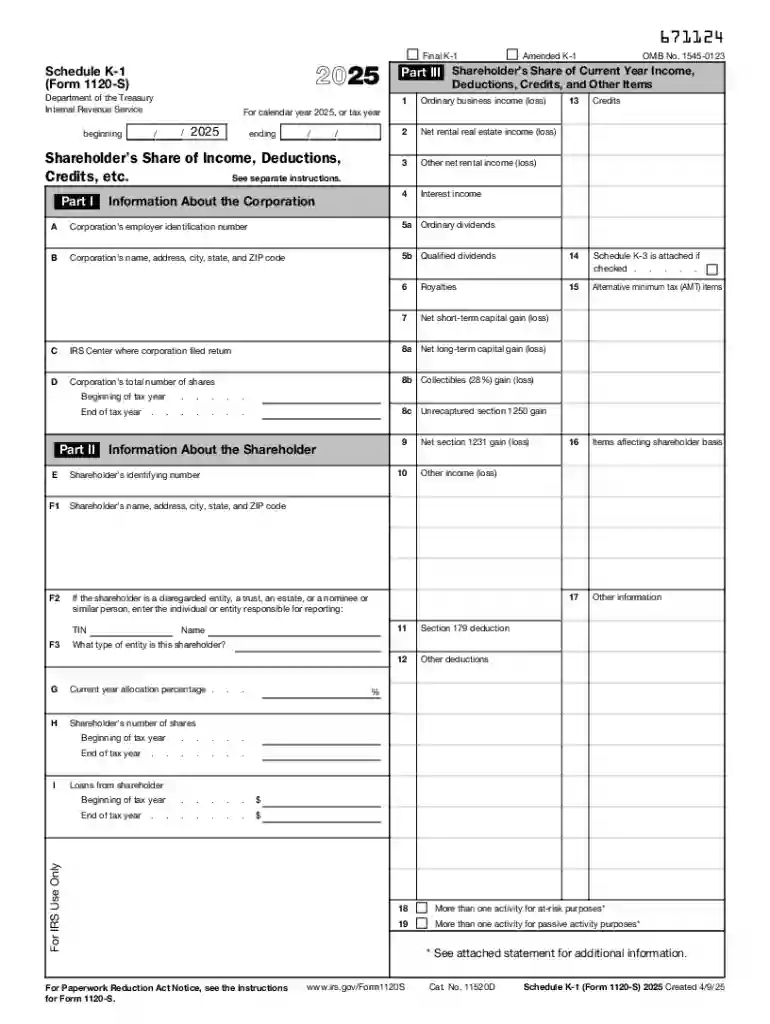
The 2025 Schedule K-1 (Form 1120-S) is a critical financial document used by S corporations to report each shareholder's share of income, deductions, credits, and other tax-related items. The form serves as a communication vehicle between the corporation and its stakeholders, helping them understand their individual tax obligations based on the corporation's financial activities.
Using the 2025 Schedule K-1 involves deciphering the financial data on the form to accurately file personal or business tax returns.
Completing the Schedule K-1 requires careful attention to detail and a thorough understanding of corporate finances.
The form comprises several critical sections that must be accurately filled out to ensure compliance and correct reporting.
The Schedule K-1 is indispensable for correctly attributing income and tax liabilities to shareholders within an S corporation.
Understanding the terminology used in the form is essential for accurate completion and interpretation.
Ensuring adherence to IRS guidelines is critical for the correct submission of Schedule K-1 forms.
We've got more versions of the 2025 Schedule K-1 (Form 1120-S) form. Select the right 2025 Schedule K-1 (Form 1120-S) version from the list and start editing it straight away!
| Versions | Form popularity | Fillable & printable |
|---|---|---|
| 2025 | 4.1 Satisfied (37 Votes) | |
| 2024 | 4.3 Satisfied (24 Votes) | |
| 2023 | 4.1 Satisfied (28 Votes) | |
| 2022 | 4.5 Satisfied (32 Votes) | |
| 2021 | 4.8 Satisfied (80 Votes) | |
| 2020 | 4.3 Satisfied (86 Votes) | |
| 2019 | 4.3 Satisfied (67 Votes) | |
| 2018 | 4.3 Satisfied (118 Votes) | |
| 2017 | 4.2 Satisfied (97 Votes) | |
| 2016 | 4.4 Satisfied (267 Votes) | |
| 2015 | 4.2 Satisfied (76 Votes) | |
| 2014 | 4.3 Satisfied (67 Votes) | |
| 2013 | 4 Satisfied (36 Votes) | |
| 2012 | 4 Satisfied (48 Votes) | |
| 2011 | 4.4 Satisfied (26 Votes) |
At DocHub, your data security is our priority. We follow HIPAA, SOC2, GDPR, and other standards, so you can work on your documents with confidence.



3. Carryforward of credits for qualified tax credit bonds and build America bonds to 2017 (see instructions) .Read more
Sep 22, 2025 6. Schedule K-1: - Complete a Schedule K-1 for each shareholder to report their share of income, deductions, and credits.Read more
Apr 9, 2025 Schedule K-1. (Form 1120-S). 2025. Shareholders Share of Income, Deductions,. Credits, etc Schedule K-1 (Form 1120-S) 2025 Created 4/9/25.Read more


