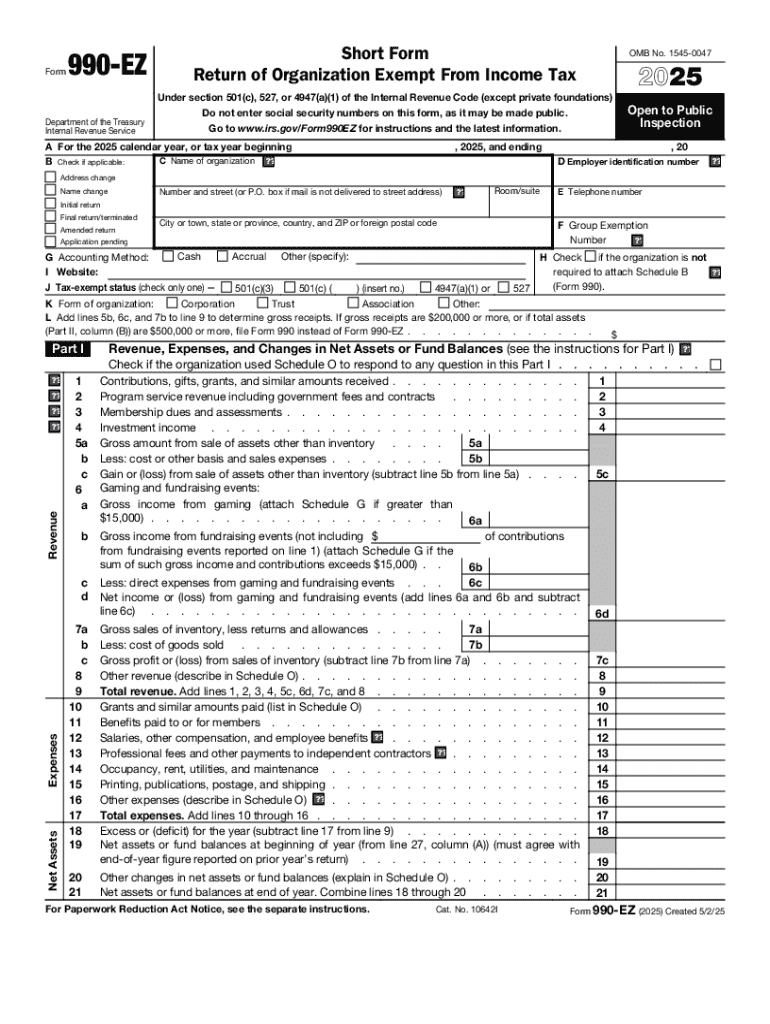





2025 Form 990-EZ Short Form Return of Organization Exempt From Income Tax-2026

Get Form
2025 Form 990-EZ Short Form Return of Organization Exempt From Income Tax Preview on Page 1

Here's how it works

01. Edit your form online
Type text, add images, blackout confidential details, add comments, highlights and more.
02. Sign it in a few clicks
Draw your signature, type it, upload its image, or use your mobile device as a signature pad.
03. Share your form with others
Send it via email, link, or fax. You can also download it, export it or print it out.

Definition & Meaning

The 2025 Form 990-EZ, officially known as the Short Form Return of Organization Exempt From Income Tax, is a simplified version of the annual reporting return filed by certain tax-exempt organizations. Under sections 501(c), 527, or 4947(a)(1) of the Internal Revenue Code, eligible organizations that have gross receipts less than $200,000 and total assets less than $500,000 can use this form to disclose necessary financial information. Reporting through Form 990-EZ helps maintain transparency and ensures compliance with IRS regulations.

Steps to Complete the 2025 Form 990-EZ

  1. Gather Required Information: Collect detailed information regarding revenue, expenses, and changes in net assets or fund balances.

  2. Revenue Reporting: Include all sources of income, such as contributions, program service revenue, and investment income. Ensure that each source of revenue is accurately categorized.

  3. Expense Reporting: Clearly outline all operational expenditures during the fiscal year, separating program services from management and general expenses.

  4. Net Asset Changes: Document the organization's net assets at both the beginning and end of the year, noting any changes due to revenue or expenses.

  5. Program Service Accomplishments: Provide a summary of the organization's significant achievements and program services. Be concise yet descriptive to illustrate the impact of these efforts.

  6. Completing the Signature Section: Certify the form by signing it. It should be signed by a current officer of the organization to confirm the accuracy of the data provided.

Eligibility Criteria

Organizations must meet specific criteria to be eligible to file the 2025 Form 990-EZ:

  • Gross Receipts: Must be less than $200,000 during the fiscal year.
  • Total Assets: Should not exceed $500,000 at the end of the fiscal year.
  • Organizational Type: Eligibility is primarily for organizations exempt under sections like 501(c), 527, or 4947(a)(1).

These criteria ensure that only small to medium-sized exempt organizations utilize the 990-EZ form for their annual returns.


decoration image ratings of Dochub

IRS Guidelines

The IRS provides comprehensive guidelines to assist organizations in completing the 2025 Form 990-EZ accurately:

  • Detailed Instructions: The IRS offers a robust set of instructions that outline every part of the form.
  • Common Mistake Warnings: Includes tips to avoid common errors such as incomplete sections or incorrect calculations.
  • Frequently Asked Questions: The FAQ section addresses typical queries regarding filing procedures and deadlines.

Filing Deadlines / Important Dates

  • Regular Deadline: Typically, the form is due by the 15th day of the 5th month after the organization’s fiscal year ends.
  • Extension Options: A six-month extension is possible using Form 8868, provided the request is submitted before the original deadline.

Required Documents

Key documents are essential for efficiently completing the 2025 Form 990-EZ:

  • Financial Statements: Accurate profit and loss reports and balance sheets.
  • Supporting Schedules: Any additional documentation required to provide further clarity on reported financial activities.
  • Donor Lists: Necessary if contributions are made by individuals or entities above a specified amount.

These documents support data accuracy and help in verifying reported figures.

Penalties for Non-Compliance

Non-compliance with filing regulations can lead to significant penalties:

  • Late Filing Fines: Organizations may incur daily fines if the form is submitted past the deadline without an approved extension.
  • Inaccurate Reporting Penalties: Providing incorrect information can result in fines and additional scrutiny from the IRS.
  • Repeated Non-filing Issues: Continuous failures to file may jeopardize the organization's exempt status.

Form Submission Methods

Tax-exempt organizations can submit the 2025 Form 990-EZ using multiple methods:

  • Online Submission: Filing electronically is recommended and often required based on revenue thresholds, using IRS-approved software for secure submission.

  • Mail Submission: Paper filing is still an option, but ensure to use the correct mailing address as provided by the IRS.

  • In-Person Drop-Off: Though less common, some may choose to hand-deliver to a local IRS office.

Who Typically Uses the 2025 Form 990-EZ

Organizations that usually utilize the 2025 Form 990-EZ include:

  • Small Charities and Nonprofits: Those with modest revenue streams and assets.
  • Community Organizations: For groups focusing on local service or advocacy.
  • Religious Ministries: Some religious groups that qualify specifically under tax-exemption sections.

These groups favor the simplified format for its relative ease of completion compared to the more comprehensive Form 990.

decoration image
be ready to get more

Complete this form in 5 minutes or less

Get form

Got questions?

We have answers to the most popular questions from our customers. If you can't find an answer to your question, please contact us.
Contact us
Tax exemption examples include nonprofits (churches, charities) exempt from income/property tax, specific income types (municipal bond interest, scholarships, some benefits), purchases by exempt entities, and individuals qualifying for certain exemptions like those for veterans or medical devices, all reducing tax liability at federal, state, or local levels. For Organizations Nonprofits: Churches, charities, schools, and other qualifying organizations (like 501(c)(3)s) are often exempt from federal income tax and sometimes state/local property or sales taxes. Economic Development: Local governments might exempt businesses from property tax to encourage them to move to a specific area. For Individuals (Income Purchases) Income: Interest from municipal bonds, life insurance payouts, certain veterans benefits, and some disaster relief payments. Specific Purchases: Sales tax exemptions for essential items like groceries, medical supplies (wheelchairs, hearing aids), or equipment for solar/wind power. Charitable Giving: Donating to a qualified nonprofit can provide a tax deduction (reducing taxable income), though the organization itself is exempt. For Specific Situations Veterans: Surviving spouses of veterans may qualify for property tax exemptions on their home. Health: Contributions to HSAs and FSAs are often tax-exempt. Sales Tax: Exemptions for items like farm equipment, manufacturing machinery, or for customers like schools or government agencies. Key Takeaway Tax exemptions work in different ways (income, property, sales) and apply to entities (nonprofits), specific income streams (bonds), or even certain purchases, all designed to reduce the tax burden. For financial advice, consult a professional. Exempt organization types | Internal Revenue ServiceJun 5, 2025IRS (.gov)Property Tax Exemptions - Texas Comptroller of Public AccountsTax Code Section 11.136 entitles a surviving spouse of veteran who died due to a qualifying condition or disease, regardless of thTexas Comptroller of Public Accounts (.gov)
Form 990 is used by tax-exempt organizations, nonexempt charitable trusts and section 527 political organizations to report income and calculate taxes owed to the federal government.
Organizations not required to file Form 990 include churches, certain church-affiliated groups, governmental instrumentalities, and some small organizations filing Form 990-N (e-Postcard) or other specific returns like Form 990-PF (private foundations) or Form 5500 (employee benefit trusts) instead. The primary exception is for small entities with gross receipts under $50,000, who file Form 990-N, while larger entities meeting higher thresholds (e.g., $200k receipts or $500k assets) must file the full Form 990. Key Exemptions from Filing Form 990: Churches and Religious Organizations: This includes integrated auxiliaries, church-affiliated schools (non-college), and religious orders. Governmental Units: State and local instrumentalities whose income is excluded from gross income under Section 115. Small Organizations: Those with gross receipts normally $50,000 or less file Form 990-N (e-Postcard) instead of Form 990. Private Foundations: Must file Form 990-PF. Employee Benefit Plans: Stock bonus, pension, or profit-sharing trusts file Form 5500. Political Organizations: Section 527 political organizations have different filing requirements. Religious Apostolic Organizations (Section 501(d)): File Form 1065. Subsidiaries: Those covered under a parent organizations group return. Organizations That Must File Form 990 (or 990-EZ): Most other tax-exempt organizations must file either Form 990 or the shorter Form 990-EZ if their gross receipts are less than $200,000 and assets less than $500,000. Important Note: Even if exempt from Form 990, organizations still have annual reporting requirements in the state where they are incorporated or fundraise. For financial advice, consult a professional. Annual electronic notice (Form 990-N) for small organizations FAQs: Who must file | Internal Revenue ServiceIRS (.gov)Annual exempt organization return: who must file - IRSAug 20, 2025 A church, an interchurch organization of local units of a church, a convention or association of churches. An integratIRS (.gov)
You generally dont have to file taxes if your gross income is below the standard deduction amount for your filing status (e.g., under $15,750 for single filers under 65 for 2025), but you might still need to if youre self-employed ($400+ net earnings), owe special taxes, bought marketplace health insurance, or want to claim refundable credits or get withheld money back. Even if your income is low, filing can be beneficial for refunds and credits, but its usually not mandatory if youre below the thresholds and have no other filing triggers, like self-employment income. Common reasons you might not have to file: Income below standard deduction: For the 2025 tax year, if youre single and under 65, your gross income must be at least $15,750 to generally trigger a filing requirement. Thresholds increase with age and different filing statuses (Head of Household, Married Filing Jointly, etc.). No self-employment: If youre not self-employed or your net earnings from self-employment are less than $400. No other specific income/situations: You dont have other reportable income or need to file for other reasons, such as owing special taxes or receiving certain health insurance subsidies. Reasons you might still need to file (even with low income): Refunds: To get back federal income tax that was withheld from your paycheck. Refundable Credits: To claim refundable tax credits, like the Earned Income Tax Credit (EITC) or Child Tax Credit, as noted on consumerfinance.gov. Self-Employment: If you earned $400 or more in net earnings from self-employment. Marketplace Health Insurance: If you bought health insurance through a state or federal marketplace and received advance premium tax credits, notes HR Block. Dependents: If someone claims you as a dependent and you have more than $1,350 in unearned income (2025). To be sure, use the IRS interactive tool for personalized guidance. For financial advice, consult a professional. Check if you need to file a tax return | Internal Revenue ServiceJan 14, 2026IRS (.gov)Guide to filing your taxes in 2026 - Consumerfinance.govFeb 12, 2026 About filing your tax return. If you have income below the standard deduction threshold for 2025, which is $15,750 forConsumerfinance.gov
IRS Form 990-EZ, officially titled Short Form Return of Organization Exempt From Income Tax, is a simplified tax return designed for smaller tax-exempt organizations with gross receipts less than $200,000 and total assets less than $500,000 at the end of their tax year.

Security and compliance

At DocHub, your data security is our priority. We follow HIPAA, SOC2, GDPR, and other standards, so you can work on your documents with confidence.

Learn more
ccpa2
pci-dss
gdpr-compliance
hipaa
soc-compliance
be ready to get more

Complete this form in 5 minutes or less

Get form

People also ask

To find out if an organization is tax-exempt, use the IRS Tax Exempt Organization Search (TEOS) tool online to check its status, eligibility for tax-deductible donations, and filed forms like the Form 990. You can search by the organizations name or Employer Identification Number (EIN), and the tool also shows if an exemption was revoked or if they filed required notices. Using the IRS TEOS Tool Go to the IRS TEOS website: IRS Tax Exempt Organization Search. Enter search criteria: Type the organizations name or its EIN into the search bar. Select database: Choose from databases like Form 990-series returns, Form 990-N (e-Postcard) filers, or Public Charity Status to verify tax-deductible contributions. Review results: The tool will show if the organization is listed and provide details on its federal tax status and filings, including confirmation of its exemption or if it was revoked. Other methods Contact the organization directly: They must provide their exemption application and recent returns (Form 990) upon request. Check state charity regulators: Your states Attorney General or Secretary of State often lists registered charities. Use charity watchdog sites: Sites like the BBB Wise Giving Alliance (Give.org) offer reports on nationally soliciting charities. For financial advice, consult a professional. Tax Exempt Organization Search | Internal Revenue ServiceAug 20, 2025IRS (.gov)Search for tax exempt organizations | Internal Revenue ServiceIRS (.gov)
(D) Non-Taxable Nontaxable benefits are benefits specifically excluded from taxation under the Internal Revenue Code. Examples include, but are not limited to: Value of housing provided by the employer, except to the extent such value is a working condition fringe. Educational assistance.Aug 2, 2023
The IRS Form 1040EZ was replaced by a redesigned, simplified Form 1040, which absorbed features from the old 1040EZ and 1040A, requiring all taxpayers to use the same base form, plus any necessary schedules for more complex situations, with Form 1040-SR (larger print for seniors) as an optional alternative for those 65+. Key Changes: Consolidation: Forms 1040EZ and 1040A were discontinued after the 2017 tax year. New Base Form: Everyone now files the standard Form 1040, which acts as a building block. Schedules: Taxpayers add only the necessary schedules (like Schedule 1, 2, etc.) for specific income, deductions, or credits, making it simpler for those with straightforward returns and more detailed for complex ones. Form 1040-SR: Introduced for seniors (age 65+), offering larger print and a printed standard deduction table for easier reading. In essence, the 1040EZ is gone, replaced by the streamlined, universal Form 1040. For financial advice, consult a professional. Here are five facts about the new Form 1040 | Internal Revenue ServiceFeb 25, 2019 Forms 1040A and 1040EZ are no longer available. Taxpayers who used one of these forms in the past will now file Form 1IRS (.gov)What Was Form 1040EZ, and Why Is It No Longer Used? - InvestopediaThe IRS previously allowed for taxpayers to select a specific Form 1040 to use based on the complexity of their tax return. The siInvestopedia

Related links