




01. Edit your form online
Type text, add images, blackout confidential details, add comments, highlights and more.

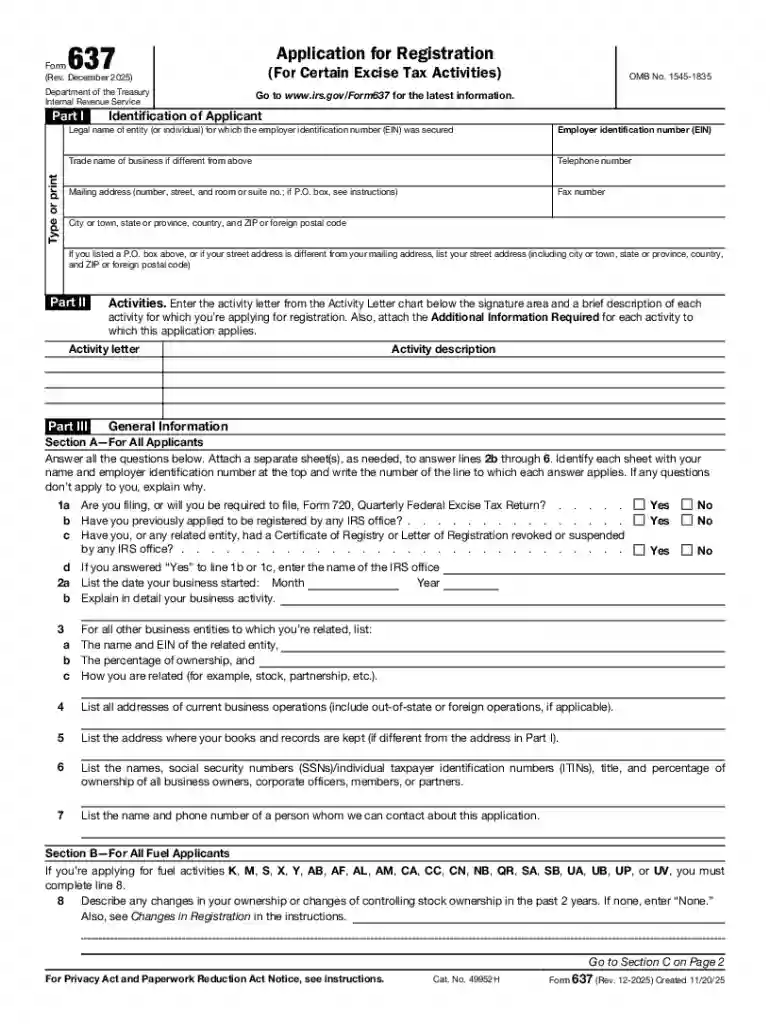
Type text, add images, blackout confidential details, add comments, highlights and more.

Draw your signature, type it, upload its image, or use your mobile device as a signature pad.

Send it via email, link, or fax. You can also download it, export it or print it out.
Form 637 (Rev December 2025) is a regulatory document administered by the Internal Revenue Service (IRS) for the purpose of registering for certain excise tax activities. This form is critical for businesses and individuals involved in activities subject to excise taxes, allowing them to conduct their operations in a compliant manner. Excise taxes typically apply to the sale of specific goods such as alcohol, tobacco, and gasoline.
Form 637 (Rev December 2025) is used by taxpayers who are required to register for certain business operations liable for excise taxes. The process involves completing the form accurately and submitting it for IRS review.
A company planning to distribute gasoline would need to register using Form 637 to ensure compliance with federal excise tax laws. This requires the business to disclose relevant operational details and obtain authorization from the IRS before commencing distribution.
Filing Form 637 involves several critical steps which taxpayers need to follow meticulously to ensure successful submission.
Using tax preparation software like TurboTax or QuickBooks can be advantageous as they are often compatible with Form 637 filings, providing a streamlined process for ensuring compliance and accuracy.
Understanding the terminology associated with Form 637 is crucial for accurately completing the form and comprehending its implications.
Form 637 comprises several key elements that applicants need to address for successful registration.
Every section must be completed with precision. For instance, if applying for allowance under a specific excise activity, detailed descriptions of business operations involved in this activity are necessary to prevent any ambiguity.
IRS guidelines for Form 637 dictate the regulatory framework within which businesses must operate to ensure adherence to tax laws.
Certain businesses may qualify for exemptions or special considerations under IRS regulations, necessitating awareness of these provisions during form completion.
While Form 637 itself may not have a specific deadline, prompt submission is crucial when starting activities subject to excise taxes.
Failure to comply with the filing requirements of Form 637 can lead to significant penalties from the IRS.
Understanding these penalties underscores the importance of timely and accurate submission of Form 637 to avoid any disruptive impacts on business operations.
At DocHub, your data security is our priority. We follow HIPAA, SOC2, GDPR, and other standards, so you can work on your documents with confidence.




Oct 6, 2025 The university prohibits any form of hazing of students, consistent with Acts 635, 637, and of the Louisiana Legislature and the 2018Read more
Apr 14, 2025 The NIST Privacy Framework 1.1 is a voluntary tool developed in collaboration with stakeholders intended to help organizations identify andRead more
Nov 20, 2025 Use Form 637 to apply for excise tax registration for activities under sections 4101, 4222, 4662, and 4682. See the Activity. Letter chart belowRead more


