






Definition & Purpose
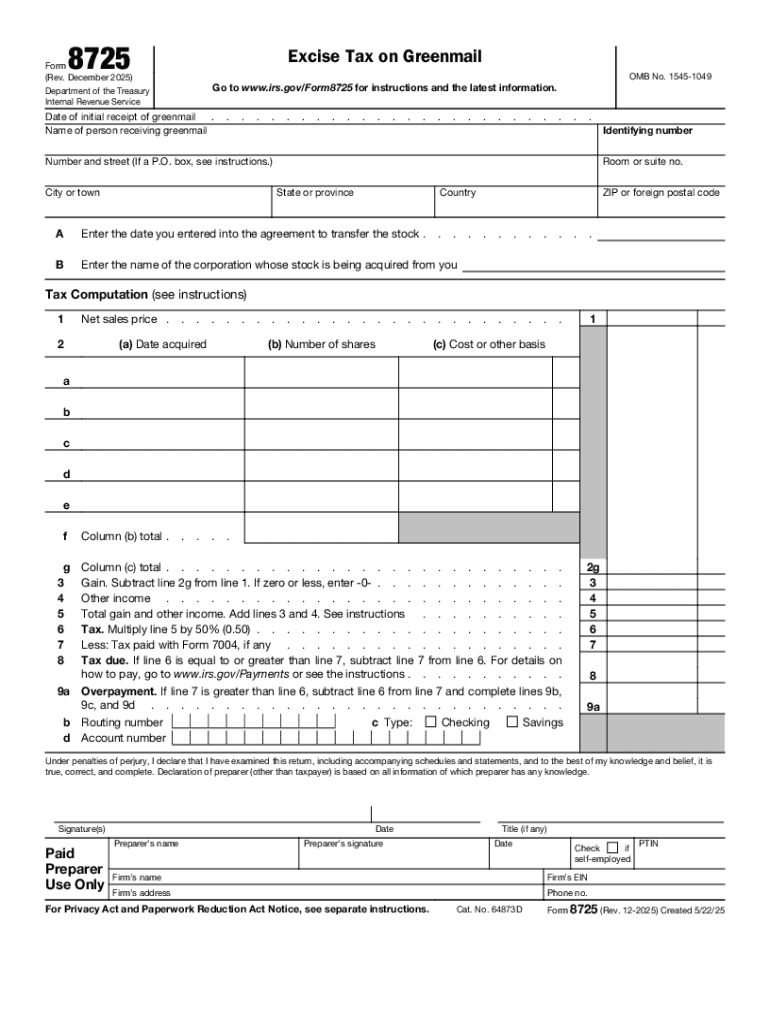
Form 8725 (Rev December 2025) is specifically designed for taxpayers subject to the excise tax on greenmail transactions. Greenmail refers to the practice of purchasing enough shares in a target company to threaten a takeover, prompting the target company to repurchase the shares at a premium to thwart the acquisition. This form is vital for reporting such transactions and calculating any applicable excise tax required by the Internal Revenue Service (IRS).
Key Elements
- Taxpayer Information: Includes the name, address, and taxpayer identification number (TIN) of the individual or entity completing the form.
- Transaction Details: Comprehensive details of the greenmail transaction, including the date, parties involved, and financial specifics.
- Calculation of Tax: Detailed sections for computing the excise tax owed based on the transaction's specifics.
How to Use the Form 8725
To accurately complete Form 8725, ensure you have all transaction documentation ready. Begin by filling in the taxpayer details followed by the specifics of the greenmail transaction. Calculate the excise tax using the guidelines provided by the IRS. Once completed, review for accuracy to prevent compliance issues.
Steps for Completion
- Gather Necessary Information: Collect all relevant documents related to the greenmail transaction.
- Complete Taxpayer Details: Fill in the upper section with personal or business information.
- Document Transaction Details: Accurately record the transaction date, parties, and monetary details.
- Compute Excise Tax: Follow IRS instructions to compute the tax based on the transaction details.
- Review and Submit: Double-check all entries for accuracy before submitting.
Obtaining the Form 8725
Form 8725 can be downloaded directly from the IRS website. For those who prefer physical copies, it is also available at IRS local offices or through authorized mail requests.
Form Access Methods
- Online Download: Visit the IRS website to download the latest version of Form 8725.
- In-Person: Collect the form from an IRS office.
- Mail: Request a physical form by contacting the IRS via postal services.
Filing Deadlines & Important Dates
The deadline for filing Form 8725 aligns with your regular tax filing. Typically, this form should accompany your tax return for the period covering the greenmail transaction.
Important Considerations
- Filing Period: Must coincide with the quarterly or annual tax return period.
- Extension Possibility: Filing extensions for tax returns could affect Form 8725 but require timely application.
Penalties for Non-Compliance
Failure to file Form 8725 or incorrect filing could lead to significant penalties. The IRS imposes fines for underreporting and inaccurate tax calculations associated with greenmail transactions.
Common Penalties
- Late Filing: Fines accumulate for each month the form is late.
- Inaccuracy Penalties: Incorrect tax calculation can result in additional charges.
- Interest on Unpaid Tax: Unpaid excise tax accrues interest and increases the penalty amount.
IRS Guidelines & Compliance
Form 8725 is governed by specific IRS regulations, ensuring taxpayers comply with the reporting and taxation of greenmail transactions. These guidelines are crucial for maintaining accurate tax documentation and avoiding legal complications.
Compliance Tips
- Stay Informed: Regularly update your knowledge of IRS guidelines.
- Seek Professional Advice: For complicated transactions, consult with a tax professional.
- Thorough Documentation: Keep detailed records of all transactions and calculations.
Required Documents for Filing
Accurate filing of Form 8725 necessitates having a comprehensive set of documents to substantiate the greenmail transaction and justify the calculated excise tax.
Essential Documents
- Transaction Agreements: Contracts or agreements related to the greenmail purchase.
- Financial Records: Detailed financial statements showcasing the tax liability.
- Communication Records: Any correspondence that outlines the intent or consequence of the greenmail transaction.
Who Typically Uses Form 8725
Form 8725 is primarily utilized by individuals, corporations, or entities that have engaged in greenmail transactions. This form ensures they're compliant with excise tax laws applicable to such transactions.
Business Entity Types
- Corporations: Often deal with greenmail due to acquisition strategies.
- Investors: Engaging in substantial share purchases that could pivot in greenmail.
- Legal and Financial Advisors: Who facilitate and report such transactions on behalf of clients.
Software Compatibility
Form 8725 is compatible with various tax preparation software, such as TurboTax and QuickBooks, which allows for seamless integration of transaction data into broader tax filings.
Popular Software Options
- TurboTax: Offers guided input for Form 8725, simplifying complex entries.
- QuickBooks: Facilitates transaction documentation and tax calculations through integrated features tailored for excise tax forms.
Incorporating these sections will provide a comprehensive understanding of Form 8725 (Rev December 2025) Excise Tax on Greenmail, covering all nuances and requirements.