






Definition and Meaning of IRS Tax Form 8990
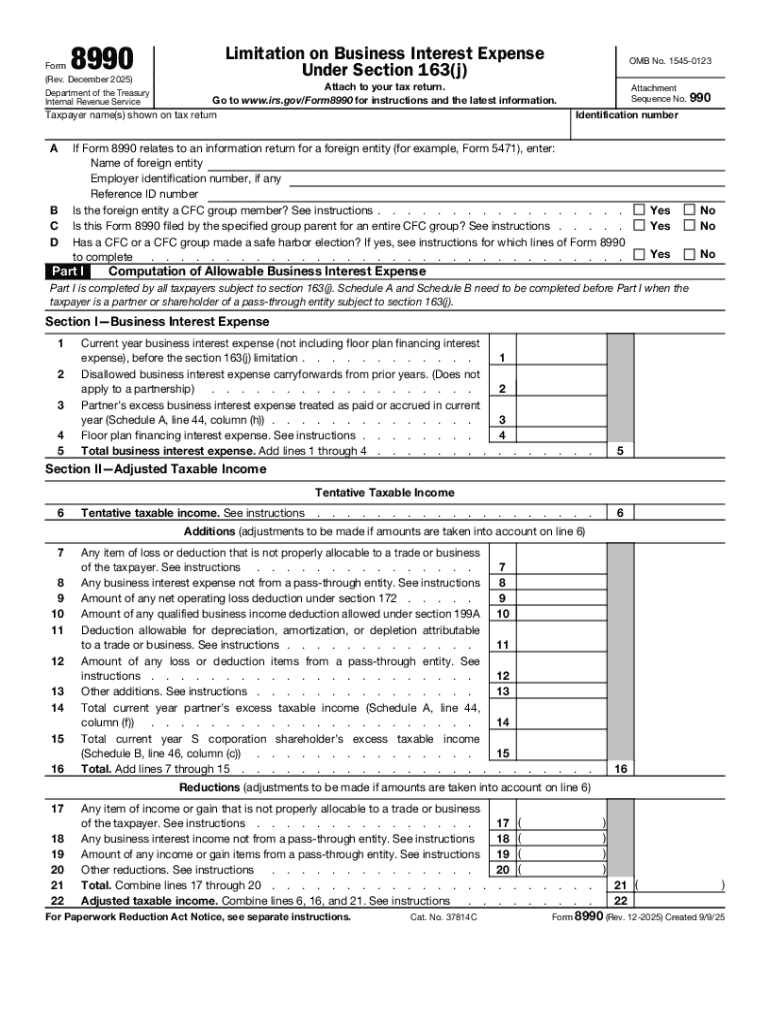
IRS Tax Form 8990, titled "Limitation on Business Interest Expense," is a critical form required by the Internal Revenue Service (IRS) for businesses to comply with the constraints imposed by Section 163(j) of the Internal Revenue Code. This regulation was established to limit the amount of business interest expense that can be deducted by certain entities, effectively capping the interest deductions against income.
Key Objectives
- To ensure fair tax practices by capping excessive interest deductions.
- To improve tax transparency for businesses by providing a clear framework for interest deduction calculations.
- To standardize the reporting of interest expenses across different types of business entities.
Who Needs to Use This Form
Businesses that have interest expense deductions exceeding a set threshold, typically based on adjusted taxable income, are required to fill out Form 8990. This rule applies to partnerships, corporations, and certain individuals with excess business losses.
How to Use IRS Tax Form 8990
Using IRS Tax Form 8990 involves a detailed process intended to accurately calculate allowable interest deductions. Understanding each section of the form is crucial for accurate completion.
Step-by-Step Usage Guide
-
Start with Part I: Total Current Year Business Interest Expense
- Calculate the current year's business interest expense subject to limitation.
- Determine any disqualified interest expense carried forward from previous years.
-
Proceed to Part II: Adjusted Taxable Income Calculation
- Compute adjusted taxable income, which forms the basis for determining allowed interest deductions.
- Adjust for depreciation, amortization, and other specified items.
-
Complete Part III: Limitation Calculation
- Apply the 30% limitation of adjusted taxable income to calculate allowable deductible interest.
- Determine any excess interest expense carryover for future tax years.
Practical Tips
- Ensure accuracy in calculations to avoid penalties.
- Maintain organized records of interest expenses and supporting documents.
Steps to Complete IRS Tax Form 8990
Completing the IRS Tax Form 8990 necessitates attention to detail and an understanding of applicable tax laws. The form consists of several steps, each requiring specific information.
Detailed Completion Steps
-
Gather Necessary Documents
- Collect financial statements, interest payment records, and prior year tax returns.
-
Calculate Business Interest Expense
- Identify all interest expense types to include in calculations and ensure separation from non-business interests.
-
Adjustable Taxable Income Computation
- Use the worksheet provided by the IRS for accurate computation of adjusted taxable income.
-
Determine Interest Limitation
- Use provided formulas in the instructions to determine the allowable interest deduction.
Common Errors to Avoid
- Misreporting non-deductible interest expenses.
- Failing to account for disallowed carryovers from previous years.
Important Terms Related to IRS Tax Form 8990
Understanding the terminology specific to IRS Tax Form 8990 is vital for accurate form completion.
Key Terms Defined
- Business Interest Expense: The cost incurred by the business for borrowing funds.
- Adjusted Taxable Income (ATI): Taxable income adjusted for specific deductions, exclusions, and additions.
- Disqualified Interest: Interest that exceeds the allowed deduction limit and may be carried forward.
- Section 163(j) Limitation: The legal code that imposes the interest deduction limitation.
Practical Implications
- Accurate understanding of these terms ensures proper application of the form rules and reduces errors.
Eligibility Criteria for IRS Tax Form 8990
Determining eligibility for filing IRS Tax Form 8990 requires understanding the specific criteria outlined by the IRS.


Who Must File
- Businesses with interest expenses exceeding set limits, typically those with higher gross receipts.
- Corporations, partnerships, and certain trusts that exceed $26 million in average annual gross receipts over the past three years.
Eligibility Exceptions
- Small businesses falling below the gross receipts threshold.
- Certain agricultural and real property trades or businesses that make an election to avoid limitation.
Filing Deadlines and Important Dates
Compliance with submission deadlines for IRS Tax Form 8990 is crucial for avoiding penalties.
Key Dates
- Tax Year Filing: Form 8990 must be attached to your timely filed tax return, including extensions.
- Extension Filing: If a filing extension is sought, ensure the form is submitted along with the extended return deadline.
Implications of Missing Deadlines
- Late filing can result in interest on unpaid taxes and penalties.
- Compliance with deadlines ensures accurate taxation and avoids additional charges.
Software Compatibility: IRS Tax Form 8990
Integrating technology solutions can streamline the process of completing IRS Tax Form 8990.
Compatible Software
- Accounting Software: Programs like QuickBooks and Xero can assist in calculating interest limitations.
- Tax Preparation Software: TurboTax and other tax platforms offer support for Form 8990, simplifying data input and calculations.
Benefits of Software Use
- Ensure accuracy by minimizing manual entry errors.
- Streamline calculations with automated systems, reducing the time spent on forms.
Taxpayer Scenarios: IRS Tax Form 8990
Understanding varying taxpayer scenarios can assist in effectively applying IRS Tax Form 8990 rules.

Common Scenarios
- Self-Employed Individuals: Entrepreneurs with substantial interest expenses may need to complete Form 8990 if they surpass income thresholds.
- LLCs and Partnerships: These entities must file Form 8990 if their interest expenses constitute a large proportion of their operational costs.
- Large Corporations: Corporations with complex interest arrangements often require careful review of business interest expense qualifications.
Real-World Application
- Each scenario demands tailored insights to ensure proper completion of the form according to specific business models and financial circumstances.