






Definition and Meaning
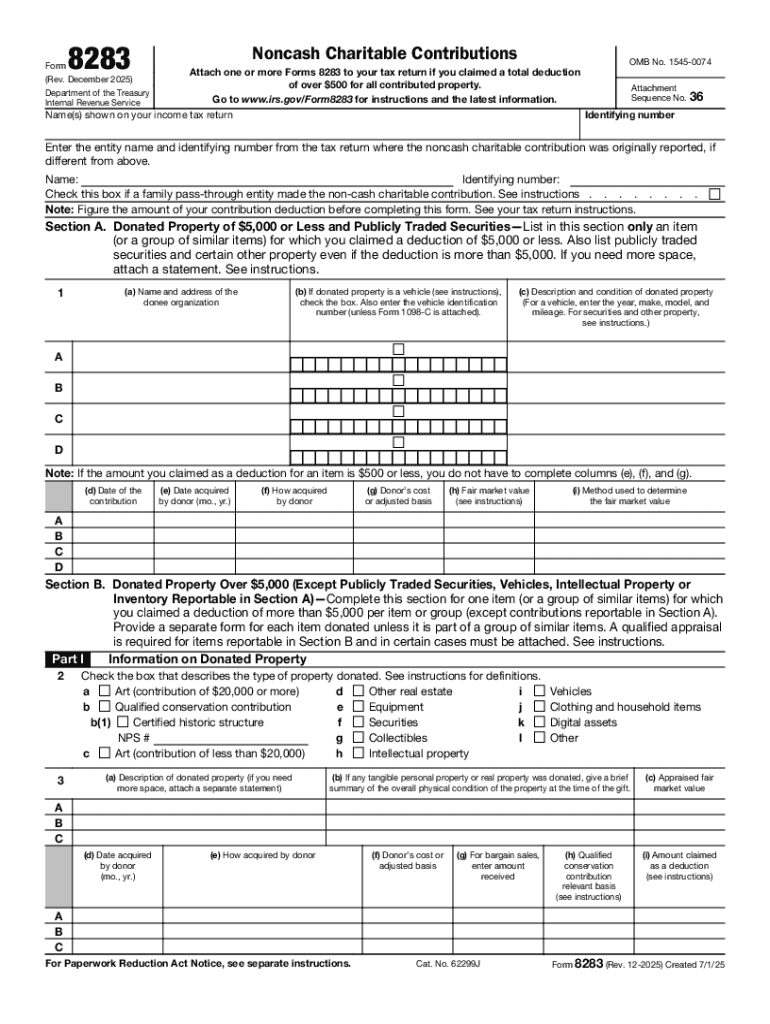
The "Form 8283 (Rev December 2025) Noncash Charitable Contributions" is used by taxpayers in the United States to report noncash charitable contributions to the Internal Revenue Service (IRS). It is essential for individuals or entities who have made noncash donations exceeding $500 during the tax year. This form helps the IRS verify the donation details to prevent fraud and ensure compliance with tax law. Noncash contributions can include items such as vehicles, securities, art, and other tangible or intangible property. Understanding its role is critical for determining its use in tax preparation and reporting.
How to Use the Form 8283
To effectively use Form 8283, start by filling out the relevant sections based on the total value of your noncash donations. The form is divided into sections that require different information:
-
Section A: For items donated with a total value from $500 to $5,000. Detailed descriptions and donor information are necessary. This includes the legal name of the donating entity or individual, the date of acquisition by the donor, and the date of the donation.
-
Section B: Required for items over $5,000. This section demands a professional appraisal and additional substantiating documentation for valuation purposes.
In both sections, you must include:
- A description of each item donated.
- Fair market value and the method for determining it.
- Name and address of the donee organization.
Steps to Complete the Form 8283
- Collect Donation Information: Gather all documents that verify your donations, such as receipts from charitable organizations and records of purchase.
- Determine Fair Market Value: Assess the fair market value of your donations using qualified appraisals for high-value items.
- Fill Section A: For donations between $500 and $5,000, complete this section with all necessary donor and donee details.
- Complete Section B: For larger donations, ensure you have professional appraisals attached and fill out this section.
- Attach Form to Tax Return: Ensure you attach the completed Form 8283 when you submit your federal income tax return.
Who Typically Uses Form 8283
Form 8283 is commonly used by individuals, estates, trusts, and business entities such as partnerships and corporations that make significant noncash charitable contributions. Nonprofit organizations often encourage donors who are focused on getting tax deductions to utilize this form, especially when handling large or unique item donations like real estate or valuable collectibles.
Key Elements of the Form
- Donor Information: Includes name, taxpayer identification number, and addresses required in both Sections A and B.
- Donation Details: Detailed description of the donated property along with the date of donation and acquisition.
- Appraisal Summary: For donations exceeding $5,000, a written appraisal as part of Section B is mandatory.
- Donee Acknowledgment: Confirmation from the receiving charity or nonprofit organization is required to validate the donation.
IRS Guidelines
The IRS guidelines for Form 8283 involve strict adherence to valuation standards and documentation requirements:
- Appraisal Requirements: Items over $5,000 must have a qualified written appraisal.
- Record Keeping: Retain all documentation related to the donation, such as receipts, acknowledgment letters, and appraisal reports.
- Charity Eligibility: Ensure the receiving organization is a qualified charity—generally registered as a 501(c)(3) entity.
Filing Deadlines and Important Dates
To avoid penalties, ensure Form 8283 is filed alongside your federal tax return by the tax filing deadline, typically April 15th of the following year. If you file for an extension, ensure this form is submitted by the extended deadline, commonly October 15th.
Penalties for Non-Compliance
Failing to correctly complete and submit Form 8283 can result in the IRS disallowing your claimed deductions, imposing fines, or subjecting you to audits. Proper documentation and adherence to appraisal rules can help prevent any issues. Noncompliance may also lead to penalties related to accuracy and negligence in tax submissions.
Taxpayer Scenarios
- Self-Employed Individuals: May donate business-related items or overstock.
- Retired Individuals: Often contribute collectibles or other accumulated assets.
- Students: Typically more likely to donate household items or personal effects.
Understanding the specific conditions under which Form 8283 is applicable ensures legal compliance and maximizes tax benefit opportunities for all taxpayers making noncash charitable contributions.