






Definition & Meaning
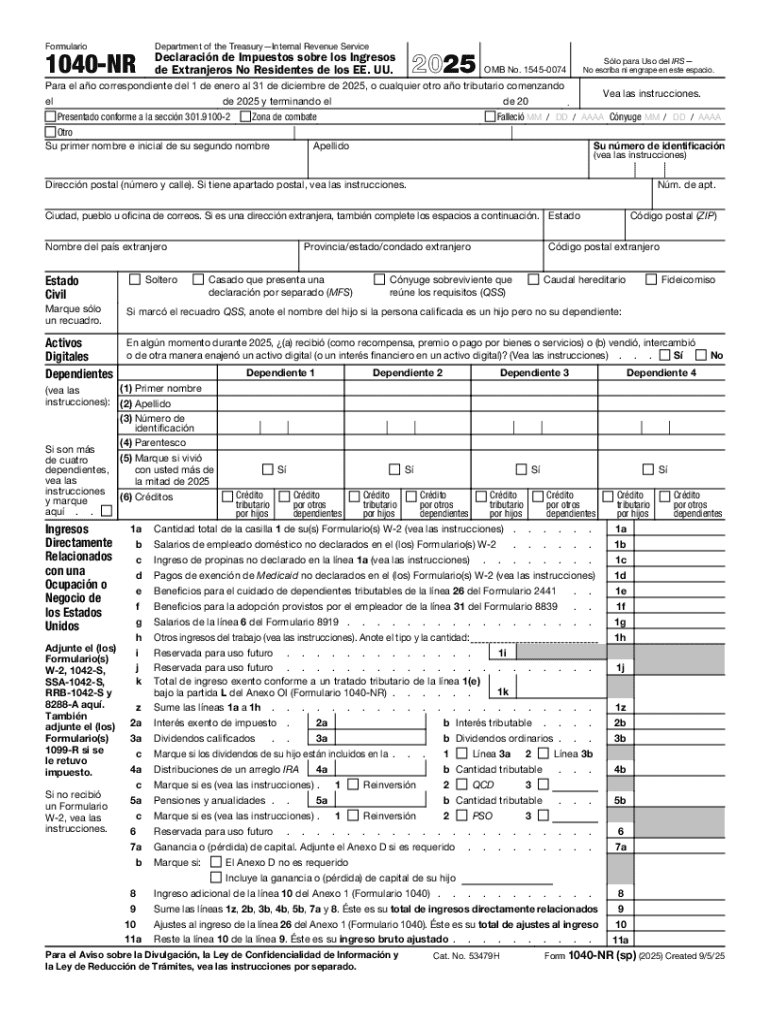
The 2025 Form 1040-NR (sp) U.S. Nonresident Alien Income Tax Return (Spanish Version) is a tax form used by nonresident aliens who have income from U.S. sources. This form, provided by the Internal Revenue Service (IRS), ensures compliance with U.S. tax regulations. It enables individuals to report income, claim applicable deductions and credits, and calculate the taxes owed or refund due. The Spanish version makes it accessible to Spanish-speaking nonresident aliens, ensuring they can meet their tax obligations effectively.
Nuances & Specific Scenarios
- Nonresident Aliens: Defined as those who do not have a green card or do not pass the substantial presence test.
- Income Sources: Includes wages from U.S. employment, business income conducted within the U.S., and capital gains, among others.
- Exemptions & Credits: Specific exemptions may not be available to nonresident aliens, and the form addresses this.
How to Use the 2025 Form 1040-NR (sp)
Completing the 2025 Form 1040-NR (sp) involves several steps to ensure accurate reporting of income and calculation of taxes:
Step-by-Step Instructions
-
Gather Required Information: Obtain all necessary documents such as income statements (e.g., W-2, 1099 forms), proofs of deductions, and ID numbers (ITIN or SSN).
-
Determine Filing Status: Identify the correct status, as this affects tax rates and eligibility for certain deductions. Common statuses include single, married filing separately, or qualifying widow(er).
-
Report Income: Accurately report all types of U.S.-sourced income, ensuring to convert foreign income into U.S. dollars as necessary.
-
Calculate Adjustments & Deductions: Utilize available deductions, taking into account that certain deductions may not apply to nonresident aliens.
-
Determine Tax Liability: Use the tax tables provided to calculate the tax due based on the reported income.
-
Sign & Submit the Form: Ensure the form is completed accurately and signed. Submission can be done electronically or via mail.
Example Scenarios
- Temporary Workers: Individuals on work visas staying for limited periods.
- Students: Nonresident students with income from internships or part-time jobs.
How to Obtain the 2025 Form 1040-NR (sp)
The form can be accessed in various ways to accommodate different preferences and technical capabilities.
Accessing the Form
- Online Download: Available directly from the IRS website, ensuring you have the most current version.
- Local IRS Offices: Obtain physical copies from IRS offices located throughout the U.S.
- Tax Preparation Software: Many programs offer electronic versions as part of their services.
Practical Tips
- Language Preference: Ensure to select the Spanish version if you prefer assistance in Spanish.
- Assistance Centers: Utilize IRS Taxpayer Assistance Centers for help and paper forms if necessary.
Steps to Complete the 2025 Form 1040-NR (sp)
Filling out the form requires careful attention to detail and adherence to IRS instructions.
Detailed Completion Guide
-
Personal Information: Fill out personal details including name, address, and taxpayer identification number accurately.
-
Income Sections: Enter all U.S.-sourced income in their respective sections, verifying figures with attached documentation to avoid discrepancies.
-
Tax Calculations: Utilize the provided tax tables, ensuring calculations align with applicable rates for nonresidents.
-
Deductions & Credits: Include valid deductions and credits while noting ineligible items for nonresidents.
-
Review & Validate Entries: Double-check all entries to confirm accuracy before submission.
Common Errors to Avoid
- Miscalculating Income: Ensure income is accurately converted if earned in foreign currencies.
- Incorrect Identification Numbers: Use correct IRS-issued numbers to avoid processing delays.
Who Typically Uses the 2025 Form 1040-NR (sp)
This form is specifically meant for Spanish-speaking nonresident aliens who generate income within the United States.


Profile of Common Users
-
Foreign Visitors: Those in the U.S. temporarily, such as tourists or short-term business travelers, who have U.S. income.
-
International Students: Students attending U.S. universities earning income from campus jobs or internships.
-
Foreign Executives or Employees: Workers temporarily assigned to U.S. branches of foreign companies.

Benefits for These Users
- Focused Compliance: Ensures that individuals not residing in the U.S. still meet federal tax requirements.
- Cultural and Language Accessibility: Offers Spanish instructions to ease the tax filing process.
Filing Deadlines / Important Dates
Meeting the IRS deadlines is crucial to avoid penalties and interests.
Key Filing Dates
- April 15, 2026: Standard deadline for submission, aligning with resident deadlines.
- October 15, 2026: Final extended deadline, requires submission of an extension request by the original April deadline.
Late Filing Consequences
- Financial Penalties: Late submission incurs penalties calculated from the original due date.
- Interest Accumulation: On any unpaid amounts from the filing date, further increasing the liability.
IRS Guidelines
Understanding and complying with IRS guidelines ensures proper form completion and submission.
Compliance Rules
-
Provision for Dual Status: Special rules apply if residency status changes within the tax year.
-
Record Retention: Maintain copies of filed forms and supporting documents for a minimum of three years.
Practical Applications
- Tax Treaty Benefits: Some nonresidents can benefit from tax treaties, reducing tax liabilities.
Required Documents
Accurate form completion relies heavily on having the right documentation.
Essential Documentation
-
Income Records: W-2s, 1099 forms, and similar documents reflect all earning types.
-
Identity Verification: Valid ITIN or SSN as required for tax filings.
-
Supporting Deduction Proofs: Documentation that supports any claimed deductions or credits.
Verification Measures
-
Double-Checking for Accuracy: Prevent discrepancies between reported and actual income figures.
-
Backup Copies: Maintain backup for personal records to avoid misfiled claims.