






Definition & Meaning
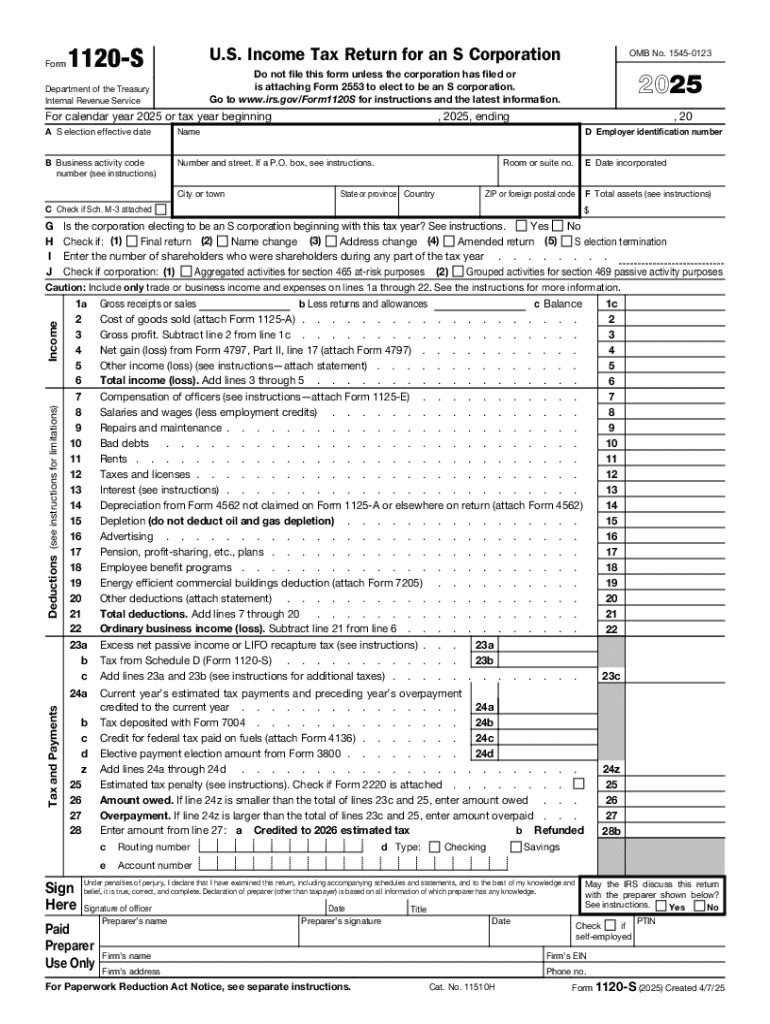
The 2025 Form 1120-S is a U.S. Income Tax Return for an S Corporation. Filed with the Internal Revenue Service (IRS), it allows an S Corporation to report income, gains, losses, deductions, and credits. S Corporations are distinct from traditional corporations in that they elect to pass corporate income directly to shareholders. This form is pivotal because it ensures that the corporation complies with tax regulations while allowing shareholders to report their share of income on personal tax returns.
Key Functions
- Income Reporting: Reflects the corporation's income allocations.
- Tax Compliance: Assists in meeting federal tax filing requirements.
- Shareholder Transparency: Enables shareholders to integrate corporate revenue with personal tax liabilities.
How to Use the 2025 Form 1120-S
Completing Form 1120-S involves accurately capturing the fiscal details of the S Corporation, which will be pivotal to both corporate compliance and individual taxpayer obligations.
Completion Steps
- Verify Eligibility: Confirm the corporation qualifies as an S Corporation under IRS regulations.
- Gather Financial Data: Assemble financial documentation, including income statements and balance sheets.
- Input Shareholder Information: Detail each shareholder's share of the corporation's earnings.
- Report Income and Deductions: Accurately list all pertinent income and deductible expenses.
- Review for Accuracy: Double-check all inputs for arithmetic and logical accuracy.
- Sign and Submit: Finalize by signing and adhering to submission guidelines.
How to Obtain the 2025 Form 1120-S
Acquiring the 2025 Form 1120-S is straightforward, as it is available from the IRS or through various document management platforms like DocHub.
Sources for the Form
- IRS Website: Downloadable PDFs are available directly from IRS.gov.
- Tax Software: Accessible via programs like TurboTax or QuickBooks.
- Document Management Services: Use platforms that prioritize security, such as DocHub, to import tax forms directly.
Steps to Complete the 2025 Form 1120-S
Accurate completion of Form 1120-S is critical for compliance and maximizing tax benefits. Here is a breakdown of the process:
- Section A – Gross Receipts: Enter total income from all sources.
- Section B – Cost of Goods Sold: Deduct costs associated with inventory and production.
- Section C – Deductions: Include operating expenses like salaries and utilities.
- Section D – Net Income Calculation: Subtract total deductions from gross receipts.
- Section E – Shareholder Data: Allocate percentages of income or loss to each shareholder.
- Final Review: Ensure deductions don't exceed limitations and are legally compliant.
- Submission: File electronically or via mail, adhering to IRS deadlines.
Important Terms Related to 2025 Form 1120-S
Understanding key terminology can simplify the filling process:
- S Corporation: A corporation that elects to pass income, deductions, and credits through to shareholders.
- K-1 Form: Document provided to each shareholder showing the share of income, deductions, and credits.
- Fiscal Year: The 12-month period used for accounting purposes.
- Ordinary Business Income: Total pre-tax income from regular operations.
Filing Deadlines / Important Dates
Timeliness in submission is crucial to avoid penalties:
- Annual Due Date: Generally, the 15th day of the third month after the end of the fiscal year (e.g., March 15 for calendar year corporations).
- Extension Requests: Can be filed using Form 7004, granting a six-month extension.
- Estimated Payments: If expected tax is $500 or more, estimated taxes should be paid quarterly.
Penalties for Non-Compliance
Failing to submit or inaccuracies in filing can lead to significant penalties:
- Late Filing or Payment: Usually incurs a 5% penalty per month on the tax due.
- Inaccurate Returns: Corrections might incur additional charges and interest.
- Inadequate Record Keeping: Can lead to audits and increased scrutiny, potentially resulting in legal proceedings.
Legal Use of the 2025 Form 1120-S
Using Form 1120-S properly safeguards the corporation and its shareholders:
- Compliance Assurance: Proper use ensures alignment with federal tax laws.
- Legal Documentation: Acts as a formal record of financial activities and tax obligations.
- Audit Preparedness: Complete and accurate filing minimizes the risk of IRS audits.
Taxpayer Scenarios
Different entities might file Form 1120-S under various circumstances:


Common Scenarios
- Startups Achieving S-Corp Status: Often seek personal tax benefits.
- Long-Established Small Businesses: Use to streamline income reporting.
- Family-Owned Corporations: Benefit from tax simplicity when passing income to family members.
Case Study
A tech startup opts for S Corporation status to avoid double taxation, electing to file Form 1120-S. This allows shareholders to receive untaxed dividends which are only taxed at the individual level. This strategic choice aids cash flow and facilitates reinvestment.