
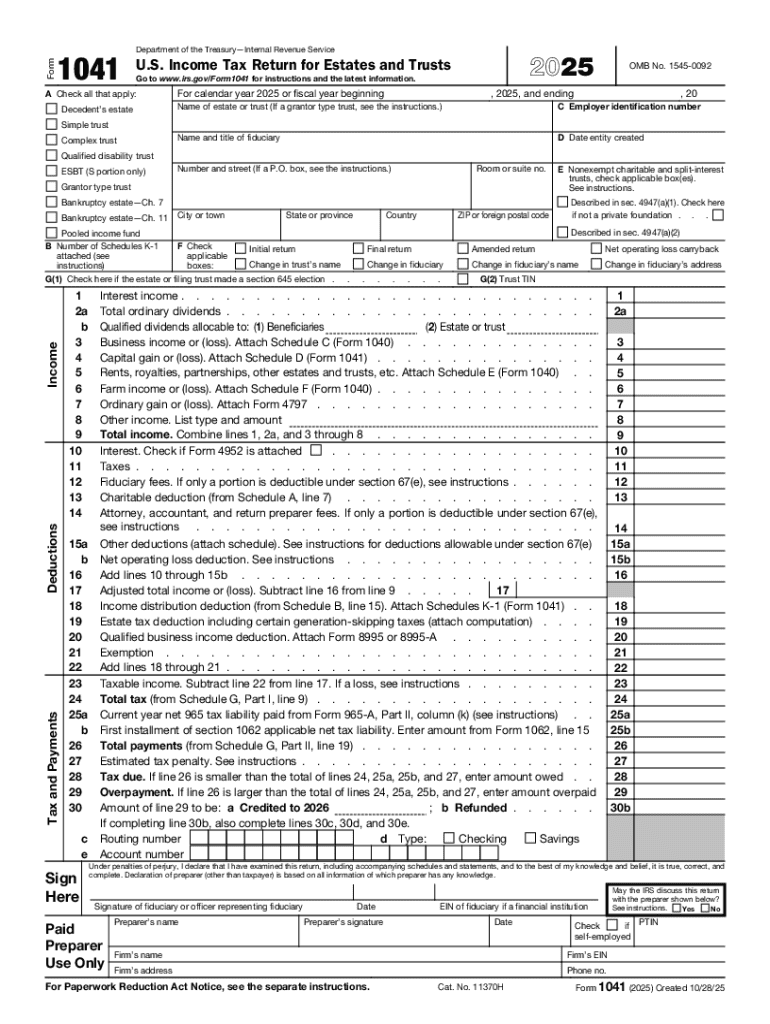







Definition and Purpose of Form 1041
Form 1041, officially known as the U.S. Income Tax Return for Estates and Trusts, is a document used by estates and trusts to report income, deductions, gains, and losses, as well as to determine tax liability. It ensures compliance with U.S. tax laws by capturing the financial activities of estates and trusts. Estates are legal entities that manage and distribute a deceased person’s assets, while trusts are fiduciary arrangements where one party holds assets for the benefit of another.
Characteristics of Estates and Trusts
- Estate: Manages assets left by a decedent.
- Trust: Holds assets for beneficiaries based on specific terms.
Importance of Filing Form 1041
- Ensures accurate tax reporting for legal entities.
- Allows for the proper distribution of assets and compliance with fiduciary duties.
Obtaining the 2025 Form 1041
The 2025 Form 1041 can be acquired from multiple sources. The Internal Revenue Service (IRS) provides various options to access the form, ensuring it is readily available for taxpayers managing trusts and estates.
Methods to Acquire Form
- IRS Website: The form is downloadable as a PDF from the official IRS site.
- Tax Software: Many tax preparation programs include Form 1041 and provide guidance on completion.
- Tax Professionals: CPAs and tax advisors can supply the form and offer assistance.
Steps to Complete Form 1041
Completing Form 1041 involves several detailed steps to accurately report all necessary financial information. Here is an outline of the process:
Preparation Stage
- Gather Financial Information: Collect data on income, deductions, and credits related to the estate or trust.
- Identify Beneficiaries: List all beneficiaries of the trust or estate to report distributions accurately.
Completing the Form
- Fill in Basic Information: Include the name, address, and EIN of the estate or trust.
- Report Income: Document all taxable income, including dividends, interest, and capital gains.
- Calculate Deductions: Record allowable deductions such as administrative costs and charitable contributions.
- Compute Tax Liability: Determine any tax owed based on the net income after deductions.
Verification and Submission
- Review and Sign: Ensure accuracy before signing the form as the fiduciary.
- Submit to IRS: File electronically or via mail by the designated deadline.
Who Typically Uses Form 1041
Form 1041 is primarily utilized by fiduciaries responsible for managing the financial affairs of an estate or trust. These fiduciaries are tasked with fulfilling legal obligations, such as filing taxes and distributing assets.
Common Users
- Estate Executors: Individuals appointed to oversee the settlement of a decedent’s estate.
- Trustees: Persons or institutions managing a trust for the benefit of designated beneficiaries.


Legal Use and Compliance
Ensuring legal compliance when filing Form 1041 is critical to avoid penalties and issues with the IRS. Fiduciaries must understand the legal backdrop of the form's use, ensuring accurate and lawful reporting of financial activities associated with estates and trusts.
Compliance Strategies
- Adhere to IRS Deadlines: Fiduciaries should file by the appropriate deadline, typically April 15th for calendar year filers.
- Maintain Accurate Records: Document all financial transactions and retain records to substantiate entries on Form 1041.
Key Elements of Form 1041
Form 1041 contains various sections that capture essential financial information. Understanding these components is vital for accurate completion.
Core Sections
- Income Section: Records all income sources, including interest, dividends, and other earnings.
- Deduction Section: Includes deductions for charitable contributions, administration expenses, etc.
- Tax Calculation: Summary of net income and tax liability.
IRS Guidelines and Instructions
The IRS provides comprehensive instructions for filling out Form 1041. These guidelines help fiduciaries navigate the complexities of the form, ensuring conformity with all applicable tax regulations.
Key Guidelines
- Detailed Instructions: Available online or in print, these instructions cover every aspect of the form.
- Examples and Scenarios: The IRS often provides examples that help illustrate how to report various types of income and deductions correctly.
Filing Deadlines and Important Dates
Filing Form 1041 by the prescribed deadline is crucial to avoid penalties. The standard due date for estates and trusts following a calendar year is April 15th. Extensions are possible but must be filed in a timely manner.
Important Dates
- Standard Deadline: April 15th for calendar year taxpayers.
- Extension Requests: Fiduciaries may file for an extension, typically providing an additional five and a half months.
Required Documents for Submission
Proper documentation is necessary to support the information submitted on Form 1041. Collecting and organizing these documents ensures that all reported data can be verified if required by the IRS.
Necessary Documents
- Income Statements: Reports detailing income from stocks, bonds, and other investments.
- Expenses Receipts: Proof of deductions like administrative and legal fees.
- Beneficiary Distribution Records: Documentation of amounts distributed to beneficiaries.


