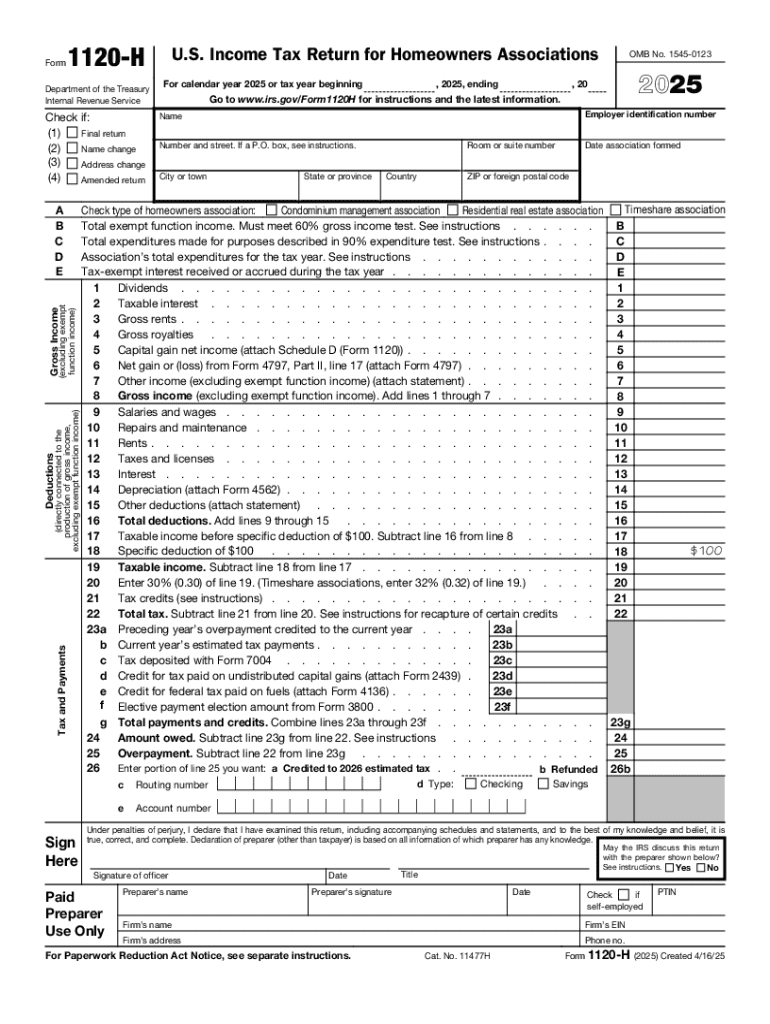







Definition and Purpose of the 2025 Form 1120-H
Form 1120-H, known as the U.S. Income Tax Return for Homeowners Associations, serves the specific purpose of enabling qualifying homeowners associations (HOAs) to report their income. The form is used primarily by associations that manage residential real estate to ensure compliance with federal income tax regulations. Through this form, associations can benefit from a simplified tax process compared to filing a standard corporate tax return. The form applies specifically to HOAs that meet criteria set forth by the IRS, ensuring that they can properly account for exempt function income.
- Exempt Function Income: This refers to income derived from homeowners' dues, assessments, and fees explicitly used for maintenance and other services tied to common areas.
- Taxable Income: If certain income falls outside the "exempt" categorization, such as interest or investment income, it must be reported and can be taxed at a flat rate.
Eligibility Criteria for 2025 Form 1120-H
To file Form 1120-H, a homeowners association must satisfy specific IRS eligibility criteria. The filing option is limited to organizations that primarily function as residential real estate associations.
- Composition and Management: At least 60% of the organization’s expenses must be for the maintenance and management of the residential property.
- Exempt Income: At least 90% of the association's income must be derived from exempt functions such as fees and assessments paid by members.
- Tax Exemption: The form primarily covers tax obligations related to income exempted under IRC Section 528.
- Restrictive Clause: The organization cannot have any stock; profits cannot be distributed to members beyond fulfilling the association's exempt function criteria.


Steps to Complete the 2025 Form 1120-H
The completion process for Form 1120-H is straightforward if the required information is properly organized:
- Identify Exempt Function Income: Calculate total income from member assessments and dues.
- List Taxable Income Sources: Identify any non-member income, such as interest accrued from the bank accounts or revenue from leasing properties.
- Calculate Deductions: Only expenses directly related to generating taxable income are deductible. This involves separating exempt function expenses from others.
- Tax Calculation: Compute the tax owed at the current flat rate applied to the net taxable income.
- Review and Submit: Ensure all entries are accurate and submit by the mandatory filing deadline to avoid penalties.
Filing Deadlines for the 2025 Form 1120-H
Timing is crucial when it comes to submitting Form 1120-H:
- Annual Deadline: The form is due on the 15th day of the third month after the end of the association’s tax year, generally March 15 for calendar year entities.
- Extensions: Filing for an extension is permissible if necessary, using IRS Form 7004, which provides an additional six months.
- Late Filing Penalties: Missing the deadline without appropriate extensions results in penalties, underscoring the importance of timely submissions.
Key Elements of the 2025 Form 1120-H
Understanding the main sections of the form helps streamline its completion:
- Identifying Information: Name and address of the HOA and Employer Identification Number (EIN).
- Income Section: Details on exempt function income and taxable income.
- Deductions: Section for listing deductions specific to taxable income.
- Calculation: Final taxable income computation and tax liability based on IRS guidelines.
- Officer Signature: An authorized official must sign, verifying the accuracy of the submitted information.
IRS Guidelines for 2025 Form 1120-H
The IRS provides a comprehensive set of guidelines on when and how to file the 2025 Form 1120-H:
- Required Compliance: Ensures associations report accurate tax, exempt function income, and expenses to maintain integrity.
- Documentation: The IRS may require additional documentation during an audit process, so thorough record-keeping of financial transactions and tax filings is essential.
- Accuracy: Any misreporting or errors can lead to penalties or delayed processing, making careful adherence to IRS instructions crucial.
Differences Between Digital and Paper Versions
The Form 1120-H can be submitted in both paper and digital formats, each with its own set of procedures and requirements:
- Paper Filing: Traditional mailing is available for associations that prefer or require physical submissions.
- Electronic Filing (E-File): Numerous IRS-approved software options are available for those who wish to submit electronically, offering speed and convenience.
- Software Compatibility: Various tax preparation platforms like TurboTax and QuickBooks support e-filing for Form 1120-H, facilitating ease of use and integration with existing financial records.
Examples of Using the 2025 Form 1120-H
Examining practical applications provides clarity for associations:
- Scenario 1: A community with 100 homes utilizes dues primarily for common area upkeep, enabling streamlined Form 1120-H filings.
- Scenario 2: A mixed-use property association with commercial leases may need both Form 1120-H and another corporate filing, contingent on income composition.
- Scenario 3: An association investing member fees into a reserve fund must delineate interest income when calculating taxable income.
Penalties for Non-Compliance
Associations face specific penalties for failing to comply with IRS rules regarding Form 1120-H:
- Late Filing: Failure to file by the deadline incurs penalties and possible interest on unpaid tax fees.
- Accuracy-Related Penalties: Misstatements or underreporting of income can result in reassessments, additional taxes, and penalties.
- Mitigation: Associations are advised to maintain diligent records and act promptly to correct errors, reducing risks of non-compliance.