






Definition and Meaning
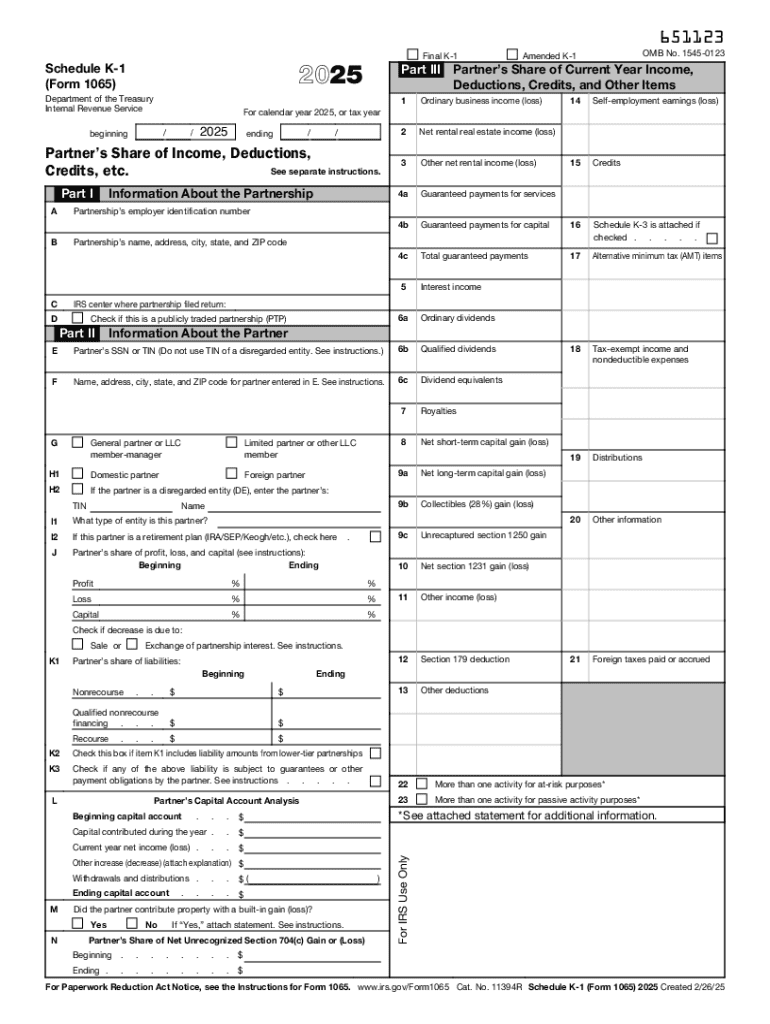
The "2025 Schedule K-1 (Form 1065) Partner's Share of Income, Deductions, Credits, etc" is a tax document used in the United States. It provides detailed information on a partner's portion of the partnership's income, deductions, credits, and additional tax-related attributes. Partnerships, which include LLCs taxed as partnerships, must furnish a K-1 to each partner to report their share of the financial activity. Unlike a corporate shareholder, a partner pays taxes on income based on their proportionate share, as detailed in the Schedule K-1.
- Purpose: The primary goal is to ensure each partner reports their share of this income on their individual tax returns.
- Scope: It captures a wide range of financial metrics, including regular income, tax credits, and any deductions applicable.
Real-World Example
Consider a law firm organized as a partnership in which each partner receives a Schedule K-1. The document outlines each partner's share of the firm's profits or losses, relevant deductions, and available credits for the fiscal year 2025.
How to Use the 2025 Schedule K-1 (Form 1065)
To effectively utilize the 2025 Schedule K-1, it is essential to understand its layout and integrate its data with your individual tax returns. Here's how you can make use of this form:
- Review Information: Ensure all the financial information provided on the Schedule K-1 is accurate. This includes checking your share of income, deductions, and credits.
- Integrate with Personal Tax Returns: Use the figures in conjunction with Form 1040 to accurately report your taxable income to the IRS.
- Consult a Tax Professional: Given the complexity of financial information, it may be beneficial to consult with a tax advisor to ensure compliance and optimize your tax position.
Practical Scenario
An architect organized as an LLC receives a K-1 indicating a share of partnership income. The architect includes this in their personal tax return, reducing potential errors and maximizing due deductions.
Steps to Complete the 2025 Schedule K-1 (Form 1065)
Completing the 2025 Schedule K-1 involves a series of detailed steps to ensure accuracy and compliance:
- Gather Necessary Documents: Collect all financial statements and Form 1065 to consolidate data.
- Calculate Allocations: Determine each partner's distributive share based on the partnership agreement.
- Fill Out the Form:
- Part I: General Information about the partnership.
- Part II: Information about the partner, including percentage of ownership.
- Part III: Partner’s share of the current year’s income, deductions, and credits.
- Verify All Entries: Double-check all inputted information for accuracy.
- Distribute to Partners: Provide a completed Schedule K-1 to each partner for their tax filing.
Detailed Example
An agricultural cooperative allocates net income among its members. Each receives a K-1 reflecting their income shares, which they incorporate into their respective tax filings.
Key Elements of the 2025 Schedule K-1 (Form 1065)
Understanding the components of the 2025 Schedule K-1 is crucial for accurate filing:
- General Partner Information: Includes partnership name, EIN, and address.
- Partner’s Share: Detailed share of specific income types and deductions.
- Analysis of Partner’s Capital Account: Changes in the capital account including withdrawals and contributions.
Example Component
In Part III, partners review and confirm their respective shares of rental income and depreciation, which significantly impacts net taxable income on personal returns.
Important Terms Related to 2025 Schedule K-1
Understanding key terms in the Schedule K-1 can simplify the filing process:
- Distributive Share: The portion of partnership income or loss assigned to a particular partner.
- Capital Account: Tracks the partner’s equity within the partnership, including contributions and withdrawals.
- Passive Income: Income received without active participation, affecting tax treatment and reporting.
Explanation of a Term
A partner's "Capital Contribution" refers to any additional resources invested into the partnership, impacting both the capital account and tax outcomes.
Filing Deadlines and Important Dates
Timely submission of Schedule K-1 is fundamental for compliance:
- Deadline: Typically, K-1s must be issued to partners by March 15 following the end of the partnership’s tax year.
- Extensions: Partnerships can apply for a filing extension, shifting deadlines to September.
Real Example
A consulting firm ensures Schedule K-1 forms are distributed before the March deadline to allow partners ample time to incorporate data into personal returns.
Who Issues the Form
The responsibility of issuing the 2025 Schedule K-1 lies with the partnership’s designated tax preparer or accountant. They compile all relevant financial data to produce accurate forms for each partner.
Example in Practice
An accounting firm managing the tax needs of a real estate partnership prepares and distributes K-1 forms post-financial close for the fiscal year.
Penalties for Non-Compliance
Failing to file or inaccurate filing of the Schedule K-1 can lead to significant penalties:
- Fines for Late Filing: Partnerships may incur penalties for each untimely K-1.
- Inaccurate Reporting: Errors necessitating correction can trigger audits or additional fines.
Scenario as a Warning
A tech startup neglects timely issuance of K-1s, resulting in penalties and strained partner relations. Early planning prevents such issues.
By structuring these insights around the 2025 Schedule K-1, partners can navigate the complexities of tax information more effectively, ensuring compliance and optimized financial outcomes.