01. Edit your form online
Type text, add images, blackout confidential details, add comments, highlights and more.

Type text, add images, blackout confidential details, add comments, highlights and more.

Draw your signature, type it, upload its image, or use your mobile device as a signature pad.

Send it via email, link, or fax. You can also download it, export it or print it out.
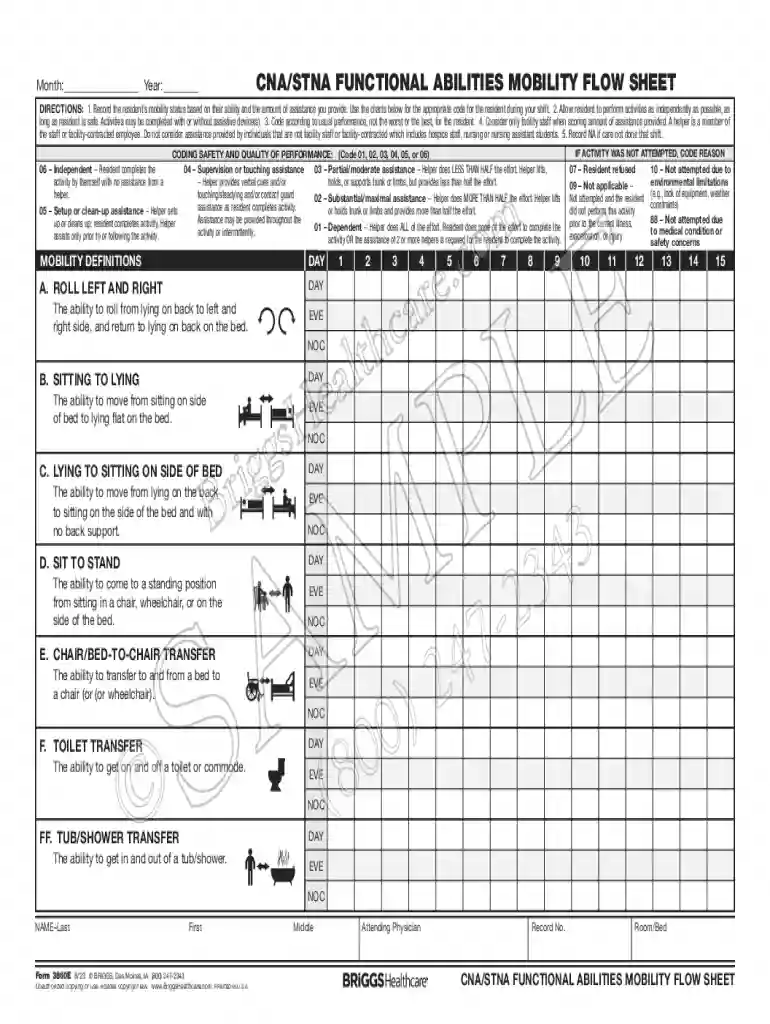
The CNA STNA Functional Abilities Mobility Flow Sheet is a critical document used in healthcare settings to assess and record a resident's mobility status. It focuses on the individual's ability to perform physical movements and the level of assistance required from caregivers. This form is primarily utilized in environments such as nursing homes and rehabilitation centers. The terms CNA (Certified Nursing Assistant) and STNA (State Tested Nursing Assistant) refer to personnel certified to provide this kind of care, though the title used can vary by state. This sheet is a tool for monitoring and ensuring patient safety and progress in mobility.
The purpose of this flow sheet is to comprehensively document the resident's mobility capabilities. It includes sections for assessing different types of movements like walking, transfers, and balance. Each category requires the caregiver to note the degree of assistance required, ranging from independent movement to needing full support. This helps healthcare teams to tailor care plans effectively.
Accurate mobility tracking is essential for setting patient goals, preventing injuries, and ensuring appropriate levels of care. The flow sheet guides the development of personalized care plans, which are crucial for both short-term therapy and long-term care strategies. It also facilitates communication among healthcare providers by providing a standardized record of the patient's progress.
Initial Evaluation: Conduct an initial assessment of the resident's mobility abilities, noting any assistive devices or special conditions.
Daily Recording: Record observations of the resident's mobility status during each shift. Consistent documentation provides an accurate picture of trends or changes.
Assistance Levels: Mark the specific type and level of assistance needed for each activity, such as walking or transferring from a bed to a chair.
Observations: Note any deviations or unusual behaviors during mobility tasks to provide a comprehensive review during team meetings.
Gather Initial Data: Start by collecting personal information, including the resident's name, room number, and date of admission.
Assessment Section: Begin with a comprehensive assessment of each mobility aspect; document both the extent of independence and areas needing support.
Daily Monitoring: Ensure each shift records their observations uniformly for consistency and accuracy.
Periodic Reviews: Conduct regular meetings to review the documented data, involving the healthcare team to discuss changes or adjustments to the care plan.
Each element of the flow sheet plays a strategic role in providing holistic care. The detailed breakdown of activities ensures that no aspect of resident mobility is overlooked, guaranteeing that care strategies are well-rounded and targeted.
Understanding these terms is crucial for documenting accurately and ensuring seamless communication among caregivers. Precision in usage helps in efficiently managing care plans and monitoring progress.


Used widely across nursing homes, rehabilitation centers, and long-term care facilities, this flow sheet is vital for ensuring that all staff are aligned in their approach to patient mobility care.
The flow sheet serves as a legal record to verify the care provided, protect institutions from liability, and ensure adherence to prescribed mobility programs. Maintaining this documentation is crucial for audits and inspections.
While the fundamental purpose of the flow sheet remains consistent, specific usage rules and terminology can vary. States set guidelines on who can complete these forms and the extent of documentation required. Healthcare providers should be familiar with local regulations to ensure compliance.
Understanding these variations is essential for multi-state operators to maintain compliance across different jurisdictions.
At DocHub, your data security is our priority. We follow HIPAA, SOC2, GDPR, and other standards, so you can work on your documents with confidence.