




01. Edit your form online
Type text, add images, blackout confidential details, add comments, highlights and more.

Type text, add images, blackout confidential details, add comments, highlights and more.

Draw your signature, type it, upload its image, or use your mobile device as a signature pad.

Send it via email, link, or fax. You can also download it, export it or print it out.
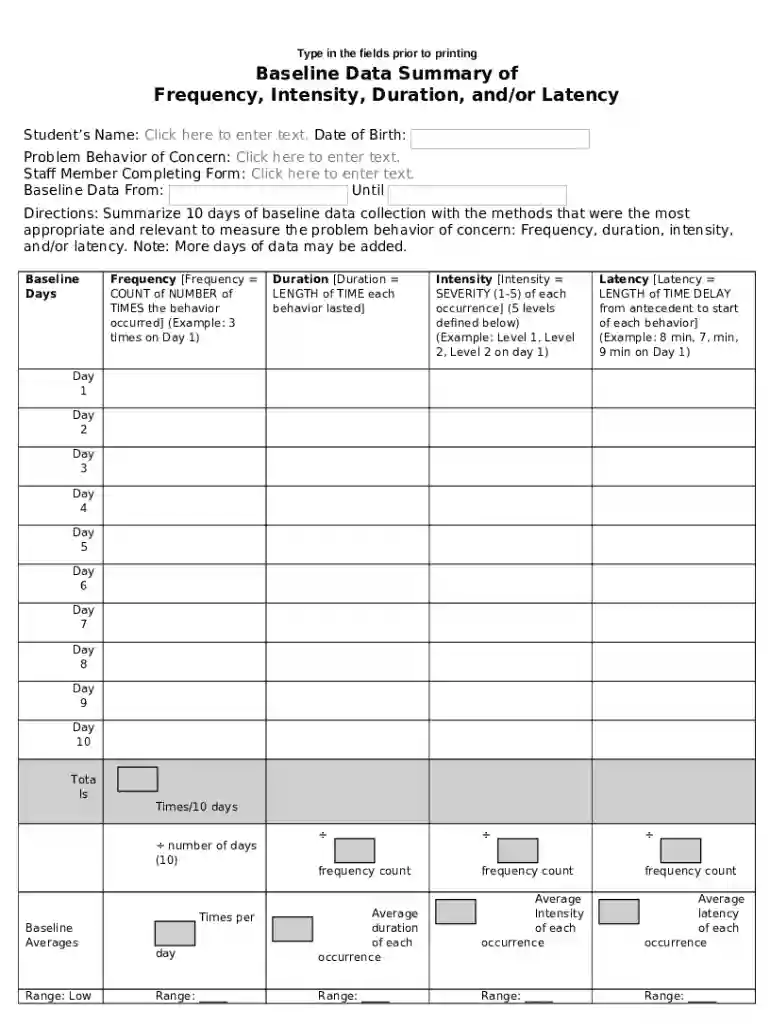
The "Baseline Data Summary of Frequency, Intensity, Duration" is a document used primarily in fields such as behavior analysis, education, and healthcare. It serves as a tool to collect and summarize baseline data related to specific behaviors or metrics, focusing on three parameters: frequency, intensity, and duration. 'Frequency' measures how often a behavior occurs, 'intensity' assesses the strength or severity of the behavior, and 'duration' tracks how long the behavior lasts. This structured summary allows practitioners to make informed decisions based on empirical data, providing a clear foundation for targeting interventions or adjustments.
Using this form involves collecting and logging specific data points over a given period. The form aids in systematically documenting each occurrence of a behavior, noting how often it occurs, its intensity, and its duration. Users typically:
This information is then analyzed to understand patterns or trends, facilitating targeted interventions or strategies to modify or understand the behaviors in question.
Filling out the form requires attention to detail and consistency:
Essential components in the "Baseline Data Summary of Frequency, Intensity, Duration" include:
These elements serve as a structured data collection method, facilitating robust analysis and intervention planning.
The form is used across various professional fields. Key users include:
Each user leverages the form's data to drive evidence-based decisions and strategies.


Various scenarios highlight the form's utility:
These applications demonstrate the form's adaptability to different contexts, ensuring comprehensive data collection.
State-specific regulations may impact how the form is used, especially in educational or healthcare settings.
Understanding and adhering to regional guidelines ensures the form’s effective and legal use.
The form is available both digitally and on paper, each offering distinct advantages:
Choosing between digital and paper depends on user preference and available resources, ensuring flexibility in adoption across varied environments.
At DocHub, your data security is our priority. We follow HIPAA, SOC2, GDPR, and other standards, so you can work on your documents with confidence.



Learn how to develop baseline data, or standards against which you will measure programmatic or community change efforts.
The initial baseline point, established at the start of the analysis is then continuously reset, at a rate determined by the peak width, to the moving average.Read more
Example: Used for higher frequency discrete behaviors or behaviors of longer duration. Interval recording yields a slightly more accurate estimate.Read more


