STEP 2 PROMPTED VOIDING TRIAL - UCLA 2026

Get Form
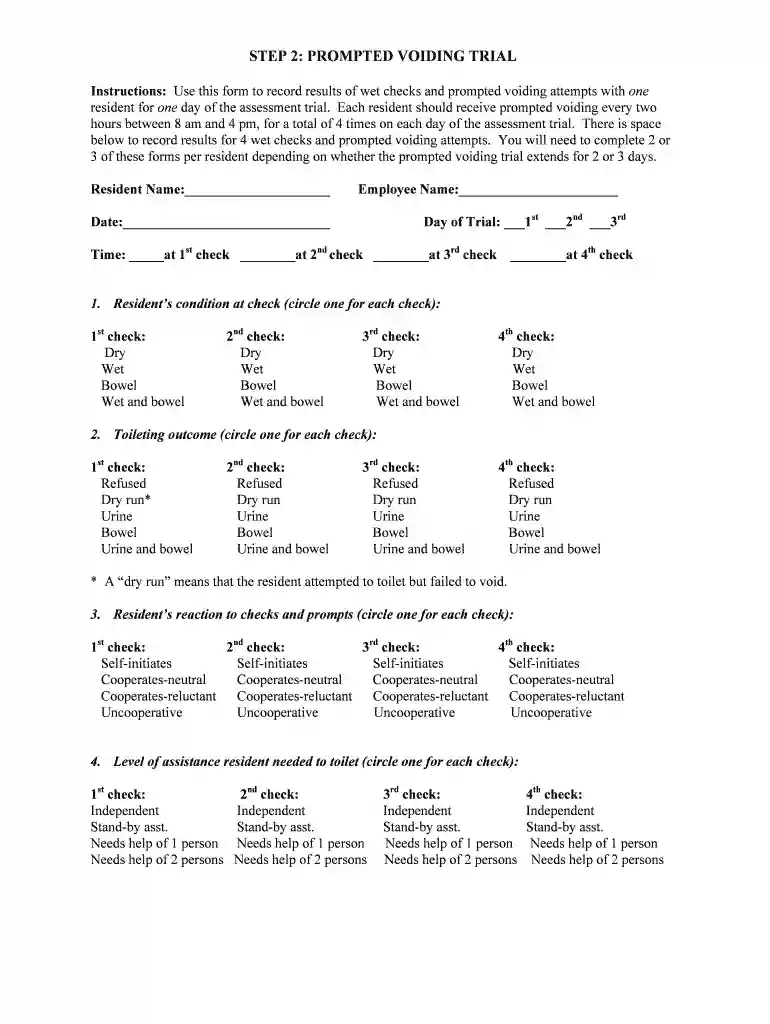
STEP 2 PROMPTED VOIDING TRIAL - UCLA Preview on Page 1

Here's how it works

01. Edit your form online
Type text, add images, blackout confidential details, add comments, highlights and more.

02. Sign it in a few clicks
Draw your signature, type it, upload its image, or use your mobile device as a signature pad.

03. Share your form with others
Send it via email, link, or fax. You can also download it, export it or print it out.

Definition & Purpose of STEP 2 PROMPTED VOIDING TRIAL - UCLA

The STEP 2 PROMPTED VOIDING TRIAL - UCLA is a structured protocol designed to assist incontinence management among patients, particularly in nursing homes. This trial involves regular inquiries about the need to toilet, verifying voiding status, and providing positive reinforcement for appropriate responses. By implementing this methodology, caregivers can systematically monitor and manage patients’ bladder control, ultimately aiming to improve their quality of life through increased autonomy in toileting.

How to Use the STEP 2 PROMPTED VOIDING TRIAL - UCLA

Using the STEP 2 PROMPTED VOIDING TRIAL involves a structured approach designed to track and enhance a patient's ability to control bladder functions. To effectively implement the trial:

  1. Initiation: Begin by establishing baseline data on the patient's incontinence patterns. This involves recording frequency, times of voiding, and instances of incontinence.
  2. Scheduling: Set regular intervals – typically every two hours – for asking patients if they need to use the restroom.
  3. Documentation: Track results after each query to identify improvements or further needs for adjustments.
  4. Positive Reinforcement: Encourage successful voiding with verbal praise or incentives, motivating the patient to continue developing control.
  5. Routine Adjustments: Make necessary adjustments based on trends observed over a series of prompts, refining strategies for better results.

Steps to Complete the STEP 2 PROMPTED VOIDING TRIAL - UCLA

Successful completion of the trial necessitates adherence to a series of clearly defined steps:

  1. Initial Assessment: Evaluate the patient’s current incontinence level. Use historical records and direct observations to set starting points.
  2. Goal Setting: Establish realistic targets for improvement, such as reduced incontinence episodes or increased self-initiation of toilet use.
  3. Implementation: Follow the established prompted voiding schedule diligently, ensuring consistent application of the methodology.
  4. Data Collection: Accurately log each interaction and outcome to ensure reliable data for analysis.
  5. Evaluation: After conducting the trial over a designated period, assess data to determine the trial's success in meeting its objectives.
  6. Reporting: Prepare a comprehensive report on findings, detailing patient improvements and offering recommendations for continued care strategies.

Key Elements of the STEP 2 PROMPTED VOIDING TRIAL - UCLA

  • Regular Prompts: Essential for instilling routine and encouraging patients to respond to natural bladder cues.
  • Consistent Reinforcement: Vital for maintaining patient motivation throughout the trial period.
  • Observational Precision: Accurate tracking of responses and voiding patterns provides critical insight into patient progress.
  • Individualized Adjustments: Tailoring the approach based on specific patient responses and needs enhances efficacy.
  • Collaborative Effort: Involvement of all caregiving staff ensures consistency and comprehensive implementation.

Who Typically Uses the STEP 2 PROMPTED VOIDING TRIAL - UCLA

Primarily employed by nursing and caregiving staff in healthcare facilities, this trial is designed for use in environments caring for elderly or disabled individuals with incontinence issues. It offers a systematic approach to manage and possibly reduce incontinence episodes, enhancing patient autonomy and dignity.


decoration image ratings of Dochub

Important Terms Related to STEP 2 PROMPTED VOIDING TRIAL - UCLA

  • Prompted Voiding: A care approach where patients are reminded at regular intervals to use the restroom.
  • Incontinence: The inability to control urination, often requiring structured management strategies.
  • Reinforcement: Used as a motivational tool to encourage desired patient behavior.
  • Baseline Data: Initial information collected to monitor patient progress and responsiveness to the intervention.

Software Compatibility

Integrating software solutions can enhance tracking and data collection during the trial. Platforms such as QuickBooks or in-house electronic health record systems can streamline record management, allowing for more efficient retrieval and analysis of patient data as part of the prompted voiding strategy.

Application Process & Approval Time

While formal application processes for this trial in institutional settings typically involve an adaptation of existing care protocols, approval and implementation require coordination with a multidisciplinary team to ensure alignment with existing patient care objectives and overall compliance with facility regulations.

be ready to get more

Complete this form in 5 minutes or less

Get form

Security and compliance

At DocHub, your data security is our priority. We follow HIPAA, SOC2, GDPR, and other standards, so you can work on your documents with confidence.

Learn more
ccpa2
pci-dss
gdpr-compliance
hipaa
soc-compliance
be ready to get more

Complete this form in 5 minutes or less

Get form