




01. Edit your form online
Type text, add images, blackout confidential details, add comments, highlights and more.

Type text, add images, blackout confidential details, add comments, highlights and more.

Draw your signature, type it, upload its image, or use your mobile device as a signature pad.

Send it via email, link, or fax. You can also download it, export it or print it out.
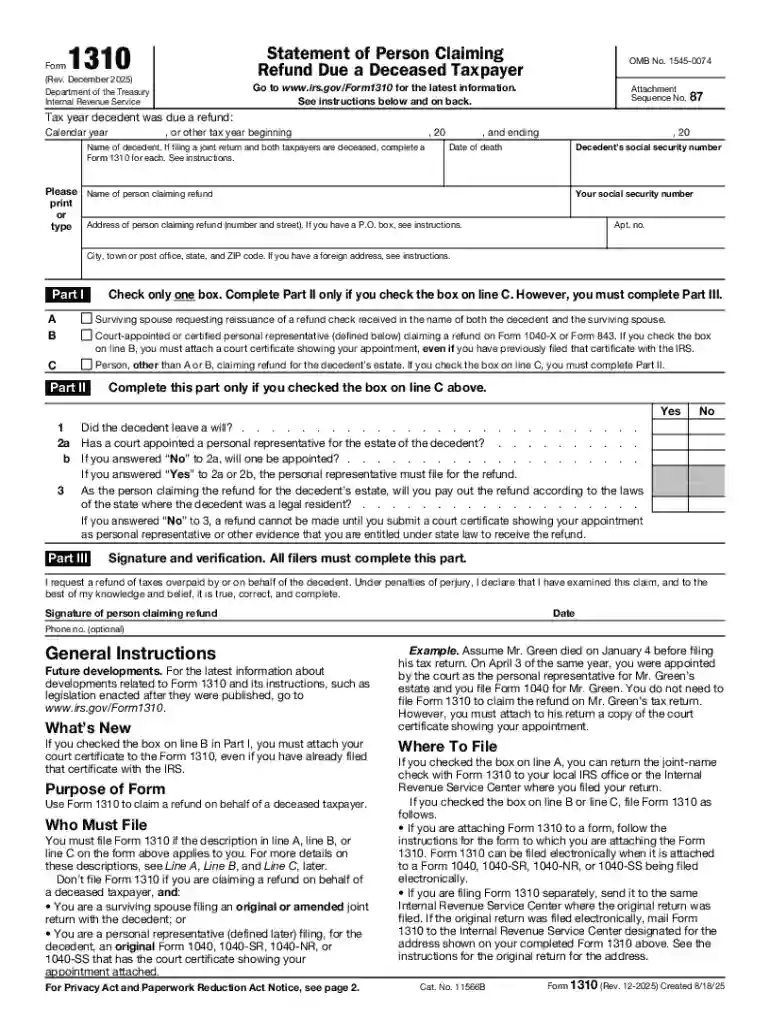
Form 1310, formally known as the "Statement of Person Claiming Refund Due a Deceased Taxpayer," is a document used in the United States for tax filing purposes by individuals who are claiming a tax refund on behalf of a deceased taxpayer. Its primary purpose is to ensure that the rightful person receives the deceased individual's tax refund and that the IRS has a record of this transaction. This form is essential for maintaining the integrity and correctness of tax returns and refunds involving deceased taxpayers.
To utilize Form 1310 effectively, follow these steps:
Determine Eligibility: Ensure that you are the legitimate party eligible to file Form 1310. Generally, this includes executors, administrators, or personal representatives of the deceased's estate.
Collect Necessary Documents: Have essential documents ready, such as the death certificate and any legal documentation proving your relationship to the deceased or your authority to file on their behalf.
Complete the Form: Fill out all required sections, including personal information about the deceased taxpayer and your own details. Ensure accuracy to prevent delays or rejection.
Attach Supporting Documents: Depending on your relationship to the deceased, you may need to attach additional substantiating documents.
Submission: Submit Form 1310 along with the deceased taxpayer's final tax return. This can be done electronically or via mail, depending on your preference and the IRS’s requirements.
Completing Form 1310 requires attention to detail. Follow these detailed steps:
Section 1: Personal Information
Section 2: Reason for Claim
Section 3: Certification
Attachments
Final Review and Submission
Form 1310 consists of several critical components:
To file Form 1310, you must meet specific eligibility guidelines:


Form 1310 is primarily used by:
The IRS provides specific guidelines for filing Form 1310:
While there isn’t a strict deadline for Form 1310 itself:
When filing Form 1310, ensure that you include:
Various methods exist for submitting Form 1310:
Failure to properly file Form 1310 can lead to:
This comprehensive coverage of Form 1310 (Rev December 2025) offers insight into its usage, necessary documentation, and filing procedures, highlighting its importance for those handling the financial affairs of deceased taxpayers.
We've got more versions of the Form 1310 (Rev December 2025) form. Select the right Form 1310 (Rev December 2025) version from the list and start editing it straight away!
At DocHub, your data security is our priority. We follow HIPAA, SOC2, GDPR, and other standards, so you can work on your documents with confidence.


Use Form 1310 to claim a refund on behalf of a deceased taxpayer. Who Must File. You must file Form 1310 if the description in line A, line B, or lineRead more
1 Introduction 2 Meeting the Statutory Requirement 3 1. The Public Interest Requirement. 3.1 Concerns the operations or activities of the government 4 2.Read more
Dec 10, 2024 Form 1310 (if a refund is due), and. A copy of the certificate of death. * If Form W-7 is for a deceased individual under 18 years of ageRead more


