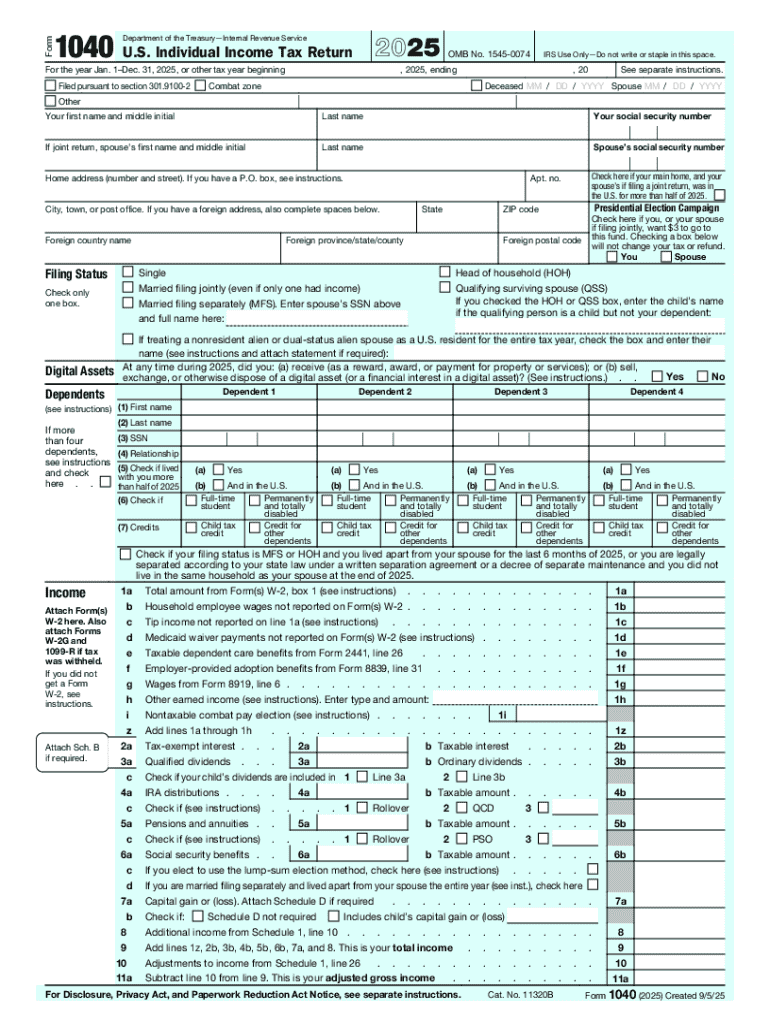







Definition and Meaning
The 2025 Form 1040 is a central document used by U.S. taxpayers to report their annual income to the Internal Revenue Service (IRS). It captures income details, such as wages, dividends, and capital gains, and calculates the amount of federal income tax owed or refund due. This form serves as a comprehensive summary of an individual's tax liability and integrates tax credits and deductions that impact the overall tax outcome for a given year.
Steps to Complete the 2025 Form 1040
Completing the 2025 Form 1040 involves a series of methodical steps:
- Gather Required Information: Collect personal details, Social Security numbers, and W-2 or 1099 forms.
- Document Income: Report total income from various sources, including salaries, interest, and additional earnings.
- Adjustments to Income: Apply eligible deductions like education costs or specific retirement contributions.
- Calculate Taxable Income: Subtract deductions from total income to determine taxable income.
- Determine Tax Liability: Refer to IRS tax tables to compute the standard tax owed.
- Apply Tax Credits and Payments: Subtract any tax credits (earned income tax credit, etc.) and withholding taxes already paid.
- Finalize and Sign: Ensure all information is accurate, sign the form, and prepare for submission.
Important Terms Related to the 2025 Form 1040
Understanding specific terms is crucial for accurately filling out the 2025 Form 1040:
- Adjusted Gross Income (AGI): Income after adjustments, pivotal in determining deductions and credits.
- Standard Deduction: A fixed deduction amount reducing taxable income, available to all filers.
- Tax Credits: Reductions in tax liability, such as child tax credit or education credits.
- Withholding: Taxes collected from income throughout the year, reducing end-of-year liability.
Filing Deadlines for the 2025 Form 1040
The IRS establishes strict deadlines for filing the Form 1040 to avoid penalties:
- Regular Filing Deadline: April 15, 2025, unless it falls on a weekend or holiday.
- Extensions: May be requested, typically extending the deadline to October 15, 2025, but taxes owed should be paid by April to avoid interest.
How to Obtain the 2025 Form 1040
Taxpayers can obtain the 2025 Form 1040 through multiple channels:
- IRS Website: Downloadable PDF format directly accessible online.
- Mail: Request a physical copy from the IRS or receive it through tax advisory services.
- Tax Software: Available within tax preparation software like TurboTax as integrated digital forms.
Required Documents for Completing the 2025 Form 1040
Having the proper documentation is essential when completing the form:
- Income Documents: W-2 forms for employment income, 1099 forms for additional earnings.
- Deduction Proofs: Receipts for deductions such as mortgage interest or charitable contributions.
- Previous Year’s Tax Return: Useful for consistency and reference.
Legal Use of the 2025 Form 1040
The 2025 Form 1040 complies with federal tax legislation, ensuring that individuals accurately report income and calculate taxes lawfully. Filing the form correctly and on time minimizes legal risks and potential audits from the IRS. Failure to file may lead to penalties, interest on unpaid taxes, and increased scrutiny from the IRS.
Examples of Using the 2025 Form 1040
Different scenarios showcase diverse applications of Form 1040:
- Self-Employed Individuals: Include additional deductions relevant to business expenses.
- Retirees: May need to report Social Security benefits along with any investment income.
- Students: Can qualify for education credits like the American Opportunity Credit to offset tuition expenses.
Form Submission Methods
Taxpayers have several options to submit the completed 2025 Form 1040:
- Electronic Filing (e-File): Secure online submission through IRS-approved software, providing speed and accuracy.
- Mailing: Traditional method, requiring postage and ample time for delivery to the IRS address.
- In-Person: Direct submission at certain IRS offices or through tax professionals.
Penalties for Non-Compliance
Failing to submit the 2025 Form 1040 or inaccuracies can lead to severe consequences:
- Late Filing Penalty: Generally, 5% of the unpaid taxes for each month the return is late.
- Accuracy-Related Penalty: 20% of underpaid taxes due to negligence or misstatement.
- Failure to Pay Penalty: Incurs additional charges on unpaid taxes from the original due date.
Software Compatibility
Many taxpayers utilize software solutions to ease the filing process:
- TurboTax and QuickBooks: Both offer features to complete and submit Form 1040 with guided steps, ensuring accuracy and efficiency.
- Compatibility: Overall compatibility with major operating systems and seamless integration with platforms like DocHub for document management and signature capture.
State-Specific Rules for the 2025 Form 1040
While the 2025 Form 1040 pertains to federal obligations, some states have specific tax requirements:
- State Income Tax Forms: Additionally required in states with income tax provisions.
- Local Deductions and Credits: Varying state-specific perks that complement federal calculations.
Key Takeaways
The 2025 Form 1040 serves as an essential document for accurately reporting and resolving annual tax liabilities with the IRS. Proper preparation, understanding applicable deductions and credits, and timely submission are crucial to avoid penalties. With the aid of digital solutions and thorough documentation, taxpayers can navigate their fiscal responsibilities more efficiently.